[SMM Analysis] Copper premiums in Yangshan rose sharply in April and it was difficult to maintain a high level of pressure on both sides of supply and demand in May.

Published: Apr 26, 2020 18:16
Since April, import prices have continued to improve, Yangshan copper premium has increased significantly. As of Friday, April 24, the average price of warehouse receipts and bills of lading was up $22 a tonne from the beginning of April. In particular, from April 20 to April 24, warehouse receipts and bills of lading increased by $6 and $5, respectively. At present, Yangshan copper warehouse bill quotes US $84-94 / ton, bill of lading quotes US $80-90 / ton, QP is May.

SMM4, 26 March:

Since April, import prices have continued to improve, Yangshan copper premium has increased significantly. As of Friday, April 24, the average price of warehouse receipts and bills of lading was up $22 a tonne from the beginning of April. In particular, from April 20 to April 24, warehouse receipts and bills of lading increased by $6 and $5, respectively. At present, Yangshan copper warehouse bill quotes US $84-94 / ton, bill of lading quotes US $80-90 / ton, QP is May.

The rapid rise in premium is mainly due to the continuous opening of the import copper window, affected by the import price, the copper foreign trade market before the light stalemate, buyers and sellers trading enthusiasm is high. The buyer actively inquired for the goods, and the demand concentrated on the warehouse receipt and the arrival bill of lading in recent months, but the supply was in short supply, and the average transaction price of Yangshan copper rose rapidly within the week.
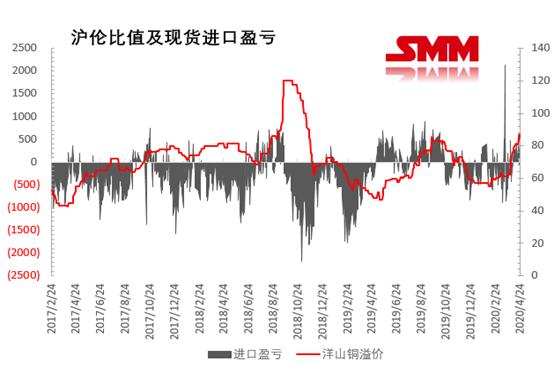
The stronger import price has directly stimulated the increase in demand for imported copper. In April, the centralized maintenance of a number of domestic smelters caused a tight supply of copper in China, especially in North and South China. The sharp reduction in scrap copper imports narrowed the price spread of superimposed fine scrap, stimulating downstream enterprises to use refined copper instead of scrap copper production, and boosting domestic demand, and maintaining a high level of water in the domestic trade market. The contango structure of LME does not change, the domestic futures contract is strong in recent months, the copper price is strong inside and outside, the import profit window continues to open, and the customs declaration profit increases to stimulate the import demand. According to SMM research, as of April 24, Shanghai bonded area copper stocks continued to decline to 305800 tons, inventories fell for five consecutive weeks.
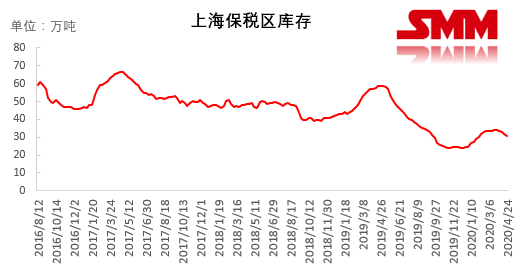
In the case of warm market demand, the supply of imported copper is tight, so Yangshan copper premium has risen rapidly. Affected by the epidemic, Chile, Peru and other major exporting countries of electrolytic copper have implemented epidemic blockade measures, and delays in overseas shipments have frequently occurred, resulting in a decrease in the number of copper imports in April and a limited number of goods held by traders. Therefore, in the face of concentrated demand in the market, quickly raise the offer.

According to SMM, traders increased their stocks of LME copper, mainly arriving in China in mid-May. Affected by the impact of Japanese orders to India, the number of bills of lading arriving in Hong Kong increased significantly in mid-late May and early June. It is expected that the shortage of import sources will ease in mid-to late May, when domestic copper imports will increase, and spot sales at home and abroad will face an impact. from the demand point of view, domestic consumption is performing well at present, partly because downstream enterprises rush into production to complete the pre-backlog of orders and terminal bottom copying, as well as hoarding due to expectations of tax cuts, and the current consumption performance is expected to last until May. However, there are still doubts about the sustainability of domestic consumption after May, and whether the tax reduction policy will fall or not will also affect the demand of the foreign trade market. In terms of supply and demand, Yangshan copper premium in mid-and late May will come under downward pressure.

(SMM Zhu Ruoxing)

Data Source Statement: Except for publicly available information, all other data are processed by SMM based on publicly available information, market communication, and relying on SMM's internal database model. They are for reference only and do not constitute decision-making recommendations.

For any inquiries or for more information, please contact: lemonzhao@smm.cn
For more information on how to access our research reports, please contact:service.en@smm.cn
Related News
Vicuña Awards 63.6-km Northern Corridor Contract as Josemaria-Filo Development Advances
1 hour ago
Vicuña Awards 63.6-km Northern Corridor Contract as Josemaria-Filo Development Advances
Read More
Vicuña Awards 63.6-km Northern Corridor Contract as Josemaria-Filo Development Advances
Vicuña Corp., the 50/50 joint venture between BHP and Lundin Mining, has awarded the construction contract for Sections A1 and A2 of the Northern Corridor in Argentina, advancing enabling infrastructure for the integrated Josemaria and Filo del Sol copper-gold-silver project. The contract was awarded to a joint venture comprising Contreras, BBC (Boetto y Buttigliengo Constructora) and San Juan-based Construmin following a technical and economic evaluation process that also considered local participation. The awarded sections cover 63.6 kilometres between Angualasto and Junta La Palca, passing through Malimán, and form the first portion of the broader Northern Corridor, which is reported at approximately 220 kilometres. The route is intended to provide future access to the Vicuña project through San Juan Province and support logistics requirements associated with upcoming development stages. The scope of work includes earthworks, embankment construction, excavation and blasting, drainage systems, retaining structures, signage and other road-safety infrastructure. Vicuña is being advanced through a staged development strategy, with Josemaria expected to form the first stage of development, followed by subsequent development of Filo del Sol. BHP has indicated that a Stage 1 final investment decision could occur as early as the end of 2026. The contract award marks another tangible infrastructure milestone for Vicuña as BHP and Lundin Mining advance one of the world’s largest undeveloped copper districts. Development of reliable road access will be important for construction logistics and future operations at the remote project. While the award does not alter the current production timetable, it demonstrates continued progress on enabling infrastructure ahead of a potential Stage 1 final investment decision.
1 hour ago
Algo Grande Intersects 30.23 m at 1.5% CuEq at Adelita, Including 3.55 m at 9.4% CuEq
1 hour ago
Algo Grande Intersects 30.23 m at 1.5% CuEq at Adelita, Including 3.55 m at 9.4% CuEq
Read More
Algo Grande Intersects 30.23 m at 1.5% CuEq at Adelita, Including 3.55 m at 9.4% CuEq
Algo Grande Copper announced first assay results from its Phase II drilling programme at the Adelita Project in Sonora, Mexico, confirming high-grade copper-silver-gold skarn mineralisation at the Cerro Grande discovery. Hole AG-CG-PH2-002 intersected 30.23 metres grading 1.5% copper equivalent from 146.70 metres, comprising 0.83% copper, 47.3 g/t silver and 0.40 g/t gold. The interval included 3.55 metres grading 9.4% CuEq, containing 5.26% copper, 311.8 g/t silver and 2.22 g/t gold, as well as a 1.20-metre interval grading 15.8% CuEq, including 9.84% copper. The company said the mineralisation was intersected approximately 100 metres above the high-grade zone encountered during its Phase I drilling programme, indicating that the Cerro Grande system extends closer to surface than previously recognised. The hole was completed at a final depth of 661.8 metres. Assays remain pending below 179 metres, where a further 40.40 metres of visually mineralised core was logged between 179 and 301 metres. Additional Phase II holes along the Cerro Grande magnetic corridor also contain visually logged copper mineralisation, although assay results for those intervals remain outstanding. The Phase II programme is designed to expand the Cerro Grande skarn discovery along a 2.5-km magnetic corridor, with approximately 7,200 metres across 15 holes planned. The latest results extend high-grade copper-silver-gold mineralisation into a shallower part of the Cerro Grande system and provide further evidence of continuity along the skarn horizon. However, significant portions of the ongoing Phase II drilling remain supported only by visual observations, making forthcoming assays important in determining whether the mineralised footprint can be materially expanded. CuEq values are based on assumed recoveries, while true widths have not yet been established.
1 hour ago
Copper Ends 10-Week Winning Streak as US Tariff Uncertainty Triggers Sharp Pullback
1 hour ago
Copper Ends 10-Week Winning Streak as US Tariff Uncertainty Triggers Sharp Pullback
Read More
Copper Ends 10-Week Winning Streak as US Tariff Uncertainty Triggers Sharp Pullback
According to foreign media reports, copper recorded its first weekly decline since June as uncertainty over potential US tariffs on refined copper triggered a sharp reversal from record highs. Three-month copper on the London Metal Exchange traded at around US$14,238/mt on Friday, leaving prices approximately 1.2% lower for the week and ending a 10-week winning streak. Copper had reached a record US$14,875/mt before falling 3.6% on Thursday, after Reuters reported that the White House had not yet made a decision on whether to impose tariffs on refined copper imports. The pullback reflected a reduction in bullish positioning following the recent rally. However, underlying physical-market conditions remained relatively tight. Available LME copper inventories stood at 117,600 tonnes, while copper stocks monitored by the Shanghai Futures Exchange fell 13% week on week to 54,780 tonnes, their lowest level since January 2024. Near-term tightness on the LME also eased. The cash-to-three-month spread shifted into contango on Thursday, with cash copper trading at a US$4.50/mt discount to the three-month contract, indicating reduced concern over immediate metal availability. Uncertainty surrounding US trade policy remains an important driver of copper flows. Reuters reported that the White House has not yet made a decision on refined copper tariffs, as officials weigh concerns over higher manufacturing costs against the potential benefits of encouraging domestic mining. Expectations of possible tariffs had previously encouraged greater copper flows into the US, contributing to regional inventory imbalances. Copper's retreat from record highs suggests that tariff expectations had become an important component of recent bullish positioning. While uncertainty over US trade policy could continue to generate short-term volatility, falling Chinese inventories and geographically concentrated stocks indicate that underlying physical supply conditions remain relatively tight. The shift of the LME spread into contango, however, suggests that immediate availability concerns have eased compared with earlier in the rally.
1 hour ago