China’s power generation investment returned to growth, while grid investment decline slowed

Published: Apr 24, 2020 11:36 (GMT+8)
Data published by China’s National Energy Administration on Thursday showed that 59.6 billion yuan was invested in power generation projects in China in the first three months of 2020, up 30.9% from the same period last year.

SHANGHAI, Apr 24 (SMM) – China’s investment in power generation projects have returned to growth, while investment in power grid projects is falling slower, boosting demand for copper.


Data published by China’s National Energy Administration on Thursday showed that 59.6 billion yuan was invested in power generation projects in China in the first three months of 2020, up 30.9% from the same period last year.


That was a reversal of a decline of 10.9% in the January-to-February period, as investment in hydropower and w/ind power projects surged. China’s investment in power generation projects for the full year of 2019 grew 15.4% to 313.9 billion yuan from 2018.


Orders for copper busbar from the power generation sector such as electric cabinet manufacturers have increased significantly since March, and a number of Chinese copper busbar producers saw orders booked through the end of May, SMM research found.


China’s investment in power grid power projects in the quarter ended March shrank 27.4% year on year to 36.5 billion yuan, much slower than a 43.5% decrease recorded in January-to-February, according to data from the energy administration.


SMM research found that many copper rod producers in China have swung to high gear following a substantial increase in orders from China's largest utility companies—State Grid and Southern Power Grid.


Copper rod producers typically offer same-day delivery, but some of them now cannot make delivery until four days after they receive the order.  


SMM data showed that operating rates at Chinese copper rod producers jumped more than 33 percentage points to 59.4% in March from February. The rate is estimated to further climb to 64.44% in April.


Combined investment in power generation and grid projects in China stood at 96.1 billion yuan in January-to-March, up 5.8% from the same period last year, according to SMM calculations based on data from the energy administration.  
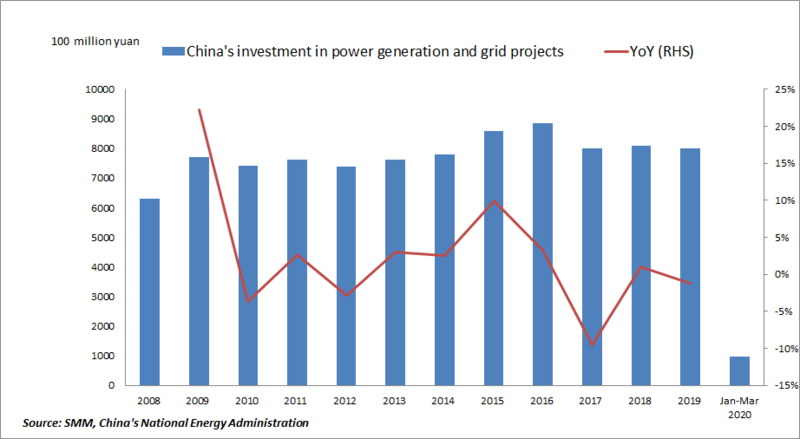
 

Data Source Statement: Except for publicly available information, all other data are processed by SMM based on publicly available information, market communication, and relying on SMM's internal database model. They are for reference only and do not constitute decision-making recommendations.

For any inquiries or for more information, please contact: lemonzhao@smm.cn
For more information on how to access our research reports, please contact:service.en@smm.cn
Related News
Tanzania’s Imwelo selects processing route after gold recovery rises to 84.5%
17 hours ago
Tanzania’s Imwelo selects processing route after gold recovery rises to 84.5%
Read More
Tanzania’s Imwelo selects processing route after gold recovery rises to 84.5%
[SMM Gold Flash] Lake Victoria Gold reported new metallurgical testwork for weathered ore at Area C of its fully permitted Imwelo Gold Project in Tanzania. Attrition scrubbing followed by desliming increased 24-hour gold extraction from 49.99% to 84.54% in agitated-leach testing. Bottle-roll recovery reached 88.15% after pretreatment, while gravity-recoverable gold also increased. The work was conducted by Nesch Mintech Tanzania in Mwanza. The company has identified attrition scrubbing and desliming as the preferred pretreatment route for further optimisation of the clay-rich near-surface material. Lake Victoria Gold says the results complement earlier work on deeper material, where recoveries of approximately 96–97% were reported. Importantly, the reported recoveries relate to tested pretreated fractions and do not yet represent overall whole-ore plant recovery; further mass-balance and optimisation work is planned.
17 hours ago
Aurum drilling delivers 155 g/t gold hit at Côte d’Ivoire’s Boundiali
18 hours ago
Aurum drilling delivers 155 g/t gold hit at Côte d’Ivoire’s Boundiali
Read More
Aurum drilling delivers 155 g/t gold hit at Côte d’Ivoire’s Boundiali
[SMM Gold Flash] Aurum Resources reported new assay results from 22 diamond holes totalling 6,172.8 metres at the BST1 deposit at its Boundiali Gold Project in Côte d’Ivoire. The results include 2.63 metres at 76.74 g/t gold from 195.2 metres, including 1.3 metres at 155 g/t, together with 24 metres at 6.31 g/t from 108 metres, including 7 metres at 19.25 g/t. Several intersections extend beyond the existing BST1 resource envelope. The results will feed into Aurum’s planned Boundiali Mineral Resource update targeted for early Q4 2026. The company says mineralisation remains open along strike and at depth, while drilling continues across the project. The results are therefore an exploration and resource-growth development rather than additional production. Boundiali currently has a 3.22-million-ounce JORC Mineral Resource, while Aurum is advancing a definitive feasibility study.
18 hours ago
Platinum Shows Stronger Inflation and Real-Rate Linkages Than Gold, Study Finds
18 hours ago
Platinum Shows Stronger Inflation and Real-Rate Linkages Than Gold, Study Finds
Read More
Platinum Shows Stronger Inflation and Real-Rate Linkages Than Gold, Study Finds
[SMM Gold & PGM Flash] A new study published in the Journal of Commodity Markets finds that platinum has exhibited broader and more persistent co-movement with inflation and real interest rates than gold. Researchers Arusha Cooray and İbrahim Özmen examined monthly data from July 1999 through December 2024 across the US, Germany, Italy, France, Switzerland and the Netherlands, using turning-point analysis, wavelet coherence and time-varying Granger-causality methods. The study found gold’s macroeconomic relationships were comparatively weaker and more fragmented, while platinum and silver showed broader synchronization, particularly in the US and Germany.​ The researchers attribute platinum’s stronger macroeconomic sensitivity in part to its substantial industrial exposure, meaning its price reflects not only monetary conditions but also manufacturing activity, investment and supply constraints. The findings do not establish platinum as a universally superior inflation hedge: the relationships varied across countries, periods and monetary-policy regimes. Instead, the study highlights a fundamental difference between the metals, with gold’s broader monetary and defensive role producing a different response to inflation and real-rate conditions.
18 hours ago