SMM4, March 16: although a few days ago OPEC+ reached a significant reduction in crude oil production agreement, but due to the epidemic triggered by depressed demand so that oil prices have not rebounded significantly, and the IEA report on crude oil data once again confirmed the market bearish expectations, oil prices fell sharply again. WTI crude oil futures fell below $20 a barrel again, down 0.2% on the day, after rising more than 3% at one point, while Brent crude oil futures also fell back to around 1%.
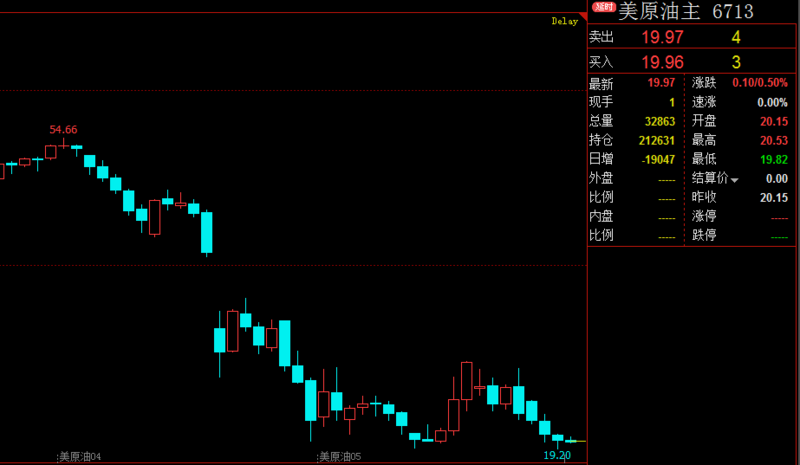
Demand for crude oil will fall to a multi-year low and the decline in production will be relatively limited. The IEA monthly report said it expected oil demand to fall by 29 million barrels a day in April from a year earlier to its level since 1995. Oil demand fell 23.1 million barrels a day in the second quarter from a year earlier, and is expected to fall 2.7 million barrels a day in December. Oil demand is expected to fall by 9.3 million barrels a day in 2020 from a year earlier, and reserves are likely to be saturated as demand falls more than OPEC + production. Following the OPEC+ agreement to cut production, oil production is expected to fall by 12 million barrels a day in May, with non-OPEC countries likely to lose 5.2 million barrels a day in the fourth quarter and 2.3 million barrels a day for the whole year.
Crude oil stocks have soared, making it difficult to digest in the short term. Last night's data showed that EIA crude oil stocks rose 19.248 million barrels in the week to April 10, compared with the market's expected increase of 11.676 million barrels. U. S. crude oil inventories rose for 12 weeks in a row, hitting another record high. Domestic crude oil production fell 100000 b / d to 12.3 million b / d last week, while US crude exports rose 603000 b / d to 3.436 million b / d last week, while US crude oil imports fell for the fourth consecutive week, according to the EIA report. Despite OPEC+ 's efforts to cut production, global oil stocks will grow by 12 million barrels a day in the first half of the year. IEA warned that the oversupply of crude oil could overwhelm logistics facilities such as tankers, pipelines and tanks in the oil industry in the coming weeks.
Industry insiders are not optimistic about the late trend of the oil market.
The IMF slashed its oil price forecast for this year to $35 a barrel. In the latest issue of the World Economic Outlook, the International Monetary Fund said that as the global economy will experience the worst economic deterioration since the Great Depression, oil prices will be at 35 US dollars a day this year at the most optimistic level. Oil prices will remain at this level in 2021. The MF had forecast oil prices at $58.03 a barrel this year and $55.31 a barrel in 2021. Despite the OPEC+ agreement to cut production by 9.7 million barrels a day from May to June and gradually before the agreement expires in April 2022, oil prices are still below IMF forecasts.
Gunvor Group LtdCEO, the world's largest oil trader, says the market is still flooded by misplaced crude oil in the short term. Spot spreads will continue to be very weak, while spot oil prices will fall sharply.
Goldman Sachs believes that assuming that the core members of the OPEC can fully implement the production reduction agreement without discount in May, and the performance rate of the other members is 50%, then OPEC+ production will actually be only 4.3 million barrels per day less than in the first quarter of 2020. The bank believes that this scale of production cuts are far from making up for the loss of demand caused by the new crown epidemic, and that WTI oil prices are at risk of falling to $20 a barrel in the short term.
Even after the world's largest oil producers recently decided to cut production as never before, the global oil glut will take time to resolve, according to US energy and resources officials.
SMM "current combination" training class

Registration contact: Lu Qingping, SMM Iron and Steel Division
Tel: 021-51595781 / 187-1777-4590
![Platinum and Palladium Stayed in the Doldrums This Week; the Spot Market Cooled and Faced Severe Involution [SMM Platinum and Palladium Weekly Review]](https://imgqn.smm.cn/usercenter/yhuhG20251217171735.jpg)