[SMM Daily Review] Nonferrous Metals generally upward, lead and Zinc strong continued to rise, Black Series trend differentiation crude Oil fell 4.59% in the previous period

Published: Apr 14, 2020 16:55 (GMT+8)
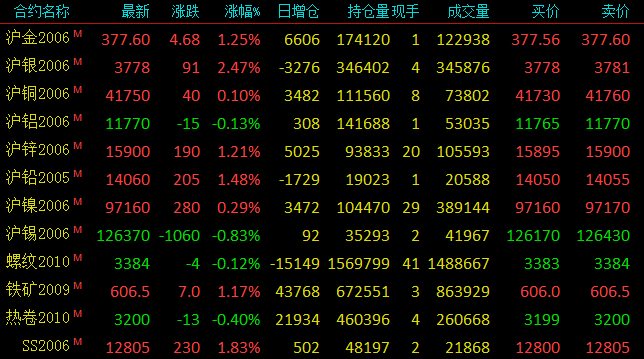
Today, the non-ferrous metals market mostly closed higher, Shanghai lead rose 1.48% Shanghai zinc rose 1.21%, Shanghai tin opened lower, down 0.83%. Since the end of March Shanghai lead continued to rebound after the continuation of the concussion market.

SMM4 14: most of today's non-ferrous metals market closed higher, Shanghai lead rose 1.48% Shanghai zinc rose 1.21%, Shanghai tin opened lower, down 0.83%. Since the end of March Shanghai lead continued to rebound after the continuation of the concussion market. Today, the Shanghai lead 2005 contract opened high after breaking the shock range on the edge of a sharp rise, once rose to 14235 yuan / ton. SMM believes that the short-term lead price is still under pressure, the expected increment of supply is greater than the incremental consumption, to a certain extent, there is the possibility that consumption is weaker than the previous month, but due to the strong consistency of short selling in the market, there is a risk of being forced to take positions in low inventories, so we can see that short positions are not firm enough, and the price as a whole is in a volatile market, so it is recommended to wait for the inflection point to go to the warehouse. China imported 441926 tons of unwrought copper and copper in March, up 13 per cent from a year earlier, and imported about 1.28 million tons from January to March this year. Since February, although domestic consumption has been hit by the epidemic, imports have always maintained a small loss. As demand recovers, Yangshan copper premium rises slowly, which also leads to an increase in imports. SMM expects imports of unwrought copper and copper products to fall month-on-month in April.

Black iron ore rose 1.17%, thread hot coil fell slightly. China exported 6.476 million tons of steel in March and 14.286 million tons from January to March, down 16.0 percent from 17.015 million tons in the same period last year, according to customs data. China imported 85.913 million tons of iron ore in March and 176.84 million tons in January-February. In the first quarter, China imported 262.732 million tons of iron ore, up 1.3 per cent from 259.329 million tons in the same period last year. The incoming volume of SMM35 increased by 400000 tons over the previous month. The supply side of iron ore continues to accumulate, and the short-term domestic demand side increases with the increase of blast furnace operation rate, but the medium-and long-term supply increment continues, and the demand increment is restrained by the spread of overseas epidemic situation, and the point of view of iron ore price pressure remains unchanged.

Crude oil fell 4.59% in the previous period. The US Energy Information Agency (EIA) predicts that shale oil production in the United States, the world's largest crude oil producer, could fall by a record in April, while other major oil producers will also cut production. Analysts, oil industry executives and others believe that OPEC production cuts, no matter how much they pieced together, will not be enough to offset the impact of the epidemic on global oil demand by about 1/3. Oil prices are still down more than 50 per cent so far this year. Although some G20 countries have agreed to buy oil as national reserves, inventories are expected to fill up quickly.

As of today's daytime close:
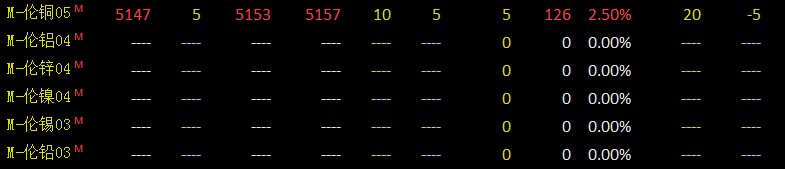
As of 16:10, the new US dollar denominated small metals contracts on the HKEx are as follows:
Today's capital flow

Commodities fell on a large scale, and the commodity index as a whole remained dominated by capital inflows. Precious metals, which led the rise, were favored by nearly 1.1 billion of the money, while Shanghai gold enjoyed more than 900m. Shanghai crude oil, which has plummeted, has increased its daily position by more than 10,000, accidentally reaping more than 600m capital favorites. The weak and volatile rebar has significantly reduced its positions by more than 30,000 hands, which has been rejected by more than 200 million funds.

Brief comment of SMM analyst on April 14th


Updating.

SMM "current combination" training class

Registration contact: Lu Qingping, SMM Iron and Steel Division

Tel: 021-51595781 / 187-1777-4590

Data Source Statement: Except for publicly available information, all other data are processed by SMM based on publicly available information, market communication, and relying on SMM's internal database model. They are for reference only and do not constitute decision-making recommendations.

For any inquiries or for more information, please contact: lemonzhao@smm.cn
For more information on how to access our research reports, please contact:service.en@smm.cn
Related News
Tanzania’s Imwelo selects processing route after gold recovery rises to 84.5%
Sep 25, 2026 16:02 (GMT+8)
Tanzania’s Imwelo selects processing route after gold recovery rises to 84.5%
Read More
Tanzania’s Imwelo selects processing route after gold recovery rises to 84.5%
[SMM Gold Flash] Lake Victoria Gold reported new metallurgical testwork for weathered ore at Area C of its fully permitted Imwelo Gold Project in Tanzania. Attrition scrubbing followed by desliming increased 24-hour gold extraction from 49.99% to 84.54% in agitated-leach testing. Bottle-roll recovery reached 88.15% after pretreatment, while gravity-recoverable gold also increased. The work was conducted by Nesch Mintech Tanzania in Mwanza. The company has identified attrition scrubbing and desliming as the preferred pretreatment route for further optimisation of the clay-rich near-surface material. Lake Victoria Gold says the results complement earlier work on deeper material, where recoveries of approximately 96–97% were reported. Importantly, the reported recoveries relate to tested pretreated fractions and do not yet represent overall whole-ore plant recovery; further mass-balance and optimisation work is planned.
Sep 25, 2026 16:02 (GMT+8)
Aurum drilling delivers 155 g/t gold hit at Côte d’Ivoire’s Boundiali
Sep 25, 2026 15:58 (GMT+8)
Aurum drilling delivers 155 g/t gold hit at Côte d’Ivoire’s Boundiali
Read More
Aurum drilling delivers 155 g/t gold hit at Côte d’Ivoire’s Boundiali
[SMM Gold Flash] Aurum Resources reported new assay results from 22 diamond holes totalling 6,172.8 metres at the BST1 deposit at its Boundiali Gold Project in Côte d’Ivoire. The results include 2.63 metres at 76.74 g/t gold from 195.2 metres, including 1.3 metres at 155 g/t, together with 24 metres at 6.31 g/t from 108 metres, including 7 metres at 19.25 g/t. Several intersections extend beyond the existing BST1 resource envelope. The results will feed into Aurum’s planned Boundiali Mineral Resource update targeted for early Q4 2026. The company says mineralisation remains open along strike and at depth, while drilling continues across the project. The results are therefore an exploration and resource-growth development rather than additional production. Boundiali currently has a 3.22-million-ounce JORC Mineral Resource, while Aurum is advancing a definitive feasibility study.
Sep 25, 2026 15:58 (GMT+8)
Platinum Shows Stronger Inflation and Real-Rate Linkages Than Gold, Study Finds
Sep 25, 2026 15:52 (GMT+8)
Platinum Shows Stronger Inflation and Real-Rate Linkages Than Gold, Study Finds
Read More
Platinum Shows Stronger Inflation and Real-Rate Linkages Than Gold, Study Finds
[SMM Gold & PGM Flash] A new study published in the Journal of Commodity Markets finds that platinum has exhibited broader and more persistent co-movement with inflation and real interest rates than gold. Researchers Arusha Cooray and İbrahim Özmen examined monthly data from July 1999 through December 2024 across the US, Germany, Italy, France, Switzerland and the Netherlands, using turning-point analysis, wavelet coherence and time-varying Granger-causality methods. The study found gold’s macroeconomic relationships were comparatively weaker and more fragmented, while platinum and silver showed broader synchronization, particularly in the US and Germany.​ The researchers attribute platinum’s stronger macroeconomic sensitivity in part to its substantial industrial exposure, meaning its price reflects not only monetary conditions but also manufacturing activity, investment and supply constraints. The findings do not establish platinum as a universally superior inflation hedge: the relationships varied across countries, periods and monetary-policy regimes. Instead, the study highlights a fundamental difference between the metals, with gold’s broader monetary and defensive role producing a different response to inflation and real-rate conditions.
Sep 25, 2026 15:52 (GMT+8)