[quarterly report] Tharisa:Q1 Chromium concentrate production 310.1kt decreased by 9.5% compared with the same period last year

Published: Apr 10, 2020 11:45

SMM4, 10 Mar: recently, Tharisa released its production report for the second quarter of March 31, 2020, which pointed out that the South African government has imposed a national blockade on COVID-19 for a period of 21 days since the afternoon of March 25, 2020. starting from April 6, 2020, utilizing uses 300 ktpm Voyager plants to reduce mining activities, and on Metallurgical Chromium contract declares force majeure. Ris Tharisa has received a force majeure notification from its PGM concentrate purchaser that the company's ongoing capital account has been suspended, the lender is actively supporting the business and is in the process of inventory financing.

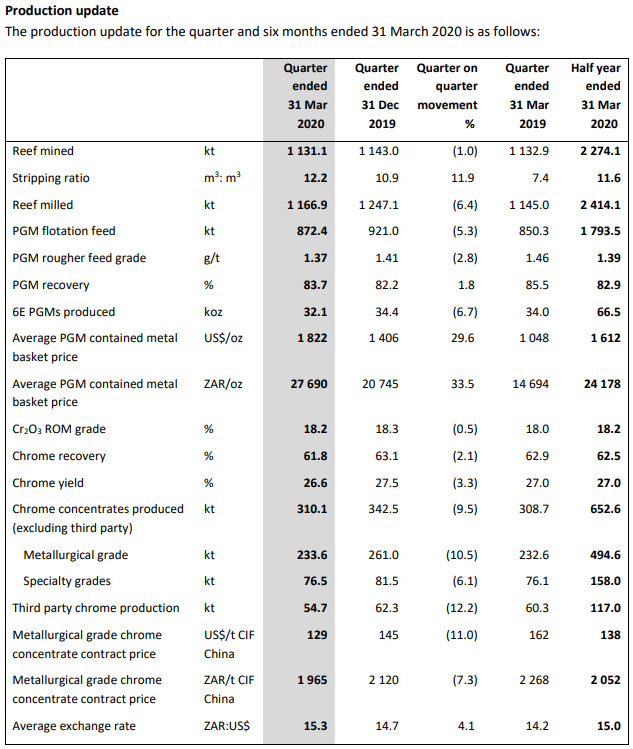
During the quarter, the tonnage of reef mined was 111.3 kt, and the recovery of 166.9 kt, platinum group metal (PGM) was 83.7%. The recovery rate of 32.1 koz, chromium based on 6e was 61.8%, and the concentrate output was 310.1 kt.

During the six months ended 31 March 2020 (the first two quarters), the tonnage of reef mined was 2 274.1 kt, of which the recovery rate of ground 2 414.1 kt,PGM was 82.9%, the recovery rate of 6e production of 66.5 koz, chromium was 62.5%, and the concentrate output was 652.6 kt.

With Tharisa performing strongly at a stable mining and stripping rate and strong ore processing, Tharisa was satisfied with the stable performance over the past quarter, in line with its vision target of 2020 at the end of the 2020 calendar year.

The impact of the epidemic remains a major and unquantifiable threat to the South African economy, and the Tharisa fully supports the government's efforts to respond to the global pandemic. Since the lock began, Tharisa has fully complied with DMRE, to ensure that the Tharisa mine continues to reduce operations during the lock-in period. Tharisa is an important producer of chemical and foundry grade chromium concentrates, which are used in many important industries.

The company said the team would work tirelessly with DMRE and the Minerals Commission to keep the Tharisa mine in operation during the lock-in period, while protecting employees in terms of social alienation and improved health measures in an open-pit, low-labor environment.

Tharisa's mining performance has been tracking the achievement of Vision 2020 production requirements. This has been achieved mainly through pit redesign, which was the focus area for fiscal year 2019, and with the increase in the availability of reefs and the length of workstations, it provides the necessary flexibility to meet the production targets planned in the 2020 vision plan and is achieving results.

The mining industry was disrupted by the blockade imposed by the Government on 25 March 2020, affecting the last ten days of March. Tharisa fully supports the measures taken by the Government of South Africa and is committed to adopting best practices as recommended by the relevant authorities. The safety and well-being of our employees, contractors and stakeholders are of paramount importance to the business.

A total of 1131.1 kt, of reef mined in the current quarter is equivalent to 1143.0 kt mined in the first quarter of 2020, totaling 2 274.1 kt in the six months ended 31 March 2020.

Mines and mining equipment were safely maintained and maintained before Tharisa was allowed to continue limited mining production during the lock-in period.

Tharisa's two separate processing plants, Genesis and Voyager, continued to maintain capacity above the nameplate until the shutdown. Happily, the PGM recovery rate for the quarter increased by 1.8% to 83.7%, with an average growth rate of 82.9% over a six-month period, producing 32.1 koz and 66.5 koz based on 6e, respectively. The grade of crude raw materials in this quarter is 1.37 g and 1.39 g in half a year.

Chromium concentrate production for the quarter was 310.1 kt, including metallurgical grade 233.6 kt and special grade 76.5 kt,. When added to the first quarter results, the total chromium concentrate production for six months was 652.6 kt, divided into metallurgical grade 494.6 kt and special grade 158.0 kt.

As the K3 plant began operation in late January 2020, consistent with the operation of the concentrator, third-party chromium production was low this quarter, at 54.7 kt. The production of third-party chromium in six months is 117.0 kt. During the lock, K3 remains completely paused.

Due to the blockade, the Vulcan Project of Tharisa has been suspended until further notice.
China International stainless Steel Industry Market and Application Development Forum 2020

Scan QR codes, apply to attend the meeting or join the SMM Metal AC Group

Data Source Statement: Except for publicly available information, all other data are processed by SMM based on publicly available information, market communication, and relying on SMM's internal database model. They are for reference only and do not constitute decision-making recommendations.

For any inquiries or for more information, please contact: lemonzhao@smm.cn
For more information on how to access our research reports, please contact:service.en@smm.cn
Related News
Disturbance from Expectations for Production Cuts on Supply Side Intensifies, Silicon Metal Prices Continue Strengthening [SMM Silicon Industry Weekly Review]
9 hours ago
Disturbance from Expectations for Production Cuts on Supply Side Intensifies, Silicon Metal Prices Continue Strengthening [SMM Silicon Industry Weekly Review]
Read More
Disturbance from Expectations for Production Cuts on Supply Side Intensifies, Silicon Metal Prices Continue Strengthening [SMM Silicon Industry Weekly Review]
[Supply Side Production Cut Expectations and Disruption Intensify, Silicon Metal Prices Continue Strong]: On the market quotation and transaction side, affected by expectations for month-end production cuts at large plants in Xinjiang, silicon enterprises generally have a strong sentiment to hold prices firm. Their quotes increased WoW, and futures-spot traders also raised their quotes following the rise in futures prices, leaving almost no low-priced supply in the market. The center of suppliers' quotations generally increased, while China's downstream users and users outside China show little willingness to chase price rises. Some downstream users have poor acceptance of high prices and mainly place orders on demand for restocking.
9 hours ago
Criminal Networks Target Amazon’s Critical Minerals
9 hours ago
Criminal Networks Target Amazon’s Critical Minerals
Read More
Criminal Networks Target Amazon’s Critical Minerals
[SMM Flash] Criminal organisations in the Amazon are increasingly positioned to expand from illegal gold mining into coltan, cassiterite, lithium, nickel, niobium and rare earth elements as demand grows for minerals used in batteries, semiconductors, defence, AI and clean-energy technologies. Existing networks controlling territory, clandestine airstrips, river routes and money-laundering channels can be adapted to support illicit mineral extraction and trade. In June 2026, Brazil’s Federal Police identified an illegal mining site in Pará where nearly 80 kg of gold was reportedly extracted over three years. The growing concern is that illegally sourced minerals can be mixed with legally mined material and laundered through forged documentation, intermediary companies and cross-border trade, making their origins difficult to detect. In April 2025, Colombian authorities seized nearly 49 tonnes of coltan and tin reportedly extracted from areas controlled by armed groups and destined for illegal export to China. Strengthening mineral traceability, financial intelligence, border controls and international cooperation will therefore be critical to protecting emerging critical-mineral supply chains from criminal infiltration.
9 hours ago
[SMM Chromium Flash] China July 2026 HC FeCr Imports Fall 9.9% MoM to ~132,825 t as South Africa Drops Out
10 hours ago
[SMM Chromium Flash] China July 2026 HC FeCr Imports Fall 9.9% MoM to ~132,825 t as South Africa Drops Out
Read More
[SMM Chromium Flash] China July 2026 HC FeCr Imports Fall 9.9% MoM to ~132,825 t as South Africa Drops Out
[SMM Chromium Flash] China July 2026 HC FeCr Imports Fall 9.9% MoM to ~132,825 t as South Africa Drops Out
China's high carbon ferrochrome (HC FeCr) imports totalled approximately 132,825 tonnes in July 2026, down 9.9% month-on-month from around 147,361 tonnes in June, per Chinese customs data. Kazakhstan retained its position as China's largest HC FeCr supplier in July, shipping approximately 84,429 tonnes, up a marginal 1.2% MoM from June's 83,415 tonnes. With other origins pulling back more sharply, Kazakhstan's share of total imports rose to roughly 63.6%, up from 56.6% in June. Zimbabwe posted the strongest gain among suppliers, with volumes climbing 72.1% MoM to approximately 22,901 tonnes in July from around 13,306 tonnes in June, lifting its import share to roughly 17.2% from 9.0% the previous month. India also grew its share, with shipments up 50.8% MoM to approximately 23,889 tonnes in July from around 15,845 tonnes in June, taking its share of total imports to roughly 18.0% from 10.8%. Imports from other origins fell sharply, down 55.7% MoM to approximately 1,607 tonnes in July from around 3,628 tonnes in June. South Africa recorded no HC FeCr shipments to China in July, a sharp reversal from June's approximately 31,166 tonnes, which had accounted for around 21.2% of that month's total. Overall, July's data shows a rebalancing of China's HC FeCr supply base, with Kazakhstan consolidating its lead while Zimbabwe and India expanded their footholds to help offset South Africa's exit from the month's import mix.
10 hours ago
[quarterly report] Tharisa:Q1 Chromium concentrate production 310.1kt decreased by 9.5% compared with the same period last year - Shanghai Metals Market (SMM)