Disrupted wood charcoal imports likely delay resumption of silicon plants in wet season

Published: Apr 03, 2020 11:01 (GMT+8)
Chinese silicon plants may face difficulties to resume production as scheduled in the wet season starting from June as the global widespread COVID-19 has disrupted the supply chain and led to a shortage of raw material wood charcoal. SMM learned that most silicon plants have conducted maintenance and tried to secure feedstock for the preparation of resumption.
SHANGHAI, Apr 3 (SMM) – Chinese silicon plants may face difficulties to resume production as scheduled in the wet season starting from June as the global widespread COVID-19 has disrupted the supply chain and led to a shortage of raw material wood charcoal. SMM learned that most silicon plants have conducted maintenance and tried to secure feedstock for the preparation of resumption.


Mass application of wood charcoal in domestic silicon production is mostly seen in Yunnan province, where silicon mills use wood charcoal as a reducing agent to ensure the quality of finished products. Besides providing a carbon source for smelting, wood charcoal can also increase production due to its favourable properties.


While Myanmar is the major source of wood charcoal supply in Yunnan, the Yunnan Customs has suspended import from the country due to the fast-spreading of COVID-19. This kept silicon producers in Yunnan depleting their inventories of wood charcoal. 


As of this week, silicon plants in operation in Yunnan are mostly located in Baoshan and Nujiang areas and stocks of wood charcoal are insufficient. Some producers have only around one month of feedstock to meet production, and stockpiles of Chinese traders are limited. Large-scale companies face even severe shortage of wood charcoal.


In addition, reduced production of wood charcoal near the China-Myanmar border drove traders to secure products from alternative sources. This added to the transportation costs and eroded profits, pushing some market participants out of the market and intensifying the supply tightness.


Supply of silica in Yunnan has also tightened up due to import disruption from Myanmar and Vietnam caused by the COVID-19. Production at domestic mines, another source of the raw material for Yunnan, came lower than the previous year as the pandemic delayed the resumption of mining operations and the return of workers. The silica mining will again halt in the upcoming rainy season and this reinforces concerns about supply shortage.


The resumption of silicon production in Dehong of Yunnan will likely be later than as compared to previous years as local plants are required to install desulphurisation equipment. Production could only restart after the installation is checked and accepted by authorities, which should be done before June 30. The installation has kicked off in most silicon mills in Yunnan.
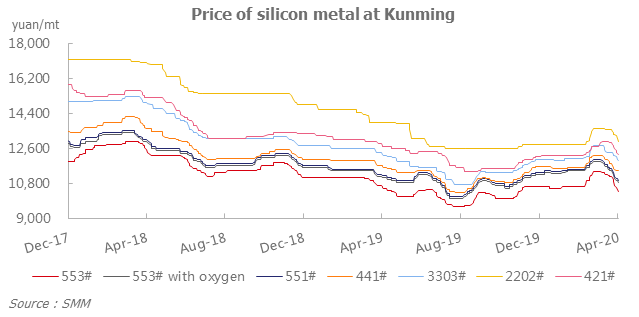


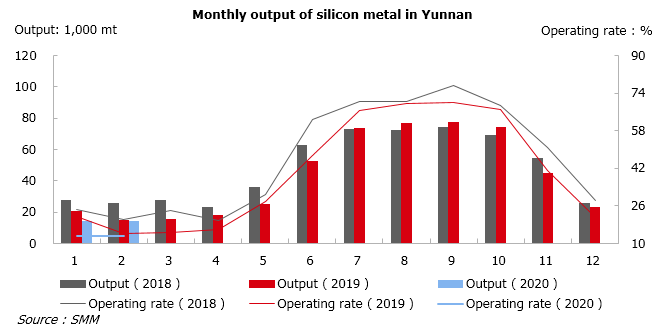
The anticipation of higher supply in the wet season had kept the market bearish about silicon prices, which partly accounted for the recent steep declines in prices. However, SMM expects the raw material shortage, limited profits at silicon mills and desulphurisation issue to slow down the rebound of silicon supply in the wet season. The operating rates at silicon producers then will likely stand lower than the previous year.


Data Source Statement: Except for publicly available information, all other data are processed by SMM based on publicly available information, market communication, and relying on SMM's internal database model. They are for reference only and do not constitute decision-making recommendations.

For any inquiries or for more information, please contact: lemonzhao@smm.cn
For more information on how to access our research reports, please contact:service.en@smm.cn
Related News
[SMM Chromium Week Review] 'Port Stocks Draw Down as Departures Extend Gains, Zimbabwe Tightens Chrome Mining Rules'
Sep 25, 2026 20:43 (GMT+8)
[SMM Chromium Week Review] 'Port Stocks Draw Down as Departures Extend Gains, Zimbabwe Tightens Chrome Mining Rules'
Read More
[SMM Chromium Week Review] 'Port Stocks Draw Down as Departures Extend Gains, Zimbabwe Tightens Chrome Mining Rules'
[SMM Chromium Week Review] 'Port Stocks Draw Down as Departures Extend Gains, Zimbabwe Tightens Chrome Mining Rules'
Published: Sept 25, 2026
Sep 25, 2026 20:43 (GMT+8)
[SMM Chromium Flash] FS Mining Details $500m Zimbabwe Ferrochrome Smelter and Power Plant Plans
Sep 25, 2026 15:21 (GMT+8)
[SMM Chromium Flash] FS Mining Details $500m Zimbabwe Ferrochrome Smelter and Power Plant Plans
Read More
[SMM Chromium Flash] FS Mining Details $500m Zimbabwe Ferrochrome Smelter and Power Plant Plans
[SMM Chromium Flash] FS Mining Details $500m Zimbabwe Ferrochrome Smelter and Power Plant Plans
FS Mining, a South African-registered company developing a chrome mine in Zimbabwe, is advancing plans for a US$500 million investment split between a US$100 million ferrochrome smelter and a US$400 million thermal power project, director Dr. Precious Mabuza said in an interview published September 25. The company is currently building a US$15 million wash plant as its first phase of development, and is progressing through the technical, engineering and financing stages of the planned smelter and power plant, with construction timelines dependent on completing feasibility work and securing the necessary approvals. The smelter is planned to begin with 16.5 MVA of sintering plant capacity, paired with a 25MW thermal power station in the project's first phase. Mabuza said the longer-term vision is to expand the power-generation component to 320MW, with the company hoping to extend rural electrification to communities surrounding its operations once the plant is built out. Eventual chrome production volumes will be determined once the final furnace configuration, engineering design and operating parameters are concluded, she said. Mabuza framed the investment around Zimbabwe's push for greater domestic beneficiation, noting the government has banned the export of raw minerals, including chrome, to force local value addition. She said the mine currently employs 100 people, with the company targeting 1,500 jobs at the smelter and power station once operational, and roughly 5,000 jobs across the wider value chain including mining, logistics, services and construction. The reliable baseload electricity from the planned thermal power station is central to the project's strategy, intended to support both the smelting operation and, eventually, electrification for nearby communities.
Sep 25, 2026 15:21 (GMT+8)
[SMM Chromium Flash] Outokumpu Unveils EvoMaterials Technology to Boost Ferrochrome's Chromium Content
Sep 25, 2026 15:15 (GMT+8)
[SMM Chromium Flash] Outokumpu Unveils EvoMaterials Technology to Boost Ferrochrome's Chromium Content
Read More
[SMM Chromium Flash] Outokumpu Unveils EvoMaterials Technology to Boost Ferrochrome's Chromium Content
[SMM Chromium Flash] Outokumpu Unveils EvoMaterials Technology to Boost Ferrochrome's Chromium Content
Outokumpu has unveiled EvoMaterials, a proprietary sulfidation-based technology platform designed to increase the chromium content and chromium-to-iron ratio of ferrochrome, with potential to extend to nickel, molybdenum, and metals recovered from waste streams. The company said its Kemi mine in Finland, the EU's only operating chrome mine, gives EvoMaterials a strategic starting point in enriched ferrochrome and chromium metal aimed at space, aviation and defense applications, and that over the longer term the technology could help establish a fully Western supply chain for critical chromium materials, while also being economically competitive against conventional production routes. Development began in the US in 2021, supported in part by a non-exclusive MIT patent license. Outokumpu CTO Stefan Erdmann said the process can recover critical materials from resources previously treated as waste. Testing is under way at a Massachusetts lab, with a pilot plant in New Hampshire set to scale the technology from 1 kg to 1 mt by early 2027, ahead of a targeted industrial-scale plant in 2030 at a US or European site still to be decided. CEO Kati ter Horst framed the platform as addressing the need for supply chains that are lower-carbon, geopolitically resilient and economically competitive at once.
Sep 25, 2026 15:15 (GMT+8)