China’s demand for LFP energy storage batteries to soar 87% in 2020 following the rise of 5G

Published: Apr 1, 2020 16:38
China’s demand for lithium iron phosphate (LFP) batteries in energy storage is expected to soar 87% in 2020, as Beijing ramps up 5G network construction in a bid to offset the economic fallout from the COVID-19 pandemic and shore up its economy in the long term.
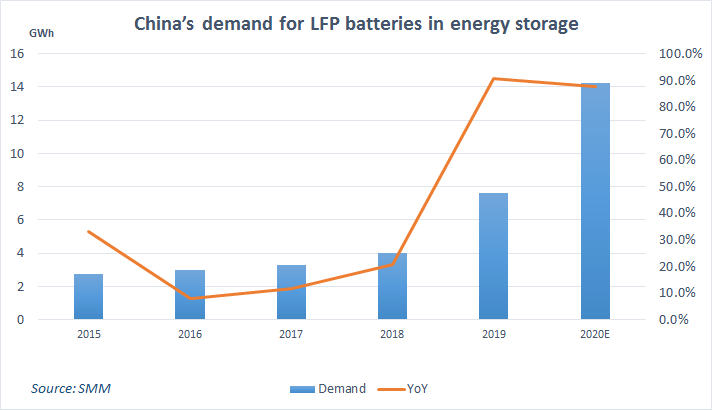
SHANGHAI, Apr 1 (SMM) – China’s demand for lithium iron phosphate (LFP) batteries in energy storage is expected to soar 87% in 2020, as Beijing ramps up 5G network construction in a bid to offset the economic fallout from the COVID-19 pandemic and shore up its economy in the long term.


LFP batteries have been favored by 5G base stations for energy storage. On March 4, state-owned telecom service provider China Mobile, revealed its 2020 bidding announcement for the centralised procurement of LFP batteries. It plans to purchase a total of 512.2 million Ah of specification 3.2V LFP batteries for telecommunications with no more than 250.8 million yuan (tax included). Purchasing is required to complete within a year.


SMM estimates that China Mobile needs about 1.92 GWh of LFP batteries a year, equating to 4,300 mt of LFP cathode material or 1,000 mt of lithium-carbonate equivalent (LCE). This procurement is expected to add 1 GWh of demand for LFP batteries in 2020, as actual application is expected in the second half of the year, and to generate a 13% increase from 7.6GWh of China’s demand for LFP energy storage batteries in 2019.


China Tower announced on March 11 that it would purchase lithium iron phosphate batteries on a large scale with a procurement scale of about 2GWh. The telecom infrastructure firm has stopped purchasing lead-acid batteries since 2018 and switched to using LFP batteries retired from electric vehicles.


China's top industry regulator, the Ministry of Industry and Information Technology (MIIT), expects over 600,000 5G base stations to be built nationwide by the end of 2020. China Mobile, China Unicom and China Telecom plan to build a total of more than 550,000 5G base stations this year, and they have commissioned about 156,000 as of early February.


Aside from back-up power storage applications in telecom base stations, LFP batteries are also gaining popularity in grid energy storage. Batteries are used to store electrical energy, especially from intermittent power plants such as renewable electricity sources such as wind power, tidal power, solar power, during times when electricity is plentiful and inexpensive or when demand is low. The stored power will be fed into the grid when demand is high.


Litian Wanshi is expected to use LFP batteries to store energy in its 20GWh lithium-ion battery and system project in east China’s Zhejiang. This project kicked off construction in early March, and is expected to see Phase 1 built in March 2023.


Shanghai-listed Luoyang Glass said in February that its subsidiary—China National Building Materials (Hefei) New Energy Resources—plans to build a 1MW/4MWh LFP battery energy storage base.

Data Source Statement: Except for publicly available information, all other data are processed by SMM based on publicly available information, market communication, and relying on SMM's internal database model. They are for reference only and do not constitute decision-making recommendations.

For any inquiries or for more information, please contact: lemonzhao@smm.cn
For more information on how to access our research reports, please contact:service.en@smm.cn
Related News
[ESS: EVE Energy Signs 206GWh Battery Supply Agreement with Fluence]
4 hours ago
[ESS: EVE Energy Signs 206GWh Battery Supply Agreement with Fluence]
Read More
[ESS: EVE Energy Signs 206GWh Battery Supply Agreement with Fluence]
[ESS: EVE Energy Signs 206GWh Battery Supply Agreement with Fluence]
EVE Energy's subsidiary EVE Power signed a supply agreement with global energy storage integrator Fluence on Sep 17 to produce and deliver 206GWh of batteries during 2027-2031, including a committed 16GWh for 2027 and 190GWh of reserved capacity for 2028-2031. EVE said the deal recognizes its battery performance and supply qualification, and marks a key step in its global footprint expansion. Specific terms will be set in subsequent purchase orders.
4 hours ago
Turbo Energy Secures 15 C&I Storage Projects Worth $3.48 Million
9 hours ago
Turbo Energy Secures 15 C&I Storage Projects Worth $3.48 Million
Read More
Turbo Energy Secures 15 C&I Storage Projects Worth $3.48 Million
Turbo Energy secured firm orders for 15 commercial and industrial energy-storage projects in Spain and Chile. The projects have a combined attributable order value of approximately $3.48 million (€3 million) and total capacity of 15.6 MWh and 5.95 MW. Two systems are already operating, three are being installed, nine are in manufacturing and one remains under development. Subject to site readiness, the remaining projects are scheduled for installation and commissioning between the fourth quarter of 2026 and the first half of 2027. The figures cover binding purchase orders and executed supply agreements, excluding non-binding proposals and memoranda of understanding. The previously announced 366 MWh Pamesa project is separate from this portfolio.
9 hours ago
KEPCO Secures KRW 2.4 Billion in 2027 Budget for ESS-Based Virtual Power Line Project
Sep 17, 2026 15:13
KEPCO Secures KRW 2.4 Billion in 2027 Budget for ESS-Based Virtual Power Line Project
Read More
KEPCO Secures KRW 2.4 Billion in 2027 Budget for ESS-Based Virtual Power Line Project
KEPCO and South Korea’s Ministry of Climate, Energy and Environment announced the launch of a virtual power line project using energy storage systems to mitigate transmission congestion at an electricity-industry forum held in Seoul on September 17. The government’s 2027 draft budget allocates KRW 2.4 billion to the project, which is scheduled to begin in 2027 and expand into a large-scale government-supported program by 2030. A testing and verification framework for the grid operation of centrally contracted grid-forming BESS will also be established by November 2026.
Sep 17, 2026 15:13