China’s demand for LFP energy storage batteries to soar 87% in 2020 following the rise of 5G

Published: Apr 1, 2020 16:38
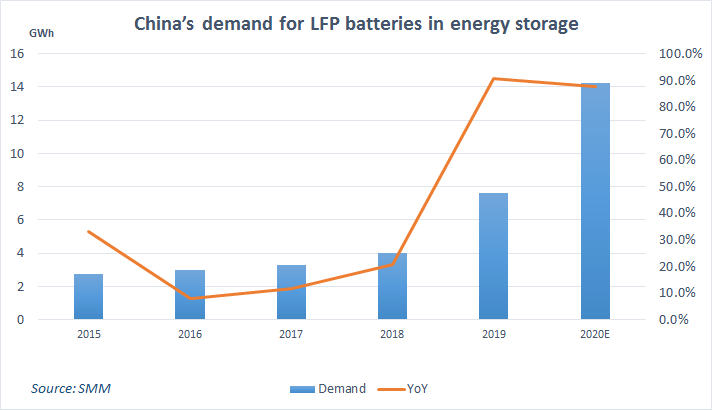
China’s demand for lithium iron phosphate (LFP) batteries in energy storage is expected to soar 87% in 2020, as Beijing ramps up 5G network construction in a bid to offset the economic fallout from the COVID-19 pandemic and shore up its economy in the long term.
SHANGHAI, Apr 1 (SMM) – China’s demand for lithium iron phosphate (LFP) batteries in energy storage is expected to soar 87% in 2020, as Beijing ramps up 5G network construction in a bid to offset the economic fallout from the COVID-19 pandemic and shore up its economy in the long term.


LFP batteries have been favored by 5G base stations for energy storage. On March 4, state-owned telecom service provider China Mobile, revealed its 2020 bidding announcement for the centralised procurement of LFP batteries. It plans to purchase a total of 512.2 million Ah of specification 3.2V LFP batteries for telecommunications with no more than 250.8 million yuan (tax included). Purchasing is required to complete within a year.


SMM estimates that China Mobile needs about 1.92 GWh of LFP batteries a year, equating to 4,300 mt of LFP cathode material or 1,000 mt of lithium-carbonate equivalent (LCE). This procurement is expected to add 1 GWh of demand for LFP batteries in 2020, as actual application is expected in the second half of the year, and to generate a 13% increase from 7.6GWh of China’s demand for LFP energy storage batteries in 2019.


China Tower announced on March 11 that it would purchase lithium iron phosphate batteries on a large scale with a procurement scale of about 2GWh. The telecom infrastructure firm has stopped purchasing lead-acid batteries since 2018 and switched to using LFP batteries retired from electric vehicles.


China's top industry regulator, the Ministry of Industry and Information Technology (MIIT), expects over 600,000 5G base stations to be built nationwide by the end of 2020. China Mobile, China Unicom and China Telecom plan to build a total of more than 550,000 5G base stations this year, and they have commissioned about 156,000 as of early February.


Aside from back-up power storage applications in telecom base stations, LFP batteries are also gaining popularity in grid energy storage. Batteries are used to store electrical energy, especially from intermittent power plants such as renewable electricity sources such as wind power, tidal power, solar power, during times when electricity is plentiful and inexpensive or when demand is low. The stored power will be fed into the grid when demand is high.


Litian Wanshi is expected to use LFP batteries to store energy in its 20GWh lithium-ion battery and system project in east China’s Zhejiang. This project kicked off construction in early March, and is expected to see Phase 1 built in March 2023.


Shanghai-listed Luoyang Glass said in February that its subsidiary—China National Building Materials (Hefei) New Energy Resources—plans to build a 1MW/4MWh LFP battery energy storage base.

Data Source Statement: Except for publicly available information, all other data are processed by SMM based on publicly available information, market communication, and relying on SMM‘s internal database model. They are for reference only and do not constitute decision-making recommendations.

For any inquiries or to learn more information, please contact: lemonzhao@smm.cn
For more information on how to access our research reports, please contact:service.en@smm.cn
Related News
[SMM Stainless Steel Flash] Fu'an Aims for $246B in Stainless Steel Output by 2026, Advances 600,000-Ton CR Project
13 hours ago
[SMM Stainless Steel Flash] Fu'an Aims for $246B in Stainless Steel Output by 2026, Advances 600,000-Ton CR Project
Read More
[SMM Stainless Steel Flash] Fu'an Aims for $246B in Stainless Steel Output by 2026, Advances 600,000-Ton CR Project
[SMM Stainless Steel Flash] Fu'an Aims for $246B in Stainless Steel Output by 2026, Advances 600,000-Ton CR Project
According to the Fu'an City Development and Reform Bureau, as outlined in its 2026 economic and social development plan released on March 6, the city is set to continuously consolidate its leading advantage in the stainless steel new materials industry. A key focus for the year is accelerating the construction and implementation of major downstream projects, specifically highlighting Runhengxin's 600,000-ton stainless steel cold-rolling project and a new titanium alloy materials manufacturing industrial park. Through these strategic capacity expansions, Fu'an aims to push the total output value of its stainless steel new materials industry to 246 billion RMB in 2026, targeting a year-on-year growth rate of over 5%.
13 hours ago
[SMM Stainless Steel Flash] Fujian Tsingshan's Stainless Steel Deep Processing Project Receives Construction Permit
13 hours ago
[SMM Stainless Steel Flash] Fujian Tsingshan's Stainless Steel Deep Processing Project Receives Construction Permit
Read More
[SMM Stainless Steel Flash] Fujian Tsingshan's Stainless Steel Deep Processing Project Receives Construction Permit
[SMM Stainless Steel Flash] Fujian Tsingshan's Stainless Steel Deep Processing Project Receives Construction Permit
According to the Zhouning County Natural Resources Bureau, the Fujian Tsingshan Special Materials stainless steel deep processing project officially received its construction engineering planning permit on February 14, 2026. The major facility, covering a land area of over 207,700 square meters with a total construction area of approximately 156,482 square meters, marks a significant step forward in capacity expansion for the Tsingshan-affiliated entity in Fujian province, further solidifying its downstream processing footprint.
13 hours ago
[SMM Stainless Steel Flash] EU Fastener Distributors Warn CBAM Acts as Penalty Tariff; Import Costs Surge Up to 50%
13 hours ago
[SMM Stainless Steel Flash] EU Fastener Distributors Warn CBAM Acts as Penalty Tariff; Import Costs Surge Up to 50%
Read More
[SMM Stainless Steel Flash] EU Fastener Distributors Warn CBAM Acts as Penalty Tariff; Import Costs Surge Up to 50%
[SMM Stainless Steel Flash] EU Fastener Distributors Warn CBAM Acts as Penalty Tariff; Import Costs Surge Up to 50%
According to EFDA, the CBAM is severely penalizing importers of screws, nuts, and other fasteners, with costs reportedly surging by 30% to 50% since the mechanism took full effect in January 2026. The EFDA attributes this drastic cost increase to structural failures by the European Commission, specifically the absence of a functioning verification system that forces importers to rely on exorbitantly high default emissions values rather than actual data. This issue is heavily compounded by a severe shortage of certified verifiers, whose accreditation is delayed until summer 2027. Warning that these bureaucratic complexities are threatening the global competitiveness of European end products like automobiles and machinery.
13 hours ago