China imports of cobalt raw materials in February dipped 21% on coronavirus impact

Published: Mar 27, 2020 11:47 (GMT+8)
The coronavirus outbreak deterred domestic logistics and companies’ operations, which led to reduced imports of cobalt raw materials last month. The feedstock deliveries normalised in early March and cobalt salt producers have lifted their operating rates to 60-70% as of March 26.

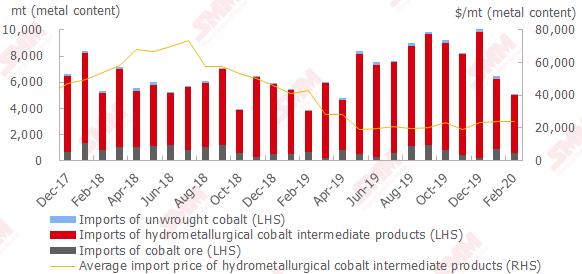
SHANGHAI, Mar 27 (SMM) – China's imports of cobalt raw materials, including ore and intermediate products, came in at 5,000 mt in metal content in February, down 21% from a month ago, showed the latest customs data. Imports in the first two months of 2020 were 24% higher on the year, standing at 12,000 mt in metal content. 


Cobalt ore imports in February stood at 602 mt in Co content, based on a Co grade of 8%, down 33% on the month and 5% on the year. The coronavirus outbreak deterred domestic logistics and companies’ operations, which led to reduced imports of cobalt raw materials last month. The feedstock deliveries normalised in early March and cobalt salt producers have lifted their operating rates to 60-70% as of March 26. 


In February, China’s imports of unwrought cobalt intermediate that was produced through hydrometallurgical processes shrank 18% on the month but rose 40% on the year to stand at 4,400 mt in Co content, based on a grade of 27%. 


Import prices of hydrometallurgical cobalt intermediate products averaged $24,093/mt in Co content in February, down 44% from a year ago.


Cobalt raw materials imports in China (Source: SMM, China customs)

The fast-spreading COVID-19 has triggered the lockdown of some African countries, which may impact the deliveries of cobalt raw materials to China in June-July if the exports from major supplier Congo are disrupted. No production suspension of Congo’s cobalt mines has been heard so far.


In the short term, prices of cobalt salts in China will remain under pressure as the demand outlook remains weak on the backdrop of the worldwide outbreak of the COVID-19 and shutdown of some auto factories in Europe and the US. 


Data Source Statement: Except for publicly available information, all other data are processed by SMM based on publicly available information, market communication, and relying on SMM's internal database model. They are for reference only and do not constitute decision-making recommendations.

For any inquiries or for more information, please contact: lemonzhao@smm.cn
For more information on how to access our research reports, please contact:service.en@smm.cn
Related News
[SMM Analysis] Two Suspensions in Two Months: Sigma Lithium Permits Suspended Again, Expansion Affected
6 hours ago
[SMM Analysis] Two Suspensions in Two Months: Sigma Lithium Permits Suspended Again, Expansion Affected
Read More
[SMM Analysis] Two Suspensions in Two Months: Sigma Lithium Permits Suspended Again, Expansion Affected
[SMM Analysis] Two Suspensions in Two Months: Sigma Lithium Permits Suspended Again, Expansion Affected
6 hours ago
[Lake Resources’ Kachi Project Receives Environmental Approval]
6 hours ago
[Lake Resources’ Kachi Project Receives Environmental Approval]
Read More
[Lake Resources’ Kachi Project Receives Environmental Approval]
[Lake Resources’ Kachi Project Receives Environmental Approval]
On September 29, Lake Resources announced that its Kachi lithium brine project in Argentina has received an Environmental Impact Declaration (DIA) issued by the Mining Ministry of Catamarca Province. The DIA requires a 200-meter surface exclusion zone around the lagoon shoreline. The company said it is updating mineral resource estimates accordingly, but existing ore reserve estimates and wellfield development plans are not expected to be affected. The project uses Lilac Solutions’ direct lithium extraction (DLE) technology and is designed to reinject more than 95% of processed brine into the native aquifer, isolated from freshwater resources, and to eliminate traditional evaporation ponds. Kachi Phase 1 has a designed capacity of 25,000 tonnes per annum of lithium carbonate equivalent (LCE), and the company’s planned Phase 2 scheme aims to further increase capacity to 50,000 tpa. Following environmental approval, the project is entering the front-end engineering and design (FEED) stage, advancing engineering definition, long-lead equipment procurement, construction planning, and commercial negotiations, in preparation for a subsequent final investment decision (FID). The company also committed US$1 million to the Catamarca Province Mining Concession Trust Fund to support local community infrastructure.
6 hours ago
[China Union Holdings: Canada’s FIRES to Further Review Lithium Brine Investment]
6 hours ago
[China Union Holdings: Canada’s FIRES to Further Review Lithium Brine Investment]
Read More
[China Union Holdings: Canada’s FIRES to Further Review Lithium Brine Investment]
[China Union Holdings: Canada’s FIRES to Further Review Lithium Brine Investment]
On September 29, China Union Holdings announced that, as previously announced on August 14, it had received a notice from Canada’s foreign investment review and economic security authority (“FIRES”), which considered that the company’s investment in the Arizaro lithium brine project could affect Canada’s national security and might therefore initiate a further review within 45 days from the date of the notice. On September 29, the company received a notice from FIRES under Section 25.3 of the Investment Canada Act, notifying it of FIRES’s intention to conduct a further review of the transaction. The company and the seller are continuing to communicate with FIRES and are considering feasible options or remedies.
6 hours ago