Coronavirus lockdowns to disrupt copper scrap supply chain

Published: Mar 26, 2020 12:16
Risks of disruptions to global copper scrap supply chain are growing as world authorities put drastic measures, including travel restrictions and border shutdowns, to stop the spread of the COVID-19 pandemic. Malaysia, the biggest copper scrap supplier to the top metals consumer China and the regional hub for non-ferrous metal scrap recycling in Southeast Asia, has announced a nationwide lockdown, which will remain in place until at least the middle of April.
SHANGHAI, Mar 26 (SMM) – Risks of disruptions to global copper scrap supply chain are growing as world authorities put drastic measures, including travel restrictions and border shutdowns, to stop the spread of the COVID-19 pandemic.


All major ports across the world have adopted a 14-day quarantine period for vessels arriving from or transiting through countries that have been hit hard by the virus. Aside from shipping restrictions, factories are ordered to shut down to curb the movement of people.


Malaysia, the biggest copper scrap supplier to the top metals consumer China and the regional hub for non-ferrous metal scrap recycling in Southeast Asia, has announced a nationwide lockdown, which will remain in place until at least the middle of April.


SMM learned that copper scrap exports from Malaysia have been suspended. Most of scrap processors in the country have been shuttered, while those still in operation are to be closed soon as they are running out of raw materials after imports have been disrupted.


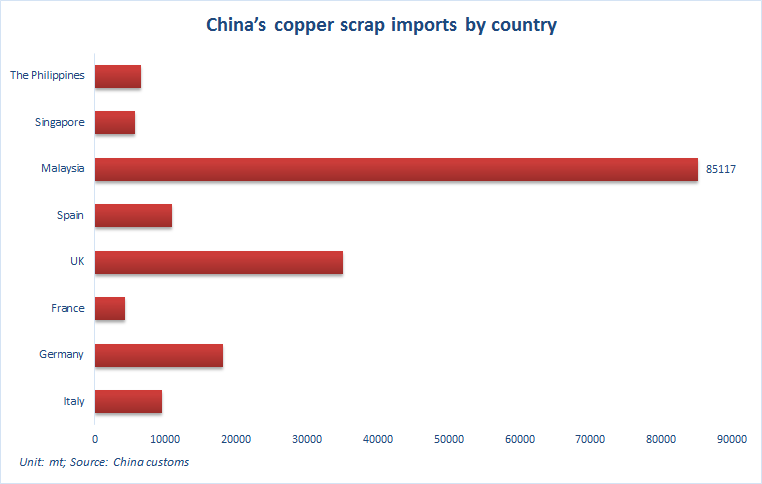
Customs data showed that China’s copper scrap imports via general trade were 388,000 mt in the second half of 2019, with those from Malaysia accounting for more than 20%, or about 85,000 mt.


Declaration of state of emergency by the hardest-hit European countries and the US also adds to the disruption risks of global copper scrap supply chain, as those countries are major copper scrap suppliers to dismantling plants, smelters, refiners and processors in China and Southeast China.


China copper scrap imports dropped 50.5% in January-February


Date from China customs showed that China imported 119,520 mt of copper scrap in the first two months of 2020, halved from 241,522 mt in the same period a year earlier.
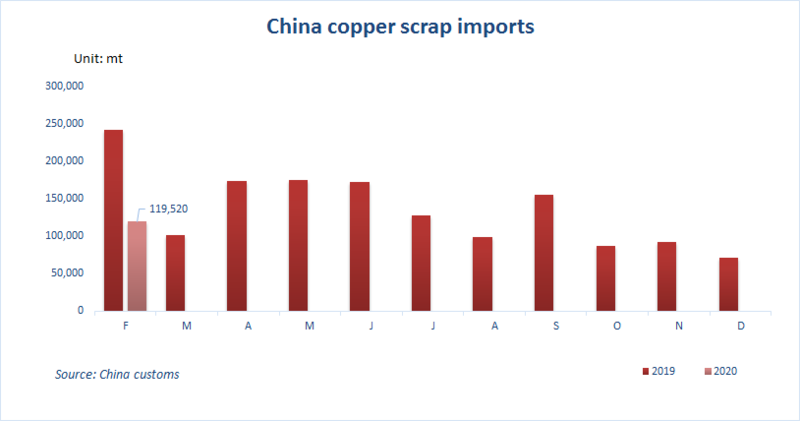


The sharp decline came despite sufficient import quotas approved by the Chinese environmental authorities. China has issued more than 305,000 mt of import allowance for copper scrap for this year, compared to 560,600 mt for the second half of 2019.


Potential disruptions to the global supply chain are set to further tighten copper scrap supply in China, where imported materials accounts for 60% of its total copper scrap supply.


Copper scrap prices in China exceeded copper prices last week, further biting into profits at copper rod producers using copper scrap as feedstock. That will keep operating rates at those plants at low levels in the short term.


Chinese copper rod producers using copper scrap as feedstock operated at an average rate of 6.47% in February, down 38.01 percentage points from the same month of 2019, according to an SMM survey.
Data Source Statement: Except for publicly available information, all other data are processed by SMM based on publicly available information, market communication, and relying on SMM's internal database model. They are for reference only and do not constitute decision-making recommendations.

For any inquiries or for more information, please contact: lemonzhao@smm.cn
For more information on how to access our research reports, please contact:service.en@smm.cn
Related News
Bank of Canada Holds Rates but Signals Possible Hikes if Inflation Persists
10 hours ago
Bank of Canada Holds Rates but Signals Possible Hikes if Inflation Persists
Read More
Bank of Canada Holds Rates but Signals Possible Hikes if Inflation Persists
The Bank of Canada chose to hold steady earlier this month, but Governor Macklem immediately warned that if inflation remains persistently high, the central bank does not rule out multiple consecutive rate hikes. The Riksbank currently belongs to the dovish camp and is expected to keep its key policy rate unchanged at 1.75% at its meeting later this month, though the market currently also expects its rate to rise later this year.
10 hours ago
US Treasury Yields Surge to 16-Year Highs Ahead of Fed Rate Decision
10 hours ago
US Treasury Yields Surge to 16-Year Highs Ahead of Fed Rate Decision
Read More
US Treasury Yields Surge to 16-Year Highs Ahead of Fed Rate Decision
As the US Fed is about to announce its interest rate decision, the sell-off in US Treasuries has intensified, with the benchmark 10-year Treasury yield climbing to its highest level since 2007. The 30-year Treasury yield, which is more sensitive to geopolitical risks, also continued to rise, reaching as high as 5.40% during the session, a new high since June 2007; the 2-year Treasury yield rose about 4 basis points to 4.68%.
10 hours ago
Trump Administration Poised to Approve Deep-Sea Mining Permits for Critical Minerals
10 hours ago
Trump Administration Poised to Approve Deep-Sea Mining Permits for Critical Minerals
Read More
Trump Administration Poised to Approve Deep-Sea Mining Permits for Critical Minerals
The Trump administration has signaled it is about to approve deep-sea mining permits, part of a broader effort to expand US access to critical minerals that are widely used across many sectors of the US economy.Interior Secretary Doug Burgum said at the G20 energy ministers' meeting in Houston that permits could be issued within months, as the administration pursues an "energy growth" strategy to expand supply chains for the US and its allies.
10 hours ago
Coronavirus lockdowns to disrupt copper scrap supply chain - Shanghai Metals Market (SMM)