Lead social inventories dropped as smelters held back on sales

Published: Mar 20, 2020 16:48
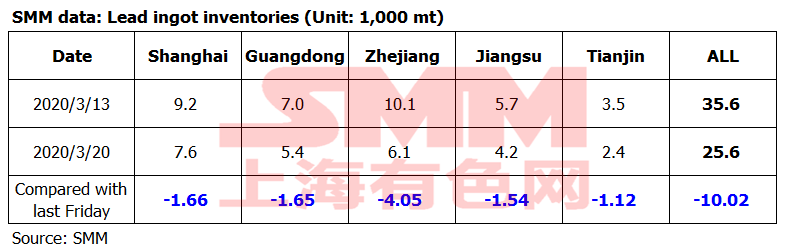
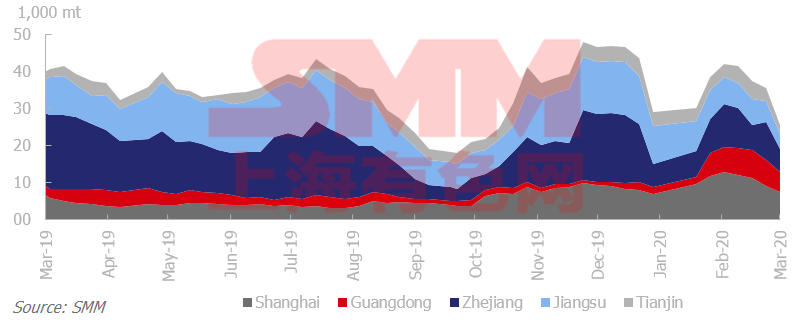
SMM data showed that lead social stocks across Shanghai, Guangdong, Zhejiang, Jiangsu and Tianjin decreased more than 10,000 mt in the week ended March 20 to 25,600 mt, much larger than a decline of 1,900 mt mt in the previous week.

SHANGHAI, Mar 20 (SMM) – Social inventories of lead ingots in China fell sharply this week, as downstream buyers turned to the spot market after plunging lead prices prompted smelters to hold back on sales.


SMM data showed that lead social stocks across Shanghai, Guangdong, Zhejiang, Jiangsu and Tianjin decreased more than 10,000 mt in the week ended March 20 to 25,600 mt, much larger than a decline of 1,900 mt mt in the previous week.


Lead prices dived by close to 1,000 yuan/mt this week, as the coronavirus pandemic fears battered global markets. That prompted primary and secondary lead smelters to hold back on sales and to suspend sales in the second half of the week.


Meanwhile, downstream consumer—lead-acid battery producers ramped up production and had to turn to the spot market to source raw material, leading to this week’s sharp decline in lead social inventories.


With the month drawing to a close, some battery producers will see their long-term lead supply contracts coming to an end, suggesting a potential increase in demand for spot cargoes. Social inventories of lead ingots in China are likely to continue to trend lower next week, if smelters keep sales suspended.
 

Data Source Statement: Except for publicly available information, all other data are processed by SMM based on publicly available information, market communication, and relying on SMM‘s internal database model. They are for reference only and do not constitute decision-making recommendations.

For any inquiries or to learn more information, please contact: lemonzhao@smm.cn
For more information on how to access our research reports, please contact:service.en@smm.cn
Related News
On 27th Jan, Kim Long Motor and BYD entered into strategic partnership, opening BYD’s first EV battery plant in Vietnam
11 hours ago
On 27th Jan, Kim Long Motor and BYD entered into strategic partnership, opening BYD’s first EV battery plant in Vietnam
Read More
On 27th Jan, Kim Long Motor and BYD entered into strategic partnership, opening BYD’s first EV battery plant in Vietnam
Under the agreement, China’s BYD Battery, a global leader in green vehicles, will transferring technical expertise and transfer battery technology for the project while Vietnam’s Kim Long Motor will in charge of financing and developing energy battery manufacturing plant. The project is intended to help Vietnamese companies progressively develop their own battery production capabilities. After completion, the BYD battery facility is projected to enable Kim Long Motor to raise its localization rate to more than 80% by Q2 2026.
11 hours ago
Data: SHFE, DCE market movement (Mar 16)
14 hours ago
Data: SHFE, DCE market movement (Mar 16)
Read More
Data: SHFE, DCE market movement (Mar 16)
The following table shows the ferrous and nonferrous metals movement on the SHFE and DCE on 16 Mar , 2026
14 hours ago
Overview of the new tax rebates for battery exports from China, effective from 1 April 2026.
14 hours ago
Overview of the new tax rebates for battery exports from China, effective from 1 April 2026.
Read More
Overview of the new tax rebates for battery exports from China, effective from 1 April 2026.
On 9 January, China’s Ministry of Finance and the State Taxation Administration released a new export tax rebate policy. From 1 April 2026, China’s export tax rebates of up to 13% for solar battery panels will be rolled back, while the rebate rate for battery products will be reduced from 9% to 6%. The complete phase-out of tax rebates for the above-listed products is scheduled for 1 January 2027. This policy aims to negate price distortions emerged in overseas battery markets, which have long affected the profit margins of domestic manufacturers.
14 hours ago