Operating rates of China silicon plants fell to 4-year low as COVID-19 disrupted raw materials supply

Published: Mar 10, 2020 14:03 (GMT+8)
In early February, raw materials shortage due to suspended logistics and disrupted operations at mines weighed on production at silicon mills in Xinjiang, Sichuan, Guizhou and Heilongjiang. This outweighed ramped-up production in Fujian, Guangxi and Chongqing and accounted for the declines in overall operating rates in February.

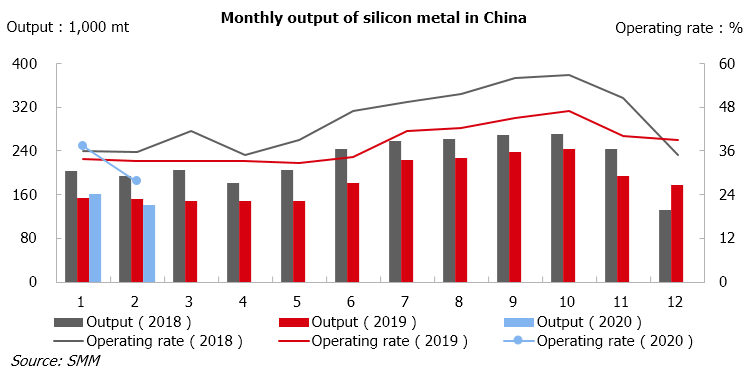
SHANGHAI, Mar 10 (SMM) – Operating rates across Chinese silicon metal producers fell to the lowest level since April 2016, standing at 27.5% in February, down 9.8 percentage points from a month ago and down 5.8 percentage points from a year ago, showed the latest SMM survey.


In early February, raw materials shortage due to suspended logistics and disrupted operations at mines weighed on production at silicon mills in Xinjiang, Sichuan, Guizhou and Heilongjiang. This outweighed ramped-up production in Fujian, Guangxi and Chongqing and accounted for the declines in overall operating rates in February.


Supply tightness of feedstock such as petroleum coke and coal, which was caused by the suspension of logistics, has eased as of March 9. However, silica and coal supply in Xinjiang and silica supply in Hubei have not improved, which could restrict the resumption of silicon production in Xinjiang and Sichuan in the near term. Silicon plants in Xinjiang cannot restart production immediately even as local mining of silica and coal resumes, as it requires some time for restarting a suspended submerged-arc furnace and the coronavirus (COVID-19) outbreak continued to affect the supply of explosives and the return of workers.


Some silicon producers in Nujiang, Yunnan province usually resume production in early March each year, but the epidemic and desulphurisation issues kept them shut as of March 9. These plants are expected to reopen in late-March if they obtain approvals from the environmental authorities. SMM expects the operating rates of silicon metal producers in China to remain at around 27% in March.


SMM data showed that China’s production of silicon metal stood at 141,000 mt in February, down 7.6% on a yearly basis. Silicon metal output in January-February shrank 1.6% on the year to 301,000 mt.

 

Data Source Statement: Except for publicly available information, all other data are processed by SMM based on publicly available information, market communication, and relying on SMM's internal database model. They are for reference only and do not constitute decision-making recommendations.

For any inquiries or for more information, please contact: lemonzhao@smm.cn
For more information on how to access our research reports, please contact:service.en@smm.cn
Related News
【SMM Analysis】Insufficient Demand Support Pulls Chromium Market Prices Down
1 hour ago
【SMM Analysis】Insufficient Demand Support Pulls Chromium Market Prices Down
Read More
【SMM Analysis】Insufficient Demand Support Pulls Chromium Market Prices Down
1 hour ago
North Kivu seller’s September proposal quotes US$4.70 per kg per 1% Tantalum
1 hour ago
North Kivu seller’s September proposal quotes US$4.70 per kg per 1% Tantalum
Read More
North Kivu seller’s September proposal quotes US$4.70 per kg per 1% Tantalum
[SMM Tantalum Flash] A seller from the Democratic Republic of Congo (DRC) quotes US$4.70 per kg for each one-percentage-point tantalum (Ta) unit. Using an illustrative grade of 35% Ta, the seller calculates US$822,500 in total, or US$164.50 per kg of ore. The grade, quantity and availability have not been independently verified. This is one seller’s asking indication, not a completed transaction or a market benchmark. The proposal divides payment into five instalments of 10%, 20%, 20%, 20% and 30%, with inspection, weighing, assay and document checks built into the acceptance process. It provides for an independent re-assay if the initial result is disputed. No buyer acceptance, payment or shipment has been confirmed. The quote specifies Ta metal units, so it should not be compared directly with Ta₂O₅-based prices without confirming the assay basis.
1 hour ago
Domestic Indium Prices Decline in Stepwise Pattern Post-Holiday Trading Week
2 hours ago
Domestic Indium Prices Decline in Stepwise Pattern Post-Holiday Trading Week
Read More
Domestic Indium Prices Decline in Stepwise Pattern Post-Holiday Trading Week
The first full trading week after the holiday saw domestic indium prices exit the previous narrow consolidation and trend down in a stepwise pattern. From October 12 to 14, prices of all grades remained unchanged from pre-holiday levels: refined indium at RMB 5,250/kg, crude indium at RMB 5,050/kg, and 6N high-purity indium at RMB 5,750/kg. On the 15th, all grades were cut by RMB 100 per kg from pre-holiday benchmarks, followed by a further RMB 50 per kg reduction on the 16th. Over the two days: Refined indium fell RMB 150 to RMB 5,100/kg (-2.9%) Crude indium dropped RMB 150 to RMB 4,900/kg (-3.0%) 6N high-purity indium decreased RMB 150 to RMB 5,600/kg (-2.6%)
2 hours ago
Operating rates of China silicon plants fell to 4-year low as COVID-19 disrupted raw materials supply - Shanghai Metals Market (SMM)