China spodumene concentrate imports in January declined in volume with lower prices

Published: Mar 3, 2020 14:06
Production, sales and pricing of lithium ore may continue to face headwinds in 2020, on the back of intensified global competition on the supply front and existing inventory pressure at mines...

SHANGHAI, Mar 3 (SMM) – China imported some 82,000 mt in physical content of spodumene concentrate in January, with the average import price down 31.1% on the year to $519.8/mt, the latest customs data showed.


The amount of imports used to produce lithium salts stood at 78,000 mt, down 41.8% from a year earlier, with the average import price at $492.2/mt, 36.6% lower on the year. No seaborne spodumene raw ore entered China in January. 


Last month, China's major lithium compounds producer Ganfeng Lithium remained the top importer of spodumene concentrate, as it took about 6,100 mt of lithium carbonate equivalent (LCE) from overseas, which was used to produce lithium salts. Grades of the spodumene imports ranged from 3.8% to 6.1%, with the average import price at $408/mt on a cif basis in January. 


Tianqi Lithium was the second-largest Chinese importer of spodumene concentrate last month, who took 1,900 mt of LCE in January (excluding the imports used to make glass-ceramic by Tianqi Xinlong). Import prices of the company averaged $669/mt on a fob basis. 


Grade and average prices of spodumene concentrate imports in January 
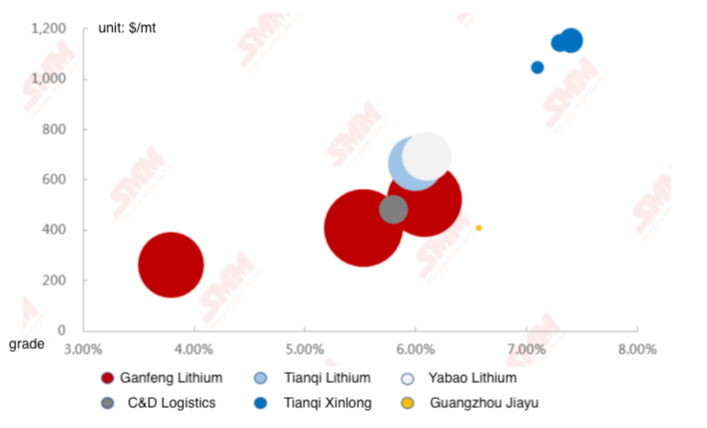

Excluding the imports by some major enterprises such as Tianqi, Ganfeng and Yabao Lithium whose purchasing prices were set in long-term agreements, the average import price of spodumene concentrate used to make lithium salts stood at $483/mt in January, according to SMM calculations. SMM learned that prices of spodumene concentrate in Western Australia remained in a downward trend, but the decline has slowed. 


Production, sales and pricing of lithium ore may continue to face headwinds in 2020, on the back of intensified global competition on the supply front and existing inventory pressure at mines, SMM believes. 


According to customs data in January, some Chinese companies have tested sample ore from African countries in a bid to further cut costs. 


Since mid 2019, falling lithium prices have slowed the operations of some newly-commissioned lithium salt producers in Liaoning and Shandong that use spodumene as feedstock, and some smelters that already stockpiled lithium ore delayed their production schedule in a falling market. Current lithium ore prices in negotiations have approached the production costs at several mines in Western Australia. 


Inventory pressure lingered at lithium mines even as they reduced output to control inventories since the fourth quarter. SMM calculations indicated that the global spodumene inventory stood above 150,000 mt of LCE in 2017-2019. 
 

Data Source Statement: Except for publicly available information, all other data are processed by SMM based on publicly available information, market communication, and relying on SMM's internal database model. They are for reference only and do not constitute decision-making recommendations.

For any inquiries or for more information, please contact: lemonzhao@smm.cn
For more information on how to access our research reports, please contact:service.en@smm.cn
Related News
South Korea to Ease Regulations to Foster Urban Mining
4 hours ago
South Korea to Ease Regulations to Foster Urban Mining
Read More
South Korea to Ease Regulations to Foster Urban Mining
South Korea’s Ministry of Climate, Energy and Environment will launch regulatory exemption projects to recover critical minerals from semiconductor process waste, used batteries and end-of-life solar panels. The government plans to test technologies that recover silicon, copper, titanium and tungsten from semiconductor waste such as used silicon and targets, while reviewing regulatory changes to use such byproducts as circular resources rather than waste. Critical mineral recovery from used batteries and end-of-life solar panels will also be included in the demonstrations.
4 hours ago
Kia Unveils Large Electrified PBV PV7 for First Time
4 hours ago
Kia Unveils Large Electrified PBV PV7 for First Time
Read More
Kia Unveils Large Electrified PBV PV7 for First Time
Kia unveiled the PV7 for the first time at IAA Transportation 2026, the world’s largest commercial vehicle exhibition, held in Hanover, Germany, on September 14. The PV7 is Kia’s second dedicated electrified PBV following the PV5 launched last year. It is a large model that combines a flexible body structure that can be adapted for different use cases with electrified performance, in-vehicle software and fleet operation solutions. The PV7 is based on Kia’s dedicated PBV electric platform, E-GMP.S. Based on the platform, Kia secured a wide, flat interior and cargo space while applying 71.5 kWh and 96.2 kWh NCM high-voltage batteries, a high-efficiency electric drive system and an 800 V charging system. The model will be offered in Standard and Long Range versions. The Long Range Cargo Long variant can travel more than 460 km under Europe’s WLTP standard, based on Kia’s own measurements.
4 hours ago
SK Innovation Says It Has No Plans for SK On IPO
4 hours ago
SK Innovation Says It Has No Plans for SK On IPO
Read More
SK Innovation Says It Has No Plans for SK On IPO
SK Innovation said on September 14 that it currently has no additional business restructuring plans following its absorption merger of SK IE Technology (SKIET). The company has been carrying out large-scale business portfolio restructuring, or rebalancing, to improve its financial structure, but said no decisions have been made beyond the SKIET merger. SK Innovation also said it is not considering an initial public offering (IPO) for SK On.
4 hours ago
China spodumene concentrate imports in January declined in volume with lower prices - Shanghai Metals Market (SMM)