Update: China nickel ore imports fell for 3 months

Published: Jan 22, 2020 10:04
China imported 4.32 million mt of nickel ore and concentrate last month, down 27.91% from November

(Added a chart)

SHANGHAI, Jan 21 (SMM) – China’s imports of nickel ore and concentrate fell in December for a third straight month, as the rush to ship the raw material used in stainless steel and batteries out of Indonesia before an export ban came into force from January eased after a temporary export halt ordered by the Indonesian government in late October rattled Chinese buyers.

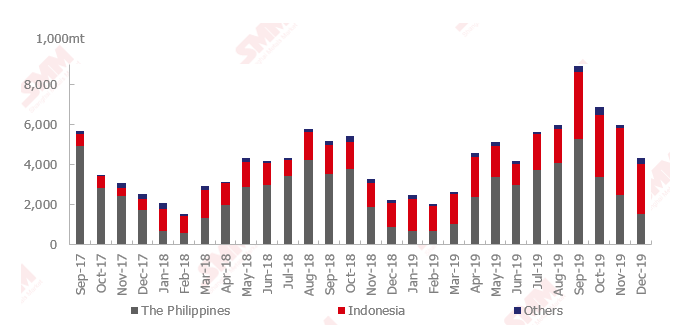
China imported 4.32 million mt of nickel ore and concentrate last month, down 27.91% from November but up 94.2% from the same month of 2018, according to SMM calculations based on data from China customs.

Indonesia exported 2.47 million of nickel ore to China in December, remaining the top nickel ore exporter to China. This was down 26.13% from a month ago, but more than doubled from a year ago.

Nickel ore imports originating from the Philippines dropped 37.88% to 1.54 million mt last month, some 76% higher than the corresponding month of 2018. The Philippines’ nickel ore exports to China have shrank for three consecutive months, due to the rainy season.

For the same month, China’s nickel ore imports from regions beyond the two Southern Asian countries jumped some 86% to 250,000 mt.

China’s nickel ore imports are set to continue to decline in January, as Indonesia’s export ban has taken effect and the wet season in the Philippines has not ended.


Chart: China's nickel ore imports
Data Source Statement: Except for publicly available information, all other data are processed by SMM based on publicly available information, market communication, and relying on SMM‘s internal database model. They are for reference only and do not constitute decision-making recommendations.

For any inquiries or to learn more information, please contact: lemonzhao@smm.cn
For more information on how to access our research reports, please contact:service.en@smm.cn
Related News
Nickel Prices Rise Amid Cost Pressures, Stainless Steel Demand Subdued
15 hours ago
Nickel Prices Rise Amid Cost Pressures, Stainless Steel Demand Subdued
Read More
Nickel Prices Rise Amid Cost Pressures, Stainless Steel Demand Subdued
[SMM Nickel Flash] March 4 news: Supply side, nickel ore and auxiliary material prices continued to rise, upstream cost pressure gradually increased, and quotes remained firm. Demand side, steel scrap currently has a clear cost advantage, stainless steel selling prices were flat, and under losses pressure, purchasing sentiment was relatively subdued.
15 hours ago
SMM High-Grade NPI Sentiment Rises in March, Upstream and Downstream Factors Improve
15 hours ago
SMM High-Grade NPI Sentiment Rises in March, Upstream and Downstream Factors Improve
Read More
SMM High-Grade NPI Sentiment Rises in March, Upstream and Downstream Factors Improve
[SMM High-Grade NPI] News on March 4: The SMM high-grade NPI market sentiment factor was 2.09, up 0.02 MoM; the high-grade NPI upstream sentiment factor was 2.87, up 0.01 MoM; and the high-grade NPI downstream sentiment factor was 1.32, up 0.03 MoM.
15 hours ago
[SMM Stainless Steel Flash] Indonesian Major Mill Hikes 316L Export Price by $100/t
16 hours ago
[SMM Stainless Steel Flash] Indonesian Major Mill Hikes 316L Export Price by $100/t
Read More
[SMM Stainless Steel Flash] Indonesian Major Mill Hikes 316L Export Price by $100/t
[SMM Stainless Steel Flash] Indonesian Major Mill Hikes 316L Export Price by $100/t
According to SMM, on March 4, an Indonesian major stainless steel mill raised its 316L export quotation by USD 100/mt, pushing the price spread between 316L and 304 to USD 1,800/mt. This sharp increase is driven by a rallying molybdenum market: while domestic mines have begun concentrated shipments, molybdenum concentrate transaction prices continue to trend upward. The entire industry chain currently exhibits firm raw material prices and cost-driven pressure, with downstream demand gradually following suit. Strong cost support from the ferromolybdenum market has led to this significant price divergence.
16 hours ago