
Hoshine Silicon to add 800,000 mt/year silicon metal capacity in Yunnan

Published: Dec 13, 2019 10:37
Sustainable availability of high-grade silicon ore has made Zhaotong in Yunnan province ideal for investment

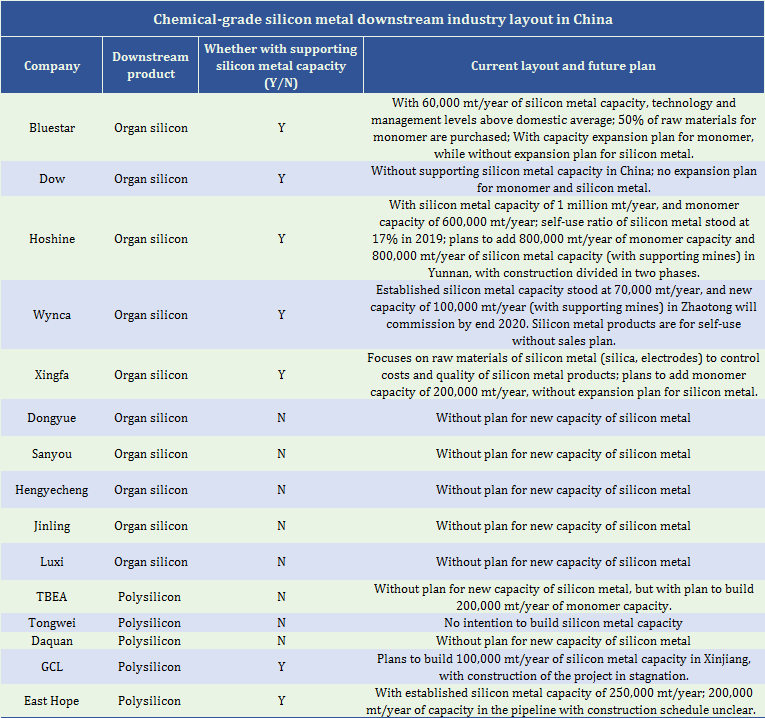
SHANGHAI, Dec 13 (SMM) –Hoshine Silicon, a Zhejiang-headquartered major silicon producer in China, will build 800,000 mt/year of silicon metal capacity in Zhaotong, Yunnan province. 

Although electrical power costs in Zhaotong are higher compared with other cities in Yunnan, sustainable availability of high-grade silicon ore has made Zhaotong ideal for investment, amid supply tightness of high-quality ore in China.

Yunnan currently has an annualised designed capacity of 1.3 million mt, located mostly in the western part of the province, including Dehong, Baoshan, Nujiang, and Lincang that boast rich hydro-power resources. 

The capacity utilisation rate, however, stands at low levels in Yunnan due to maintenance and dry season issues. The monthly average operating rate at silicon producers in the province stood at 46% in 2018. 

China’s silicon industry features low concentration ratios, as small and medium-scale producers with a capacity below 40,000 mt/year accounted for 89% in terms of number and 53% in terms of production capacity of the total silicon producers in China.

Silicon plants in Yunnan are mostly of medium-scale with an annualised capacity of 20,000 mt, invested by companies in Fujian and Zhejiang provinces before 2010. The past decade saw limited silicon capacity addition and expansion projects in Yunnan.

The opportunity of expansion/merger of Yunnan's existing small and medium-scale silicon companies came even smaller as the local implementation of desulfurisation methods over the past two years, ahead of other major silicon production areas in China, increased the cost of investment by around 10%.

Silicon metal can be categorised into metallurgical-grade and chemical-grade products based on downstream applications. Metallurgical-grade silicon, used to produce aluminum alloy, also sees limited chances of new investment due to demand bottleneck in the downstream car market, which is the main consumer of silicon-aluminium alloy. Besides, silicon accounts for only 3-7% of the feedstock to make silicon-aluminium alloy.

There will be more opportunities to invest in chemical-grade silicon on the back of the domestic shortage of high-quality ore and the trend in demand growth. Chemical-grade silicon is used mostly in organ silicon monomer and polysilicon, which have higher requirements for the stability and composition element of raw materials. 

For instance, chemical-grade silicon metal has to reach certain standards of content regarding not only main impurities such as iron, aluminium, and calcium, but also trace elements like phosphorus, boron, titanium, and carbon. 

On the policy front, major production areas such as Yunnan and Xinjiang have imposed controls on the total silicon capacity, but a national-level production quota scheme has not been introduced.  Yunnan aims to control silicon metal capacity within the province below 1.3 million mt/year by 2020, while boosting production and capacity of the top five producers to above half of the market share. 

New silicon projects in Yunnan should be equipped with downstream facilities to obtain government approval.

Xinjiang enjoys the advantages of lower electricity prices and thermal power plants that could guarantee production all year round without the impact of seasonality.  In terms of production capacity, Xinjiang has surpassed Yunnan to become the top silicon metal producer in China in 2015.

Addition of silicon capacity and construction of new self-owned power plants in Xinjiang face greater restrictions since 2018 as Xinjiang shifted its focus to high-level development. 

As a total 2 million mt silicon metal capacity quotas were all issued in Xinjiang, large companies are mulling acquisition or replacement of unrealised quotas for their further expansion. 

Besides capacity quotas, limitations on carbon emissions in each province will also be closely monitored.

Some silicon producers in Xinjiang were forced to cut or halt production due to depletion of carbon emissions quotas, a SMM survey showed. Some silicon mills in Fujian even purchased emissions quotas to extend production. 

A severe mismatch between the production capacity and carbon emission quotas has been seen across silicon production areas in China.
Data Source Statement: Except for publicly available information, all other data are processed by SMM based on publicly available information, market communication, and relying on SMM's internal database model. They are for reference only and do not constitute decision-making recommendations.

For any inquiries or for more information, please contact: lemonzhao@smm.cn
For more information on how to access our research reports, please contact:service.en@smm.cn
Related News
[Flash | Chile's Weather Bites Back: Caserones Copper Guidance Slashed, Molybdenum Caught in the Crossfire]
2 hours ago
[Flash | Chile's Weather Bites Back: Caserones Copper Guidance Slashed, Molybdenum Caught in the Crossfire]
Read More
[Flash | Chile's Weather Bites Back: Caserones Copper Guidance Slashed, Molybdenum Caught in the Crossfire]
[Flash | Chile's Weather Bites Back: Caserones Copper Guidance Slashed, Molybdenum Caught in the Crossfire]
Chile's Caserones copper-molybdenum mine was previously affected by extreme winter weather, experiencing two winter storms that disrupted power supply and site access, causing an actual impact on mine production. The impact of this event has now carried over from a short-term operational disruption into full-year output expectations: Lundin Mining subsequently lowered its full-year copper production guidance for Caserones from the original 130,000–140,000 tonnes to 120,000–130,000 tonnes. By-product molybdenum output is expected to come under pressure in tandem, though a specific molybdenum production guidance figure has not yet been separately disclosed.
2 hours ago
[SMM Chromium Flash] Samancor's Collapsed Dikwena Chrome Tailings Dam Was Never Registered, Probe Finds
Sep 4, 2026 22:18
[SMM Chromium Flash] Samancor's Collapsed Dikwena Chrome Tailings Dam Was Never Registered, Probe Finds
Read More
[SMM Chromium Flash] Samancor's Collapsed Dikwena Chrome Tailings Dam Was Never Registered, Probe Finds
[SMM Chromium Flash] Samancor's Collapsed Dikwena Chrome Tailings Dam Was Never Registered, Probe Finds
A government investigation into the August 13 collapse of a tailings storage facility at Samancor's Dikwena Chrome complex near Brits, North West, has found the facility was showing persistent seepages prior to the failure and that the collapse was reasonably foreseeable based on available evidence, according to a Notice of Orders issued by the Department of Mineral and Petroleum Resources and reported by Daily Maverick. The department's findings also indicate the facility appears not to have been registered with the Department of Water and Sanitation, raising questions about compliance oversight at the site before the incident occurred. The facility, known as the Inyoni tailings storage facility, forms part of Samancor's Dikwena chrome plant complex and is operated by contractor One Chrome, a company reported to have no public website. The collapse sent slurry into the neighboring Eland mine, owned by Northam Platinum, which briefly closed an access road as a precaution. Updated reporting indicates one injury was recorded alongside no fatalities. Samancor Chrome itself is unlisted and is no longer a member of the Minerals Council South Africa, a body whose members commit to industry safety and governance standards. The findings add a regulatory compliance dimension to a case that had previously centered on the physical and environmental impact of the failure. South Africa's tailings storage facility guidelines date back to 1998 and are currently under revision, and at least one senior mining executive has said they were unaware of any operation that actually follows them, pointing to a broader industry gap in registration and compliance practices beyond this single incident. The scope of enforcement action beyond the Notice of Orders, along with the full extent of environmental damage and rehabilitation costs, has not yet been disclosed.
Sep 4, 2026 22:18
[SMM Chromium Flash] Zimbabwe Pitches Chrome Smelting Investment Opportunities to Australian Miners in Perth
Sep 4, 2026 22:13
[SMM Chromium Flash] Zimbabwe Pitches Chrome Smelting Investment Opportunities to Australian Miners in Perth
Read More
[SMM Chromium Flash] Zimbabwe Pitches Chrome Smelting Investment Opportunities to Australian Miners in Perth
[SMM Chromium Flash] Zimbabwe Pitches Chrome Smelting Investment Opportunities to Australian Miners in Perth
Zimbabwe's Deputy Minister of Mines and Mining Development, Dr. Eng. C. Makwiranzou, presented chrome among a slate of commodity-specific investment opportunities at the Zimbabwe Mining Investment Seminar, held during the Africa Down Under 2026 conference in Perth. Rather than a general appeal for capital, Makwiranzou detailed opportunities across lithium, platinum group metals, chrome, gold, iron and steel, and coal, positioning the pitch as a targeted approach to Australian mining investors specifically. On chrome, Makwiranzou pointed to Zimbabwe's regional beneficiation hubs policy, under which chrome-producing areas are earmarked to specialise in ferrochrome and chromium alloy production, describing the framework as "industrial policy with a map attached." He identified patient capital, funding with a long-term investment horizon suited to the extended payback periods typical of smelting and refining infrastructure, as the critical ingredient Zimbabwe needs from prospective investors to realise its beneficiation ambitions. The chrome pitch was delivered alongside a broader downstream-processing narrative: Makwiranzou also flagged a gap in downstream processing within Zimbabwe's platinum group metals sector, where existing operations including Zimplats, Mimosa, Unki and Karo have created scope for further exploration along the Great Dyke's under-explored margins. Taken together, the presentation signals Zimbabwe is actively marketing its beneficiation policy abroad rather than relying solely on domestic and Chinese investment to build out chrome smelting capacity, a shift worth tracking for what it might mean for the pool of investors ultimately financing the country's ferrochrome ambitions.
Sep 4, 2026 22:13