
Hoshine Silicon to add 800,000 mt/year silicon metal capacity in Yunnan

Published: Dec 13, 2019 10:37
Sustainable availability of high-grade silicon ore has made Zhaotong in Yunnan province ideal for investment

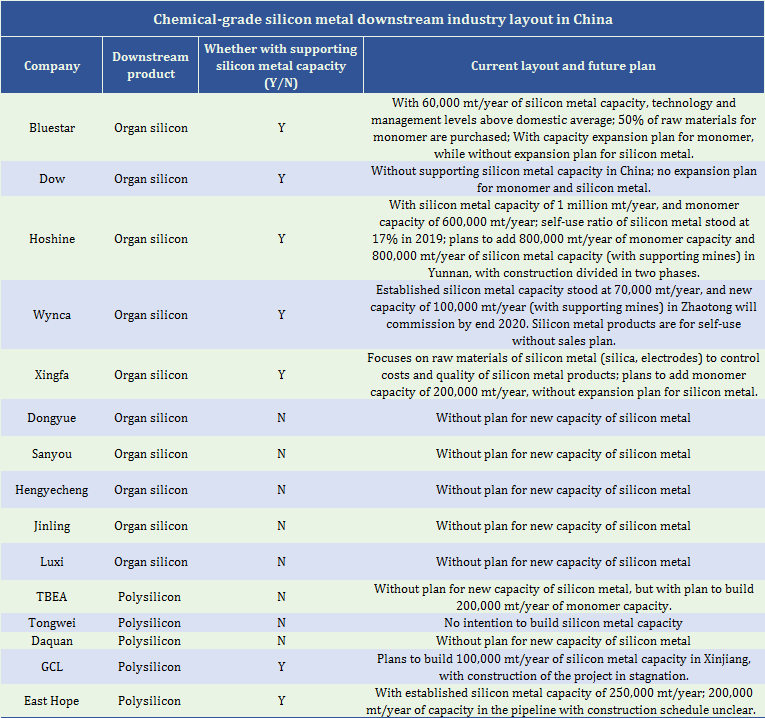
SHANGHAI, Dec 13 (SMM) –Hoshine Silicon, a Zhejiang-headquartered major silicon producer in China, will build 800,000 mt/year of silicon metal capacity in Zhaotong, Yunnan province. 

Although electrical power costs in Zhaotong are higher compared with other cities in Yunnan, sustainable availability of high-grade silicon ore has made Zhaotong ideal for investment, amid supply tightness of high-quality ore in China.

Yunnan currently has an annualised designed capacity of 1.3 million mt, located mostly in the western part of the province, including Dehong, Baoshan, Nujiang, and Lincang that boast rich hydro-power resources. 

The capacity utilisation rate, however, stands at low levels in Yunnan due to maintenance and dry season issues. The monthly average operating rate at silicon producers in the province stood at 46% in 2018. 

China’s silicon industry features low concentration ratios, as small and medium-scale producers with a capacity below 40,000 mt/year accounted for 89% in terms of number and 53% in terms of production capacity of the total silicon producers in China.

Silicon plants in Yunnan are mostly of medium-scale with an annualised capacity of 20,000 mt, invested by companies in Fujian and Zhejiang provinces before 2010. The past decade saw limited silicon capacity addition and expansion projects in Yunnan.

The opportunity of expansion/merger of Yunnan's existing small and medium-scale silicon companies came even smaller as the local implementation of desulfurisation methods over the past two years, ahead of other major silicon production areas in China, increased the cost of investment by around 10%.

Silicon metal can be categorised into metallurgical-grade and chemical-grade products based on downstream applications. Metallurgical-grade silicon, used to produce aluminum alloy, also sees limited chances of new investment due to demand bottleneck in the downstream car market, which is the main consumer of silicon-aluminium alloy. Besides, silicon accounts for only 3-7% of the feedstock to make silicon-aluminium alloy.

There will be more opportunities to invest in chemical-grade silicon on the back of the domestic shortage of high-quality ore and the trend in demand growth. Chemical-grade silicon is used mostly in organ silicon monomer and polysilicon, which have higher requirements for the stability and composition element of raw materials. 

For instance, chemical-grade silicon metal has to reach certain standards of content regarding not only main impurities such as iron, aluminium, and calcium, but also trace elements like phosphorus, boron, titanium, and carbon. 

On the policy front, major production areas such as Yunnan and Xinjiang have imposed controls on the total silicon capacity, but a national-level production quota scheme has not been introduced.  Yunnan aims to control silicon metal capacity within the province below 1.3 million mt/year by 2020, while boosting production and capacity of the top five producers to above half of the market share. 

New silicon projects in Yunnan should be equipped with downstream facilities to obtain government approval.

Xinjiang enjoys the advantages of lower electricity prices and thermal power plants that could guarantee production all year round without the impact of seasonality.  In terms of production capacity, Xinjiang has surpassed Yunnan to become the top silicon metal producer in China in 2015.

Addition of silicon capacity and construction of new self-owned power plants in Xinjiang face greater restrictions since 2018 as Xinjiang shifted its focus to high-level development. 

As a total 2 million mt silicon metal capacity quotas were all issued in Xinjiang, large companies are mulling acquisition or replacement of unrealised quotas for their further expansion. 

Besides capacity quotas, limitations on carbon emissions in each province will also be closely monitored.

Some silicon producers in Xinjiang were forced to cut or halt production due to depletion of carbon emissions quotas, a SMM survey showed. Some silicon mills in Fujian even purchased emissions quotas to extend production. 

A severe mismatch between the production capacity and carbon emission quotas has been seen across silicon production areas in China.
Data Source Statement: Except for publicly available information, all other data are processed by SMM based on publicly available information, market communication, and relying on SMM's internal database model. They are for reference only and do not constitute decision-making recommendations.

For any inquiries or for more information, please contact: lemonzhao@smm.cn
For more information on how to access our research reports, please contact:service.en@smm.cn
Related News
[SMM Chromium Flash] EU's Toughening Trade Stance Raises Fresh Risks for Ferrochrome and Stainless Steel Supply Chains
9 hours ago
[SMM Chromium Flash] EU's Toughening Trade Stance Raises Fresh Risks for Ferrochrome and Stainless Steel Supply Chains
Read More
[SMM Chromium Flash] EU's Toughening Trade Stance Raises Fresh Risks for Ferrochrome and Stainless Steel Supply Chains
[SMM Chromium Flash] EU's Toughening Trade Stance Raises Fresh Risks for Ferrochrome and Stainless Steel Supply Chains
European governments are preparing to seek broader safeguard measures against surging imports, primarily from China, marking a further shift toward tighter trade protection as European industrial sectors face high energy costs and weak demand. The European Union currently has a safeguard regime covering ferro-alloys, while governments including France, Italy and Germany are now pushing for additional investigations covering chemicals and plastics. For the chromium market, the development could have implications beyond the products directly targeted by the new proposals. A more protectionist EU trade environment could alter stainless-steel import flows and procurement strategies, potentially affecting demand for ferrochrome and the competitiveness of overseas suppliers. With the EU already using trade safeguards for ferro-alloys, further expansion of trade-defense measures could increase uncertainty for global ferrochrome flows and premiums, particularly if protection increasingly extends across both upstream alloy inputs and downstream steel products.
9 hours ago
Cost Support Meets Supply-Demand Tug-of-War; Silicon Metal Prices Stay Stagnant and Stable [SMM Silicon Industry Weekly Review]
12 hours ago
Cost Support Meets Supply-Demand Tug-of-War; Silicon Metal Prices Stay Stagnant and Stable [SMM Silicon Industry Weekly Review]
Read More
Cost Support Meets Supply-Demand Tug-of-War; Silicon Metal Prices Stay Stagnant and Stable [SMM Silicon Industry Weekly Review]
[Cost Support Combined with Supply-Demand Tug-of-War Keeps Silicon Metal Prices in Stalemate]: Silicon metal trading saw a tug-of-war between sellers and buyers, with prices consolidating in a stalemate. As of September 10, SMM oxygen-blown #553 silicon in east China stood at 9,400-9,600 yuan/mt, up 50 yuan/mt WoW, while #441 silicon was at 9,500-9,700 yuan/mt, flat WoW. In the futures market, the SI2611 contract moved sideways around 8,700-8,900 yuan/mt during the week. Affected by the tug-of-war between longs and shorts, prices repeatedly pulled back and forth around the 8,800 yuan/mt level, with Friday's close at 8,745 yuan/mt, up 10 yuan/mt WoW. In terms of market quotes and transactions, silicon producers maintained firm offers, with quotes largely stable during the week. Spot-futures traders also held prices relatively firm amid high-level consolidation in futures. Recently, trucking freight rates have stayed high, and downstream acceptance of high-priced spot cargo was moderate. Some users showed weaker purchasing enthusiasm compared with the previous week, with the market dominated by buying on dips or just-in-time procurement. Wait-and-see sentiment persisted, and transactions overall maintained a just-in-time pace, leaving the price center in a stagnant stalemate.
12 hours ago
ADC12 Consolidates on a Strong Note as Costs Rise and Orders See Marginal Improvement [Aluminum Scrap and Secondary Aluminum Weekly Review]
13 hours ago
ADC12 Consolidates on a Strong Note as Costs Rise and Orders See Marginal Improvement [Aluminum Scrap and Secondary Aluminum Weekly Review]
Read More
ADC12 Consolidates on a Strong Note as Costs Rise and Orders See Marginal Improvement [Aluminum Scrap and Secondary Aluminum Weekly Review]
[Aluminum Scrap and Secondary Aluminum Weekly Review: ADC12 Consolidates on a Strong Note amid Rising Costs and Marginal Order Improvement] In terms of price spreads, on September 10, the price difference between A00 aluminum and mixed aluminum extrusion scrap free of paint in Foshan was about 2,436 yuan/mt, and the price difference between A00 aluminum and shredded aluminum tense scrap was about 1,415 yuan/mt, both widening slightly again WoW. On the supply side, the tight raw material supply pattern remained unchanged, and the scarcity of compliant, invoiced aluminum scrap continued to rise, constraining scrap utilization enterprises' operations and procurement. Against this backdrop, some aluminum scrap yards...
13 hours ago