The Prospect of Today's Financial and Economic data: pay attention to the changes of non-agricultural Employment population after the October seasonal Survey of China's Caixin Manufacturing PMI in the United States

Published: Oct 31, 2019 22:20
Source: SMM

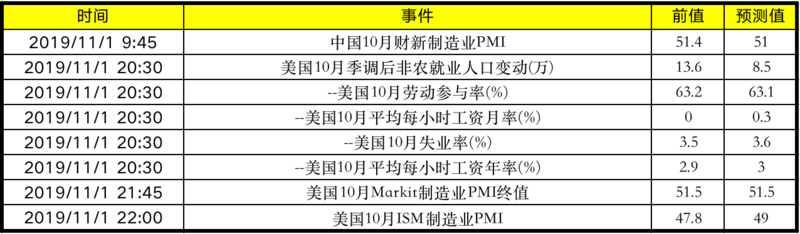
SMM11, January 1: today's focus on China's October Caixin manufacturing PMI, changes in non-farm payrolls after the October season in the United States and speech by Kaplan (Robert Steven Kaplan), chairman of the Federal Reserve in Dallas.

Important data:

China's Caixin manufacturing PMI, in October was a leading indicator of economic health, with a reading above 50 indicating manufacturing expansion in favour of the Australian dollar. Conversely, below 50 indicates a contraction in China's manufacturing sector, which is bad for the Australian dollar.

The change in the number of non-farm payrolls in the United States after the October quarterly adjustment (10,000) reflects the development and growth of the manufacturing and service industries, and the reduction in figures means that enterprises have reduced production and the economy has entered a depression; in the absence of hyperinflation, such as a substantial increase in figures, indicating that a healthy economic situation should be beneficial to the US dollar, and may indicate that it will raise interest rates and may also be beneficial to the US dollar. If the non-farm employment index increases, it reflects the rise in economic development, and vice versa.

The final value of Markit manufacturing PMI in the US in October is a leading indicator of the state of the economy as companies respond quickly to market conditions. By observing the changes in such data, foreign exchange investors judge the outlook for the US economy, which in turn affects the trend of the foreign exchange market.

The US ISM manufacturing PMI, in October is a leading indicator of economic health. Businesses can respond quickly to market conditions, and purchasing managers' views on their companies' economic conditions may be the most timely and relevant.

Important financial data for today:
"Click to sign up for a thousand people event in China's non-ferrous metals industry.


Scan QR code, apply to join SMM metal communication group, please indicate company + name + main business


 

Data Source Statement: Except for publicly available information, all other data are processed by SMM based on publicly available information, market communication, and relying on SMM‘s internal database model. They are for reference only and do not constitute decision-making recommendations.

For any inquiries or to learn more information, please contact: lemonzhao@smm.cn
For more information on how to access our research reports, please contact:service.en@smm.cn
Related News
Month-End Trading in the Spot Market Was Muted on Both Sides, and Suppliers Found It Difficult to Attract Buying Interest Even After Cutting Prices [SMM Shanghai Spot Copper]
34 mins ago
Month-End Trading in the Spot Market Was Muted on Both Sides, and Suppliers Found It Difficult to Attract Buying Interest Even After Cutting Prices [SMM Shanghai Spot Copper]
Read More
Month-End Trading in the Spot Market Was Muted on Both Sides, and Suppliers Found It Difficult to Attract Buying Interest Even After Cutting Prices [SMM Shanghai Spot Copper]
[SMM Shanghai Spot Copper] Looking ahead to tomorrow, the Shanghai spot copper market is expected to remain in the doldrums. Demand side, as it is currently month-end, most downstream enterprises have basically completed their monthly procurement plans, with limited new purchasing demand remaining, and the rest mainly focused on picking up goods under long-term contracts. Therefore, there were fewer inquiries during the day and transactions were sluggish. However, on Wednesday this week, as a new monthly procurement cycle begins, coupled with stockpiling demand ahead of the Qingming Festival, downstream buyers with cargo are expected to see some increase in purchasing demand, which may provide temporary support to spot premiums at that time. Supply side, imported cargoes have continued to arrive recently, and the destocking speed of social inventory in Shanghai has slowed down, with overall circulating supply remaining relatively ample, putting some pressure on the room for discount recovery. Overall, spot prices against the SHFE copper 2604 contract are expected to remain at current levels tomorrow, and after mid-week, attention should be paid to whether increased downstream purchasing can drive a slight narrowing of discounts.
34 mins ago
[SMM Analysis] The Copper Smelting Faces Extreme TC Tests, with Sulfuric Acid and Geopolitics Becoming Key Variables
1 hour ago
[SMM Analysis] The Copper Smelting Faces Extreme TC Tests, with Sulfuric Acid and Geopolitics Becoming Key Variables
Read More
[SMM Analysis] The Copper Smelting Faces Extreme TC Tests, with Sulfuric Acid and Geopolitics Becoming Key Variables
[SMM Analysis] The Copper Smelting Faces Extreme TC Tests, with Sulfuric Acid and Geopolitics Becoming Key Variables
1 hour ago
Copper Smelting Industry Faces the Test of Extremely Low TCs, with Sulphuric Acid and Geopolitics Emerging as Key Variables [SMM Analysis]
1 hour ago
Copper Smelting Industry Faces the Test of Extremely Low TCs, with Sulphuric Acid and Geopolitics Emerging as Key Variables [SMM Analysis]
Read More
Copper Smelting Industry Faces the Test of Extremely Low TCs, with Sulphuric Acid and Geopolitics Emerging as Key Variables [SMM Analysis]
[SMM Analysis: The Copper Smelting Industry Faces the Test of Extreme TCs, with Sulphuric Acid and Geopolitics Becoming Key Variables] Since the beginning of this year, the spot market for copper concentrate TCs has shown an unprecedentedly sharp downward trend. The SMM spot copper concentrate index has fallen all the way from -$45/dmt at the start of the year and is now approaching -$70/dmt. Both the speed and magnitude of the decline have been historically rare. So-called negative TCs mean that when smelters purchase copper concentrates, they are not only unable to obtain traditional processing income from miners, but instead must pay fees to the seller. Based on the current TC of -$70/dmt, the cost that smelters actually need to pay to the seller in the copper smelting process is equivalent to a TC of $70, or further converted to a TC+RC of about $112. This extreme price signal has quickly triggered strong market concern over smelter profitability, and has even begun to raise worries about the sustainability of production in China’s copper smelting industry.
1 hour ago
The Prospect of Today's Financial and Economic data: pay attention to the changes of non-agricultural Employment population after the October seasonal Survey of China's Caixin Manufacturing PMI in the United States - Shanghai Metals Market (SMM)