China steel scrap consumption rises 15% YoY in H1

Published: Aug 20, 2019 16:09 (GMT+8)
China consumed 101.13 million mt of ferrous scrap in the first six months of 2019, up 15.28% year on year

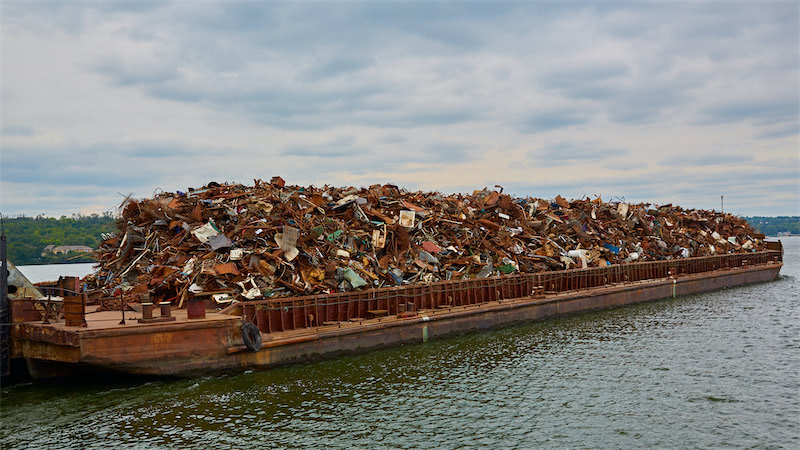
SHANGHAI, Aug 20 (SMM) – China consumed 101.13 million mt of ferrous scrap in the first six months of 2019, up 15.28% from the same period last year, showed data from China's Association of Metalscrap Utilization (CAMU).

During the same period, China’s output of pig iron rose 8.4% to 404.21 million mt, while output of crude steel expanded 9.01% to 492.17 million mt.

It took 205.5 kg of steel scrap to produce 1 mt of steel, up 6.9 kg/mt year on year, while scrap rate climbed 11.1 percentage points to 20.1%.

Electric arc furnace (EAF) production accounted for 9.8% of overall steel output, down 0.2 percentage point from the same period last year.

China’s imports of steel scrap declined 81.9% year on year to 160,000 mt in the first half of the year, while exports shrank 99.3% to 2,267 mt, showed data from China Customs.

Data Source Statement: Except for publicly available information, all other data are processed by SMM based on publicly available information, market communication, and relying on SMM's internal database model. They are for reference only and do not constitute decision-making recommendations.

For any inquiries or for more information, please contact: lemonzhao@smm.cn
For more information on how to access our research reports, please contact:service.en@smm.cn
Related News
Metycle Secures $150 Million Credit Facility to Scale Secondary Copper and Aluminium Supply
2 hours ago
Metycle Secures $150 Million Credit Facility to Scale Secondary Copper and Aluminium Supply
Read More
Metycle Secures $150 Million Credit Facility to Scale Secondary Copper and Aluminium Supply
Germany-based secondary metals supplier Metycle has secured a US$150 million asset-backed credit facility from Rivonia Road Capital to expand its sourcing and supply of secondary copper and aluminium. The financing covers the entire physical trade cycle—from supplier payment and material procurement through logistics to final buyer settlement—allowing Metycle to execute larger transactions, move greater volumes of recycled metals and increase supply to industrial buyers and smelters. The significance for the copper scrap market is that the facility directly addresses one of the key constraints in physical scrap trading: working capital and trade finance. Metycle aims to turn fragmented secondary-metal flows into specified, traceable and reliably delivered industrial feedstock. Greater financing capacity allows it to pay suppliers earlier while providing larger and more consistent flows of secondary copper to smelters and industrial consumers. At a time of tight global copper scrap availability, the entry of institutional private credit into secondary-metal trading could strengthen specialised traders' ability to compete for physical scrap supply.
2 hours ago
BioMetallica Plans Integrated Urban-Mining Facility in the Philippines for E-Waste and Industrial Scrap Recovery
2 hours ago
BioMetallica Plans Integrated Urban-Mining Facility in the Philippines for E-Waste and Industrial Scrap Recovery
Read More
BioMetallica Plans Integrated Urban-Mining Facility in the Philippines for E-Waste and Industrial Scrap Recovery
The Philippine Board of Investments (BOI) has disclosed discussions with Singapore-based cleantech company BioMetallica over a proposed integrated urban-mining and advanced e-waste recycling facility in the Philippines. The project would recover valuable metals and critical raw materials from end-of-life electronics and industrial waste streams. BioMetallica is now engaging local recycling and materials-recovery companies to assess partnerships covering feedstock sourcing, processing and facility development. The NUS spin-off has developed technologies capable of processing complex secondary feedstocks including e-waste, end-of-life solar panels, spent autocatalysts and magnets, with onsite recovery intended to reduce the need to export waste for processing. The project remains at the investment-assessment stage and no capacity, investment value or commissioning schedule has yet been disclosed. If developed, however, it would expand the Philippines' domestic capability to recover copper and other valuable metals from secondary resources rather than exporting lower-processed waste streams.
2 hours ago
Aurubis and Prysmian Sign Their Largest-Ever Long-Term Copper Wire Rod Supply Agreement 中文快讯
3 hours ago
Aurubis and Prysmian Sign Their Largest-Ever Long-Term Copper Wire Rod Supply Agreement 中文快讯
Read More
Aurubis and Prysmian Sign Their Largest-Ever Long-Term Copper Wire Rod Supply Agreement 中文快讯
Prysmian announced on September 23 that it has signed a new long-term copper wire rod supply agreement with Aurubis, representing the largest contract between the two companies in more than 30 years of cooperation. The agreement is designed to secure long-term copper supply for Prysmian’s European cable operations and strengthen regional supply-chain resilience. The companies did not disclose the contract duration, volumes or financial value. Prysmian Corporate Aurubis’ copper wire rod currently contains approximately 36% recycled material on average, and the partners intend to progressively increase circular content in future supplies. Prysmian highlighted accelerating copper demand from electrification, power-grid expansion, digitalisation and AI infrastructure as a key reason for locking in long-term access to lower-carbon copper. For the recycled-copper market, the agreement is particularly notable as a major European cable producer is securing long-term wire rod supply with a substantial and rising recycled-copper component.
3 hours ago