[SMM Analysis] the Mongolian Parliament intends to amend the Oyu Taogai Copper Mine Agreement, which has some hidden dangers to the supply side of copper raw materials.

Published: Jul 22, 2019 16:58 (GMT+8)
On July 22, 2019, the Mongolian parliament said it would vote in August on whether to amend the Oyu Tolgoi copper and gold expansion agreement, which could lead to an early dividend for Rio Tinto.

SMM7 22 July news:

On July 22, 2019, the Mongolian parliament said it would vote in August on whether to amend the Oyu Tolgoi copper and gold expansion agreement, which could lead to an early dividend for Rio Tinto.

Oyu Tolgoi copper and gold deposit is located in Khan Baogde County, South Gobi Province, Mongolia. It is one of the largest gold and copper deposits in the world. Oyu Tolgoi mine is close to the border of our country and is one of the important sources of mine supply in the north of China. Australia's Rio Tinto's turquoise resources company owns 66 per cent of the mine and the rest is owned by Mongolia. In 2009, Mongolia signed an agreement with Canadian mining giant Ivanhoe and Rio Tinto, which states that Mongolia owns 34 per cent of the Oyu Tolgoi joint venture and 66 per cent of Ivanhoe. The Mongolian government can increase its stake to 50 per cent in 30 years. Rio Tinto develops the Oyu Tolgoi project, continuously subscribes to increase its stake in Ivanhoe, and eventually becomes the controlling shareholder of Ivanhoe, in order to get rid of the contradiction between Rio Tinto and the Mongolian government. Ivanhoe transferred its stake in the Oyu Tolgoi project to turquoise Resources, which is controlled by Rio Tinto, which has been in talks with Mongolia over the Oyu Tolgoi project for years, and the two sides have been at odds over tax and development cost increases.

Mongolian lawmakers will vote in August on whether to revise the 2015 investment agreement with mining giant Rio Tinto on the giant Oyu Tolgoi copper and gold mine in the Gobi Desert. After the signing of the giant copper mine capacity expansion agreement, the Mongolian government has repeatedly called for adjustments to the mine's expansion plan on the grounds that mining development is not conducive to Mongolia's mining boom and that it is unable to reasonably share the benefits of development. The agreement covers Oyu Tolgoi's costly and delayed underground expansion.

On the cost side, due to the poor progress of the underground expansion project, production is expected to be delayed to May 2022 to June 2023, and the cost is expected to significantly exceed the budget by $5.3 billion, to about $6.5 billion-$7.2 billion, an increase of nearly 35 per cent. On the tax front, Rio Tinto has been facing legal difficulties in Mongolia, where it provided Oyu Tolgoi with a $155 million tax bill last year, its second tax dispute since 2014. The double pressure of tax and cost has frequently hindered Rio Tinto's Mongolian copper project.

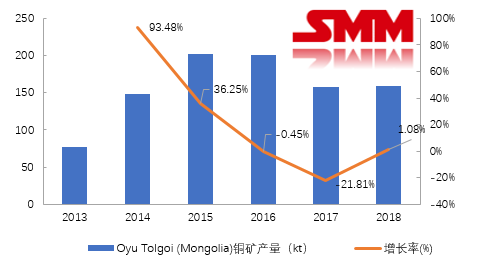
Since it was put into production in 2013, the overall output of Oyu Tolgoi has increased at first and then decreased, and the overall growth rate has decreased year by year. Copper production reached 159.1kt in 2018. Oyu Tolgoi gold deposit is an important supply source of mines in northern China. The obstruction of underground copper mine expansion process is expected to have a great impact on the future copper mine supply in China, especially to increase the pressure on the raw material supply side of the northern copper smelter.
Data Source Statement: Except for publicly available information, all other data are processed by SMM based on publicly available information, market communication, and relying on SMM's internal database model. They are for reference only and do not constitute decision-making recommendations.

For any inquiries or for more information, please contact: lemonzhao@smm.cn
For more information on how to access our research reports, please contact:service.en@smm.cn
Related News
What Could a Cobre Panamá Restart Mean for Global Copper Supply? [SMM Analysis]
2 hours ago
What Could a Cobre Panamá Restart Mean for Global Copper Supply? [SMM Analysis]
Read More
What Could a Cobre Panamá Restart Mean for Global Copper Supply? [SMM Analysis]
Cobre Panamá could again become a major source of global copper supply if Panama and First Quantum agree on a new operating framework. The mine produced 330.9 kt of copper in 2023 and historically supplied around 1% of global output. While stockpile processing has resumed, fresh mining remains suspended. Any restart would likely be phased, with timing dependent on negotiations, legal conditions and operational remobilisation.
2 hours ago
Vedanta Plans $2.3 Billion Expansion in India and Saudi Arabia, and Advances Tuticorin Smelter Restart
7 hours ago
Vedanta Plans $2.3 Billion Expansion in India and Saudi Arabia, and Advances Tuticorin Smelter Restart
Read More
Vedanta Plans $2.3 Billion Expansion in India and Saudi Arabia, and Advances Tuticorin Smelter Restart
Vedanta has unveiled a major investment plan, under which Vedanta Copper intends to invest $2.3 billion in India and Saudi Arabia over the next three to four years, targeting annual copper production of more than 1 million tonnes by 2030. The company aims to produce 500,000 tonnes annually in both India and Saudi Arabia, alongside existing production of 100,000 tonnes in Fujairah, UAE. Around $2 billion will be invested in Saudi copper mining, smelting and rod projects, with an investment decision on the proposed Saudi copper smelter expected this quarter. Vedanta is also seeking to restart its Tuticorin copper smelter in India, which has been closed since 2018. The company expects a court ruling within three months and, subject to approval, plans to invest $250 million in refurbishing the facility, targeting a restart within eight to nine months and annual copper output of 250,000 tonnes. Meanwhile, its Silvassa facility is operating at around 95% capacity, with annualised copper cathode production exceeding 245,000 tonnes.
7 hours ago
London BTC flags copper and antimony at Nevada Black Star
9 hours ago
London BTC flags copper and antimony at Nevada Black Star
Read More
London BTC flags copper and antimony at Nevada Black Star
London BTC Company Limited (LSE:BTC, OTCQB:VINZF) announced on 5 October 2026 initial on-site pXRF results from its Black Star gold-critical minerals project in Pershing County, Nevada. A maiden programme collected 69 rock-chip samples along a 2.5km corridor between the Western and Eastern targets. pXRF readings showed antimony up to 0.44% Sb, copper up to 30.0% Cu, bismuth up to 0.73% Bi and silver up to 811 ppm Ag, with the antimony-copper association appearing at both ends of the corridor. The signature mirrors a historical 1985 sample 120m south of the claims (>1% Sb, 2% Cu, 700 ppm Ag). Earlier due-diligence sampling returned up to 16.23 g/t gold and 50.5 g/t silver. Samples are now with MSALABS for laboratory assays, with full multi-element geochemistry including antimony, tungsten and copper to follow. Copper, as a by-product credit, adds strategic appeal under US critical-minerals policy, though results remain preliminary field readings.
9 hours ago