[SMM Analysis] against a background of more than a hundred drops in the base price of aluminum, the processing fees for aluminum bars in Guangdong and tin are still falling?

Published: Jun 21, 2019 21:54
In some cases, aluminum base prices have fallen, and aluminum rod producers and traders tend to raise processing fees to make up for the losses caused by falling aluminum prices. However, aluminum prices have plummeted by more than $100 this week. On the contrary, processing fees in Guangdong and tin have continued to be reduced. SMM believes that the most direct reason for this phenomenon is the weakening of downstream consumption.

The spot trading price of aluminum ingots in Guangdong and Wuxi fell significantly this week. According to the background of SMM data, the average weekly price of aluminum ingots in Guangdong last week (06.10 06.14) was around 14136 yuan / ton, while this week's average price of Guangdong aluminum ingots was 13954 yuan / ton, which is about 182 yuan / ton lower than that of last week. Similarly, the weekly average price of aluminum ingots in Wuxi last week was around 14028 yuan / ton, while this week's average price was around 13886 yuan / ton, and the two-week spread was around 142 yuan / ton.

In the context of the sharp fall in the base price of aluminum ingots in Guangdong and tin, how does the processing fee for aluminum bars change?

In Guangdong, the processing fees for aluminum bars of this week's φ 90, φ 120 and φ 178 specifications are all between 340 and 440 yuan / ton, and the average weekly price is about 20 to 40 yuan / ton lower than that of last week, and the fluctuation within the week is relatively small. The processing fees for the three specifications of aluminum bars in Wuxi this week are all between 270 and 400 yuan / ton, and the weekly average price is 20 to 60 yuan / ton lower than that of last week, and the weekly price fluctuation is only less than 20 yuan / ton. See the following figure for details.

Source: SMM
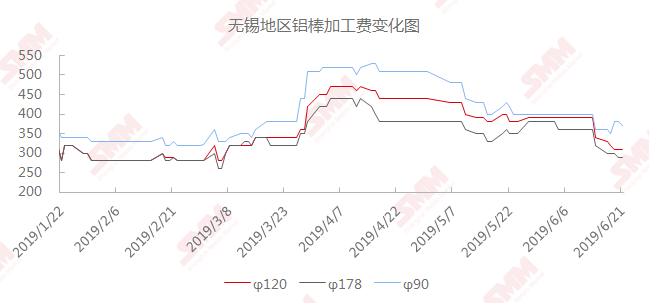
Source: SMM

In some cases, aluminum base prices have fallen, and aluminum rod producers and traders tend to raise processing fees to make up for the losses caused by falling aluminum prices. However, aluminum prices have plummeted by more than $100 this week. On the contrary, processing fees in Guangdong and tin have continued to be reduced. SMM believes that the most direct reason for this phenomenon is the weakening of downstream consumption.

SMM early repeatedly stressed that June-August this year is the aluminum processing enterprise orders weak period, the consumption of related aluminum raw materials will also be affected, this week into late June, downstream manufacturers orders reduced, the purchase of raw materials therefore reduced. SMM's actual research also learned that the overall new orders received by the aluminum profile factory in June were lower than in May, and the opening rate may fall further than in May, as confirmed by the continued decline in aluminum bar processing fees.

From the point of view of the change of processing fees, the current processing fees of aluminum bars in Guangdong and tin basically return to the level of a year ago, because the current inventory change is relatively small, superimposed the expectation of follow-up consumption, SMM believes that the subsequent processing fees of aluminum bars in the two places will not be able to rebound significantly in the short term.
Data Source Statement: Except for publicly available information, all other data are processed by SMM based on publicly available information, market communication, and relying on SMM‘s internal database model. They are for reference only and do not constitute decision-making recommendations.

For any inquiries or to learn more information, please contact: lemonzhao@smm.cn
For more information on how to access our research reports, please contact:service.en@smm.cn
Related News
Fed Governor Milan Pushes for Over 100 Basis Points Cut, Contradicts Barkin on Caution
Feb 7, 2026 17:24
Fed Governor Milan Pushes for Over 100 Basis Points Cut, Contradicts Barkin on Caution
Read More
Fed Governor Milan Pushes for Over 100 Basis Points Cut, Contradicts Barkin on Caution
Federal Reserve Governor Milan pointed out that it is necessary for the US Fed to cut interest rates by more than 100 basis points this year. At the same time, he is very much looking forward to the performance of Kevin Warsh as Fed Chairman. However, Richmond Fed President Barkin emphasized that monetary policy must remain cautious until inflation fully pulls back to the target level, thereby ensuring the stability of the labour market.
Feb 7, 2026 17:24
Democratic Senators Demand Delay in Fed Nomination Amid Criminal Investigation
Feb 7, 2026 17:23
Democratic Senators Demand Delay in Fed Nomination Amid Criminal Investigation
Read More
Democratic Senators Demand Delay in Fed Nomination Amid Criminal Investigation
All 11 Democratic members of the US Senate Banking Committee jointly sent a letter to the committee's chairman, Tim Scott, requesting that all nomination processes for the prospective Fed Chairman, Kevin Warsh, be postponed until the criminal investigation into current Fed Chairman Powell and other board members is concluded. However, Scott stated that Warsh's confirmation was a done deal.
Feb 7, 2026 17:23
Fed to Keep Large Banks' Capital Levels Unchanged, Postpones Stress Test Reforms Until 2027
Feb 7, 2026 17:23
Fed to Keep Large Banks' Capital Levels Unchanged, Postpones Stress Test Reforms Until 2027
Read More
Fed to Keep Large Banks' Capital Levels Unchanged, Postpones Stress Test Reforms Until 2027
The US Fed has announced that it will maintain the capital levels of large banks unchanged during the upcoming stress test cycle (corresponding to the 2026 cycle). At the same time, the US Fed is planning multidimensional reforms to this annual test, aiming to enhance its transparency. The US Fed's Vice Chair for Supervision, Bowman, revealed that adjustments to the stress capital buffer requirements for large banks will be postponed until 2027. This move is intended to provide the US Fed with sufficient time to evaluate potential flaws that may be exposed in its testing models when assessing banks' financial conditions under simulated economic downturn scenarios.
Feb 7, 2026 17:23