Oh, no! The economic indicators of the United States have changed dramatically in the past month!

Published: Jun 11, 2019 17:19 (GMT+8)

SMM6 11: looking back at the economic data of the past month in the United States, it is really a surprise. The author summarizes the economic performance of the United States over the past month. As shown in the figure below, red represents extremely poor and orange represents poor.
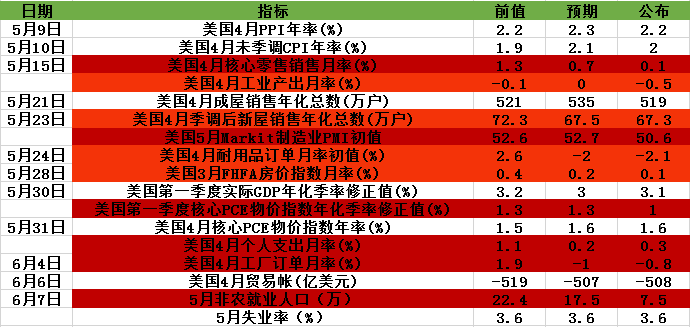
 

Although the unemployment rate continued to equalize its best performance for half a century in May, it is hard to hide the embarrassment of non-farm payrolls. The number of new jobs in the US non-agricultural sector in May was well below the 224000 in April and below market expectations. In the first five months of 2019, the US non-agricultural sector created an average of 164000 jobs a month, down from 223000 in 2018. Analysts said the May jobs data were disappointing, suggesting that uncertainty caused by escalating trade tensions had begun to have a negative impact on the domestic economy.

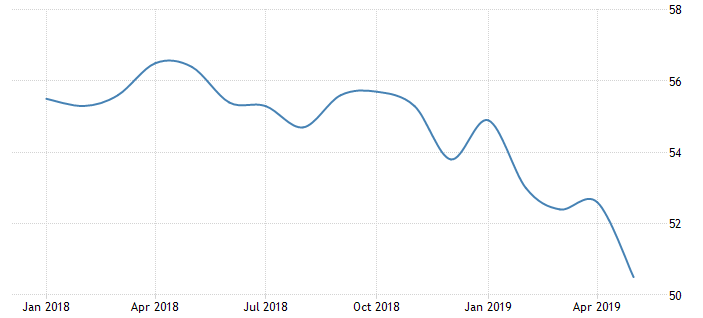
Manufacturing PMI, another important indicator in May, is also not optimistic. The latest figures from Margit, a leading business data research firm, show that the manufacturing purchasing managers' index PMI in May was 50.5, the lowest in a decade, indicating a sharp decline in the US manufacturing boom. Weak demand and economic frictions have led companies to show their lowest confidence in future output growth since mid-2012, according to the Margit report. The chart below shows the trend of manufacturing PMI in the United States over the past year.
 

In addition, retail sales, which represent US consumption, also fell unexpectedly in April, including a 1.9 per cent drop in construction materials, a 1.3 per cent drop in household appliances and electronics, and a 1.1 per cent drop in car sales. With consumption accounting for 70 per cent of the US economy, poor consumption data in April cast a shadow over the US economy in the second quarter.

The core PCE price index, which the Fed values most, performed even worse in the first quarter, which will bring about a big shift in the Fed's monetary policy. The market had expected a rate cut by December, but Goldman had a different view, warning that the growing belief that the Fed would cut interest rates soon could be wrong. "while this is a critical decision, we expect the FOMC to keep fund rates unchanged for the rest of the year," Goldman Sachs chief economist Jane Hazos said in a report on Monday. " He added: "Powell's speech is only focused on longer-term issues, otherwise some market participants may feel 'disconnected'." In addition, according to (MNI), an international market news agency, today, the Federal Reserve does not think the macro situation needs to cut interest rates, indicating that whether to cut interest rates this year or not is still uncertain.

A number of other indicators, including personal spending, factory orders, house price indices and industrial output, have also fallen by varying degrees, making it impossible for Mr Trump to say that trade frictions have no impact on the US economy. The United States wants to be alone, but Trump is ripping off everywhere. It seems that the biggest obstacle to the American economy is from their Mr. President.

Data Source Statement: Except for publicly available information, all other data are processed by SMM based on publicly available information, market communication, and relying on SMM's internal database model. They are for reference only and do not constitute decision-making recommendations.

For any inquiries or for more information, please contact: lemonzhao@smm.cn
For more information on how to access our research reports, please contact:service.en@smm.cn
Related News
KGHM and South32 launch US$725m Sierra Gorda expansion, lifting copper capacity 26%
Oct 02, 2026 16:31 (GMT+8)
KGHM and South32 launch US$725m Sierra Gorda expansion, lifting copper capacity 26%
Read More
KGHM and South32 launch US$725m Sierra Gorda expansion, lifting copper capacity 26%
KGHM and South32 have broken ground on a fourth grinding line at the Sierra Gorda copper-molybdenum mine in Chile's Atacama region. The US$725 million expansion runs for three years from January 2027, with completion by late 2029 and full output in H2 2030. Ore processing capacity rises 26%, from 131,000 tonnes per day to 165,000 tpd. Annual copper output is projected to climb from 165,000 tonnes in 2025 to 195,000 tonnes, with 6,000 tonnes of molybdenum, 58,000 ounces of gold and 1.7 million ounces of silver as by-products. The project creates over 900 direct jobs and is funded from operating cash flow and debt. Unit operating costs are expected to fall about 10%.
Oct 02, 2026 16:31 (GMT+8)
Emerita Extends Final Review of Iberian Belt West PFS, Release Expected in Coming Weeks
Oct 02, 2026 15:31 (GMT+8)
Emerita Extends Final Review of Iberian Belt West PFS, Release Expected in Coming Weeks
Read More
Emerita Extends Final Review of Iberian Belt West PFS, Release Expected in Coming Weeks
Emerita Resources has provided an update on the Preliminary Feasibility Study (PFS) for its Iberian Belt West polymetallic project in Spain, saying the study is well advanced but remains under final technical review.​ The company said the review process has been expanded to include additional technical and quality-assurance oversight before publication. As a result, Emerita now expects the PFS to be released in the coming weeks rather than within the previously indicated timeframe.​ Iberian Belt West hosts copper, zinc, lead, gold and silver mineralization and is one of Emerita’s principal development-stage assets in Spain. The PFS is expected to provide updated detail on the proposed mine plan, processing configuration, capital requirements, operating costs and project economics.​ Emerita said the additional review work is intended to ensure consistency and completeness across the technical disciplines contributing to the study before it is finalized.​ The company did not announce a revised specific publication date, and no new production, capital or economic figures were disclosed in the latest update.​ The extended review delays the next major technical milestone for Iberian Belt West, but the company continues to indicate that the PFS is nearing completion. For the copper market, the significance of the study will depend on the production profile and project economics ultimately disclosed, particularly the contribution of copper relative to the project’s other payable metals. Attention will therefore remain on the timing of the PFS release and whether the final study materially changes the project’s development outlook.
Oct 02, 2026 15:31 (GMT+8)
Cascadia Intersects 75.55 m at 1.19% Cu at Carmacks Copper-Gold Project
Oct 02, 2026 15:27 (GMT+8)
Cascadia Intersects 75.55 m at 1.19% Cu at Carmacks Copper-Gold Project
Read More
Cascadia Intersects 75.55 m at 1.19% Cu at Carmacks Copper-Gold Project
Cascadia Minerals has reported additional drill results from its 2026 exploration programme at the Carmacks copper-gold project in Yukon, Canada, with new step-out drilling extending mineralization at Zone 2000S beyond the boundaries of the existing Mineral Resource.​ Drill hole CD-26-058 returned 75.55 metres grading 1.19% copper, 0.97 g/t gold, 10.4 g/t silver and 335 ppm molybdenum, equivalent to 2.18% copper-equivalent. The interval included 48.66 metres grading 1.61% copper, 1.39 g/t gold, 15.1 g/t silver and 475 ppm molybdenum, equivalent to 3.03% CuEq.​ Within the same hole, a higher-grade interval of 14.50 metres returned 2.30% copper, 2.68 g/t gold, 29.5 g/t silver and 1,015 ppm molybdenum, equivalent to 5.08% CuEq.​ A second hole, CD-26-059, intersected 93.99 metres grading 0.96% copper, 0.70 g/t gold, 4.6 g/t silver and 919 ppm molybdenum, equivalent to 1.94% CuEq. This included 63.97 metres at 1.26% copper, 0.96 g/t gold, 6.3 g/t silver and 1,049 ppm molybdenum, equivalent to 2.52% CuEq.​ Cascadia said the latest results continue to expand mineralization at Zone 2000S beyond the limits of the current Mineral Resource and highlight the higher-grade nature of the extension. The reported drill intervals represent drilled thicknesses, with true widths estimated at approximately 60–70%.​ The latest step-out results indicate that copper-gold mineralization at Zone 2000S extends beyond the boundaries of the current Carmacks Mineral Resource. The broad intervals and higher-grade internal zones could support future resource expansion if additional drilling confirms continuity. However, the new intersections have not yet been incorporated into an updated Mineral Resource Estimate, meaning their ultimate impact on project scale and mine planning remains to be determined.
Oct 02, 2026 15:27 (GMT+8)