New Zealand cut interest rates! German economic expectations fell to 0.5%! Or meet a round of intensive interest rate cuts!

Published: May 8, 2019 13:51

SMM5, March 8: at 10:00, the Federal Reserve of New Zealand announced that it would cut its official discount rate, (OCR), by 25 basis points to 1.5 per cent. The New Zealand dollar fell more than 70 points to 0.6533 against the dollar after the Federal Reserve of New Zealand cut interest rates for the first time since November 2016 and hit its lowest benchmark rate ever, the New Zealand dollar fell more than 70 points to 0.6533 against the US dollar NZD/USD. The chart below shows the trend of the official discount rate in New Zealand over the past decade.
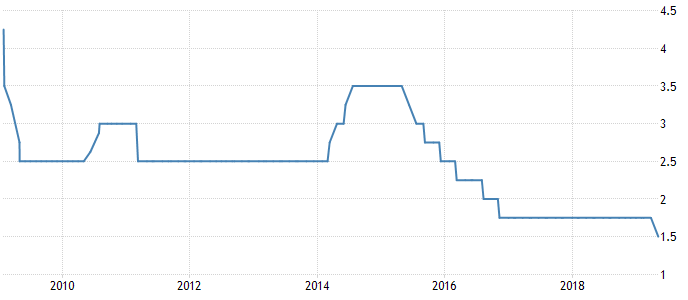
 

Global economic growth has slowed since mid-2018, easing demand for New Zealand goods and services, and domestic growth has slowed since the second half of 2018, the New Zealand Fed said in a statement. Continued low business confidence, stricter profit margins and competition for resources limit investment, the statement said. Employment is close to its highest sustainable level. However, the outlook for job growth is weaker and capacity pressures are expected to ease slightly in 2019. The statement concluded that, given this outlook for employment and inflation, a lower OCR is now best suited to achieving our goals and provides a more balanced outlook for interest rates.

When it comes to cutting interest rates, India is the first country to start cutting interest rates. As early February, the Reserve Bank of India could not help but cut interest rates by 25 basis points, and in early April, the Reserve Bank of India cut interest rates by another 25 basis points. Egypt, on the other hand, is even more fierce, cutting interest rates by 100 basis points on February 15th. In addition, on May 7, the Bank of Malaysia also decided to cut interest rates by 25 basis points, the first time the country has cut interest rates since July 2016.

I am afraid the significance of this interest rate cut by the New Zealand Fed is not just to add another member of the interest rate cutting army. As a member of the five-Eye Alliance and one of the developed countries, New Zealand is the first to cut interest rates this time ahead of other western developed countries. It means that developed economies are beginning to feel pressure and can't hold up. It can be said that the fig leaf on interest rate cuts in developed countries has been torn off, and then Australia, Europe, the United States, Canada, Japan and other countries may all compete to follow suit. At present, with the exception of the slightly better economy of the United States, other developed countries can only say that there is no worst and only worse. Just last night, Beijing time, the European Union cut Italy's economic growth rate to 0.1% in 2019, the lowest economic growth rate in the European Union, compared with a previous forecast of 0.2%. Cut Germany's GDP growth forecast for 2019 from 1.1 per cent to 0.5 per cent, the second-slowest economic growth rate in the eurozone, and warned of eurozone risks.

So it was a minute to cut interest rates, but no one dared to be the first. Now that New Zealand has taken the lead, other countries have no scruples. With the outbreak of more black swans in the world in 2019, there may be a period of intensive interest rate cuts.

Data Source Statement: Except for publicly available information, all other data are processed by SMM based on publicly available information, market communication, and relying on SMM's internal database model. They are for reference only and do not constitute decision-making recommendations.

For any inquiries or for more information, please contact: lemonzhao@smm.cn
For more information on how to access our research reports, please contact:service.en@smm.cn
Related News
Brass billet market transactions are moderate.
1 min ago
Brass billet market transactions are moderate.
Read More
Brass billet market transactions are moderate.
[SMM Brass Billet Flash] According to SMM, recycled brass raw materials remain scarce and expensive, downstream new orders for brass billet are limited, and overall market trading is weak.
1 min ago
Data: SHFE, DCE market movement (Aug 31)
29 mins ago
Data: SHFE, DCE market movement (Aug 31)
Read More
Data: SHFE, DCE market movement (Aug 31)
The following table shows the ferrous and nonferrous metals movement on the SHFE and DCE on 31 Aug , 2026
29 mins ago
Chile, Argentina, Bolivia and Peru Sign Strategic Minerals Declaration to Strengthen Regional Supply Chains
42 mins ago
Chile, Argentina, Bolivia and Peru Sign Strategic Minerals Declaration to Strengthen Regional Supply Chains
Read More
Chile, Argentina, Bolivia and Peru Sign Strategic Minerals Declaration to Strengthen Regional Supply Chains
Chile, Argentina, Bolivia and Peru have signed a joint declaration on strategic minerals, establishing a new regional framework aimed at promoting responsible mining investment, technical cooperation and deeper integration across mineral supply chains. The agreement was signed on August 28, 2026, during the first ministerial meeting on strategic minerals held in Santiago, with representatives from the mining authorities of all four countries participating. The governments said the initiative is intended to position the region as a reliable strategic supplier of minerals required for decarbonisation, electromobility and artificial intelligence. Under the declaration, the four governments agreed to encourage responsible investment and economic development across the regional mining value chain, while exploring greater technical and institutional cooperation between their respective mining authorities. Areas identified for collaboration include geological knowledge, mining regulation and supervision, public policy, specialised workforce development and the exchange of technical experience. The countries will also seek technical and financial support from multilateral institutions and explore joint programmes involving both public and private participants in research, innovation and institutional development. The initiative builds on existing bilateral cooperation in the region, including the Chile–Argentina Mining Integration and Complementation Treaty, whose Administrative Commission was reactivated this year, and the mining cooperation memorandum signed between Chile and Peru in 2025. Chilean officials said the intention is to use these existing arrangements as models for broader regional integration with Peru and Bolivia, particularly as South America seeks to strengthen its role in global supplies of copper and other minerals required for the energy transition. The declaration does not establish specific copper production targets or immediately change regional mine supply, but it represents a broader policy effort by four mineral-rich South American countries to coordinate investment, regulation, technical expertise and value-chain development. The initiative is particularly relevant to copper given the large existing and prospective resources in Chile, Peru and Argentina. If translated into project-specific agreements, infrastructure cooperation and more coordinated investment frameworks, the initiative could help reduce development barriers and support the region’s longer-term contribution to global copper supply.
42 mins ago
New Zealand cut interest rates! German economic expectations fell to 0.5%! Or meet a round of intensive interest rate cuts! - Shanghai Metals Market (SMM)