Why does it make no sense for M2 to bounce back to the bottom? why is it pointless for money to release water?

Published: Apr 16, 2019 18:18

SMM4 16-month news: on Friday, the central bank released the March social and financial data M2 data, both rebounding, exceeding market expectations. Data show that China increased RMB loans by 1.69 trillion yuan in March, with a 2.86 trillion increase in social and financial scale in that month, and M2 rose 8.6% in March from a year earlier to a 13-month high!

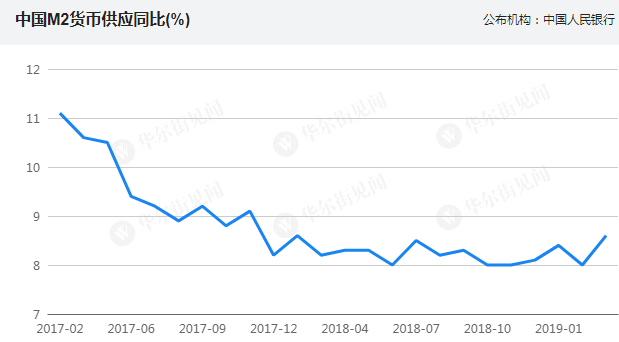
Judging from the chart, the bottom of M2 has been formed, and the growth rate of 8% is the lowest in history. This stronger than expected rebound has confirmed the M2 historical low of 8%, which has brought great confidence to the market. At the same time, it shows that monetary policy is gradually becoming looser.

Since the beginning of the 21st century, M2 growth rate of more than 20% is common, the highest year 2009 M2 growth rate reached 28.5%, a large number of currencies to support the vigorous development of China's economy, at the same time, M2 / GDP ratio is also rising all the way. From 1 in 1996 to more than 2 now, this shows that the trend of economic monetization is becoming more and more serious, resulting in a large amount of overcapacity in the manufacturing sector and a sharp rise in the real estate market for 20 years. To put it bluntly, the great economic development since the new century is closely related to the emergence of the commercial housing market and the development of the international market after China's entry into WTO. M2 plays a role in adding fuel to the flames in this process, but with the gradual saturation of the real estate market and foreign markets, economic growth lacks a new growth point, and the correction of M2 is also natural. This is just a very normal phenomenon in the face of slowing economic growth.

It is an indisputable fact that China's economy has entered the new normal. Under the new normal, there is downward pressure on the economy, the growth rate of investment slows down, the growth rate of M2 slows down, the growth of consumption slows down, and under the new normal, the marginal effect of simple monetary stimulus is decreasing. The effect of monetary water release on the economy is getting weaker and weaker, so it is meaningless to release water again at this time. Releasing water will only make China's economy go further and further on the road of monetization, which is quite disadvantageous to the future economic development. What we need to do now is to find new sources of economic growth, rather than making a fuss about monetary policy. Without substantial economic development, M2 growth will become a rootless wood and a source of water.
Data Source Statement: Except for publicly available information, all other data are processed by SMM based on publicly available information, market communication, and relying on SMM's internal database model. They are for reference only and do not constitute decision-making recommendations.

For any inquiries or for more information, please contact: lemonzhao@smm.cn
For more information on how to access our research reports, please contact:service.en@smm.cn
Related News
India, Russia Eye Expanded Mining and Critical Minerals Partnership
2 hours ago
India, Russia Eye Expanded Mining and Critical Minerals Partnership
Read More
India, Russia Eye Expanded Mining and Critical Minerals Partnership
New Delhi, Moscow seek to expand cooperation from mineral exploration to advanced materials.
2 hours ago
Data: SHFE, DCE market movement (Sep 09)
5 hours ago
Data: SHFE, DCE market movement (Sep 09)
Read More
Data: SHFE, DCE market movement (Sep 09)
The following table shows the ferrous and nonferrous metals movement on the SHFE and DCE on 09 Sep , 2026
5 hours ago
Cobre Secures Third-Party Ore Supply to Add 300 t/month of Copper Cathode at Sierra Atacama
5 hours ago
Cobre Secures Third-Party Ore Supply to Add 300 t/month of Copper Cathode at Sierra Atacama
Read More
Cobre Secures Third-Party Ore Supply to Add 300 t/month of Copper Cathode at Sierra Atacama
Cobre Limited announced on September 9 that its Sierra Atacama operation in Chile has signed ore-purchase agreements with two third-party copper oxide miners in the Antofagasta region, with deliveries expected to ramp up from Q4 2026. The agreements are expected to supply approximately 50,000–75,000 tonnes of oxide ore per month grading 1.0–1.5% total copper, adding around 300 tonnes per month of copper cathode production.​ The additional production will be processed through Sierra Atacama’s existing SX-EW plant, which has installed copper cathode capacity of approximately 20,000 tonnes per year and is currently operating below nameplate capacity. As the purchased ore does not require Cobre to incur its own mining and development costs, the company said incremental costs will primarily comprise the ore purchase price and variable processing costs, including acid, power and reagents. Higher throughput is also expected to spread the plant’s fixed costs over a larger production base.​ The approximately 300 tonnes per month of additional cathode will be incremental to Cobre’s previously announced production targets, which remain unchanged. The company is continuing to stabilise underground production while preparing to transition toward a larger open-pit operation from 2027. Cobre said negotiations with additional regional ore suppliers are also underway, potentially providing further feed for the under-utilised SX-EW facility.​ The agreements represent a near-term increase in copper cathode supply from Sierra Atacama without requiring additional mining development or new processing capacity. At the initial expected rate, the third-party feed could contribute approximately 3,600 tonnes of additional cathode on an annualised basis. More importantly, it should raise utilisation of the existing SX-EW plant ahead of Cobre’s planned transition to expanded open-pit production in 2027. Further ore-supply agreements would provide additional upside to plant utilisation and cathode output.
5 hours ago