SMM3, 20 Feb: in the more than two years since Trump became president, his idea of governing the country has been very clear, practicing isolationism and trade protectionism, excluding immigrants, starting a tariff war, and frightening the capital markets. At home, everything is dominated by the jobs and interests of the working people of the middle and lower classes, tax cuts promote the return of capital, promote employment, and so on. This is what he called the general plan and political thinking that made America great again. I put it down to Trump's three major propositions.
Trump believes that unequal trade agreements harm the interests of the American people. Therefore, he stressed the reciprocal relationship between the two sides of the trade and resolved the current inequality in trade mainly through trade negotiations. Internally, exports are promoted mainly through a weak dollar, thereby flattening the trade deficit. As a businessman-turned-president, Trump is so good at negotiating that he has a penchant for trade negotiations, talking to Canada and Mexico, talking to China, talking to the European Union, Japan, and even taking the time to talk to Kim Jong un. In order to achieve the purpose of weakening the dollar. Trump did not hesitate to interfere with the independence of the Federal Reserve, came forward more than a dozen times to criticize the Fed's monetary policy, and from time to crack down on oil prices. It is contradictory that Trump wants the US economy to prosper and the dollar to weaken.
2. Increase employment
Trump is well aware that the working people at the bottom have given him the chance to enter the White House, so he has been working for the jobs and interests of the people at the bottom. To the outside world, he withdrew from TPP, to repatriate immigrants and built a border wall between the United States and Mexico to prevent refugees from sneaking in, on the one hand, to prevent refugees from robbing the American people of rice jobs, and on the other hand, to put an end to the problem of refugees. Internally, as soon as he came to power, he introduced big tax cuts to benefit businesses and hire more workers. In addition, he called for Apple to move its assembly plant back to the United States to create jobs, and recently reopened GM's closed plant in Ohio.
3. Balance expenditure
Trump is very good at budget, which is in line with the nature of businessmen. In order to reduce federal government spending, Trump withdrew from the United Nations Educational, Scientific and Cultural Organization and the Human Rights Council. Not only that, Trump also proposed to let Germany, France and other countries increase military spending to share the pressure on US military spending. In addition, Trump has withdrawn all U. S. troops in Syria and half of the troops in Afghanistan, where he has said the war in Afghanistan cost Americans time, money and lives.
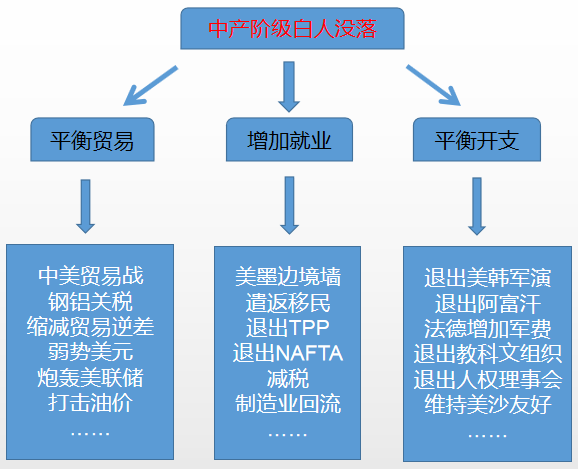
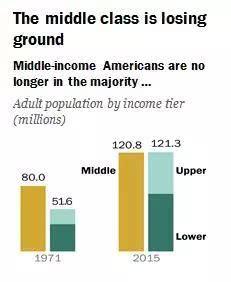
Behind Trump's three claims is actually an embarrassing situation in the United States, the decline of the American middle class. According to a report released by the Pew Research Center, the proportion of middle-class households in the United States has fallen to 49.4 percent, down from 61 percent in 1971, and the middle class is no longer the majority of the United States.
According to the report, 49% of America's total income went to wealthy households in 2014, up from 29% in 1970. At the same time, 43 per cent of state income went into the pockets of the middle class in 2014, down from 62 per cent in 1970.
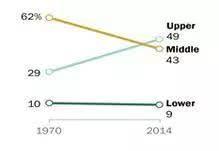
In other words, as a result of globalization over the past few decades, the rich in the United States have become richer, but the middle class has not made any gains, and on the contrary, they have received less wealth. The hollowing out of the middle class has become a source of panic among many economists, politicians and the public.
At the same time, at the other end of the world, the middle class in developing countries, led by China, is rising rapidly. It is reported that the number of middle class in China has increased by 38.5 million since 2000, while that in the United States has increased by only 12.9 million. The growth rate of the middle class in China is three times that of the United States. This has something to do with the high wages of American workers and the massive relocation of American companies, which has brought rapid development to emerging market countries such as China and India.
Therefore, the emergence of Trump's coming to power, the Sino-US trade war, including the recent New Zealand white murder case, seems accidental, but in fact, it is also inevitable. The decline of the American middle class needs someone to speak for them. This person is Trump. When the economy is developing rapidly, perhaps the problem of how to cut the cake is not too big, once the economic development has come down, how to divide the cake has become a big problem, and now is at this time.