

SMM3, March 8: on March 6, NASDAQ released the latest research report on the southern copper industry. With the support of increasing low-cost production and growth investment, the company's performance may continue to improve. However, weak copper prices and high debt levels will also affect its near-term performance.

The company continues to enjoy the benefits of cost-cutting. Although the cost of fuel and other materials increased by 16.5 per cent, cash costs fell by 5.3 per cent to 87 cents per pound in 2018. Taking into account the average price of its main products last year, southern copper expects the average cash cost per pound of copper to be 80 cents per pound in 2019, a further reduction of 8%, consolidating its leadership as a low-cost producer.
In addition, Southern Copper has the largest copper reserves in the industry and operates high-quality world-class minerals in countries such as Mexico and Peru. As of December 31, 2018, its copper reserves totaled 69.7 million tons at a copper price of $2.90 per pound. The company's performance will continue to improve with the support of positive market prospects, increasing low-cost production and growth investment.
Expand projects to drive growth
In the fourth quarter of 2018, Southern Copper completed the expansion of the Toquepala concentrator for US $1.3 billion. By the end of 2018, the mine had about 60 per cent of its full capacity and is expected to reach full capacity by the beginning of the second quarter of 2019. The expansion will increase annual copper production at the Toquepala mine to 258000 tons in 2019, an increase of 52 per cent over last year. In 2019, the company expects total copper production to be 986700 tons, up from 883700 tons in 2018.
In Mexico, the company plans to invest US $413 million in the Buenavista Zinc-Sonora project, including the development of a new concentrator that produces about 80, 000 tons of zinc and 20, 000 tons of copper a year. Once completed, the new zinc concentrator could double the company's zinc production.
The Pilares-Sonora project in Mexico is estimated to invest US $159 million, including an open pit with an annual production capacity of 35000 tons of copper concentrate. This will significantly improve the overall ore grade. In addition, there are many other projects that may be carried out. By 2025, the company expects copper production to reach 1.5 million tons.
Peru: a key Catalyst
In June 2018, Southern Copper completed the acquisition of the Cajamarca Michiquillay project in Peru, which has 1.15 billion tons of mineral resources. The company will produce 225000 tons of copper and molybdenum, gold and silver and other by-products a year at a competitive cash cost. Michiquillay offers the company a huge opportunity for growth in line with its mining portfolio in the Americas, particularly in Peru. It is likely to become one of the largest copper mines in Peru.
The Southern Copper Board approved the project in Peru with a total capital budget of $2.9 billion, of which $1.8 billion has been invested. Taking into account the projects of Michiquillay (US $2.5 billion) and Los Chancas (US $2.8 billion), the company's total investment in Peru is US $8.2 billion. Peru, currently the world's second-largest copper producer, is expected to produce 4.8 million tons a year by 2021, twice as much as in 2017.
Recent concern: lower copper prices, higher debt
(LME) copper fell 9.3 per cent to $2.80 a pound on the London Metal Exchange in the fourth quarter of 2018, down from an average of $3.09 in the fourth quarter of last year. The fall in prices reflects the market uncertainty caused by the escalation of the trade war between China and the United States.
The company's current debt-to-equity ratio of 90% is also a concern.
Long-term outlook: metal prices will pick up
Although copper prices are currently low, the upcoming imbalance between supply and demand will eventually push up copper prices. Copper production has recently been affected by falling investment, a problem that has plagued several companies in recent years. In addition, labour unrest, high government taxes and technical difficulties are further affecting production. All of these factors will limit supply growth, but demand for copper is rising in all sectors.
Under the background of reasonable demand and slowing supply growth in the oil and gas industry, the price of molybdenum is bound to rise. The long-term fundamentals of zinc remain strong because of its large industrial consumption and the possibility of a mine shutdown. In addition, the price of silver is likely to rise due to the increase in its industrial use and the upcoming imbalance between supply and demand.
Southern copper's shares fell 34.1% last year, compared with a 31.5% drop in the industry.
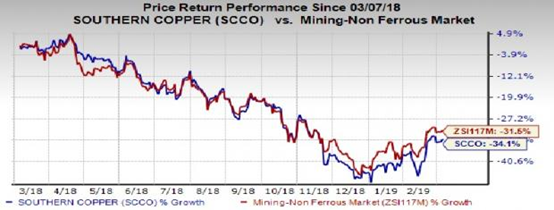
(note: if copyright issues are involved, please contact SMM and we will deal with "View the original text" in a timely manner)

"Click to enter the registration channel

Scan QR code, apply to join SMM metal exchange group, please indicate company + name + main business
![Suppliers Sold Off Cargoes Before the Holiday Without Pressuring Discounts, Shanghai Spot Copper Discounts Held Steady [SMM Shanghai Spot Copper]](https://imgqn.smm.cn/usercenter/fEiiq20251217171711.jpg)

![Weakening Market Demand Drove Down Spot Premiums [SMM North China Spot Copper]](https://imgqn.smm.cn/usercenter/kvwSZ20251217171710.jpg)