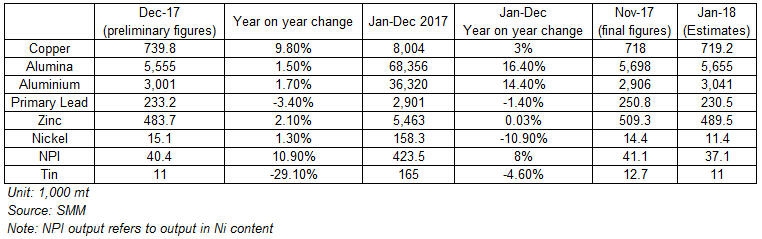
SHANGHAI, Jan 9 (SMM) – SMM surveys major Chinese producers in the base metals market every month to get first-hand production data. The following table shows the latest output in December and our forecast for January.
Copper
China’s copper output rose in December as some large producers looked to hit their annual production target at the year-end. Qingyuan Jiangxi Copper and Shandong Humon Smelting Group also resumed production in December while other small and medium-sized smelters cut output due to environmental protection measures. Tongling Nonferrous Metals saw stable refined copper output.
SMM forecast China’s copper output in January to drop from levels seen in December due to limited production from small to medium-sized smelters, slower production pace at larger ones, and the ongoing testing work at Huludao Hongyue Copper’s 150,000-mt project.
Alumina
We saw three reasons for the alumina output drop in December:
Production restriction in winter seasons: Companies including Henan East Hope Sanmenxia, Kaiman, Shanxi Zhaofeng, Fushen, Shandong Weiqiao and China Aluminium Shandong Branch were all affected.
The 30-day special green policy in Henan province: East Hope Sanmenxia and Henan Zhongmei were required to run at only 50% of their capacities while the Shandong branch of the Aluminium Corp of China (Chalco) was also under such pressure.
Natural gas shortage: China Power Investment Corporation and Kaiman were affected by natural gas shortage. While Huiyuan has resumed its operations, Inner Mongolia Xinwang is expected to resume by the end of January. One production line of Guangxi Xinfa was under maintenance, affecting its output in December.
SMM forecast China’s alumina output to grow in January due to the closure of Henan’s special green policy and the newly-increased capacity of Liulin Senze and Huaqing Aluminium.
Aluminium
Despite the supply-side reform and winter cuts last year, recovered and newly-added capacity made up for the suspended capacity at Shandong Weiqiao, Shandong Xinfa, Xinjiang Xiwang, Xinjiang Jiarun and Inner Monglia Jinlian.
As of late December 2017, domestic aluminium ingots inventory stood at 1.76 million mt, up by 1.42 million mt from a year ago. The actual surplus was over 1.14 million mt considering those held up in Xinjiang.
The operating capacity is expected to rise in January considering the newly-built capacity of Huaren, Hualei, Huarun, Gansu Zhongrui, Mengtai and Chuangyuan.
Zinc
The overall growth in output was limited in December despite the maintenance work was finished at Mengzi Mining Group and the recovery of Kingstone Mining Group. Shortage of raw materials due to environmental inspections in Huayuan county in Hunan led to suspensions of some smelters. Maintenance work at Zhongjin Lingnan Nonfemet and the dry season in Yunnan also limited production.
Primary Lead
Primary lead output dropped in December due to electricity rationing at Henan Jiyuan, Wanyang and Jinli. Besides, Yunnan province suffered from a major environmental inspection, resulting in short supply of lead concentrate and severe losses for smelters. The overall operating rate also declined in December.
It is unclear when in January smelters in Henan would resume production except for Jinli Gold & Lead Group, which sees the end of its maintenance work on January 10. Separately, Hechi South, Zhuzhou Smelting Group and Minshan plan to go on maintenance this month.
Nickel
The main reason for increased production in December was that one smelter in northeast China rushed to hit its annual output target. However, output in January will slip because of weak consumption and the approaching of Chinese New Year. The fire accident at Jinchuan Group would also limit output this month.
Nickel Pig Iron
The drop was mainly caused by less output of low-grade NPI, which was down 20.7% to 5,800 mt in December. Some low-grade NPI plants reduced or switched production because demand was significantly weakened due to lower output of series 200 stainless steel. Output of high-grade NPI remained stable in December but in January it would edge down because of maintenance work at large-scale NPI plants.
Tin
Output was lower as some smelters in Yunnan have suspended operations for several weeks. We expect to see stable production in January as raw materials remained costly. China Tin Group is also expected to see output suspended for some time in January.
For editorial queries, please contact Daisy Tseng at daisy@smm.cn
For more information on how to access our research reports, please email service.en@smm.cn