Inner Mongolia silicon plants shift production to ferrosilicon

Published: Dec 26, 2017 16:57
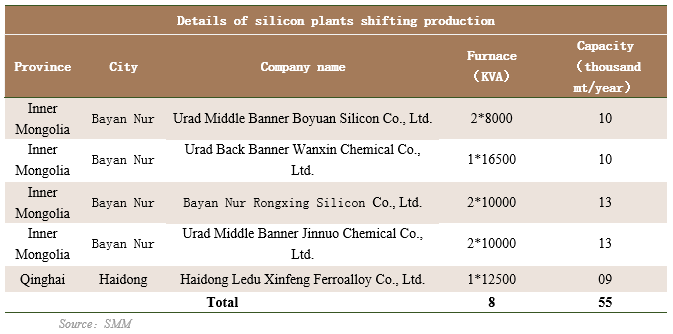
Several silicon producers in Bayan Nur city in Inner Mongolia have switched their production capacity to produce ferrosilicon due to a surge in ferrosilicon price earlier this month.

SHANGHAI, Dec 26 (SMM)- Several silicon producers in Bayan Nur city in Inner Mongolia have switched their production capacity to produce ferrosilicon due to a surge in ferrosilicon price earlier this month.

SMM understood that one producer in Qinghai province has also recently switched to producing ferrosilicon, bringing the number of plants doing so to five.

The plants in Bayan Nur that have switched their capacity account for 13% of Inner Mongolia’s silicon output. Following such shift in output, silicon producing capacity in Bayan Nur stood at about 80,000 mtpy.

Inner Mongolia and Qinghai are the major producing provinces for non-oxygen #553 silicon in North China.

Ferrosilicon prices surged earlier this month due to production cuts in Ningxia province following environmental inspection activities. However, some plants have resumed production and ferrosilicon prices have come back down.

A source at one of the plants that have switched to ferrosilicon production told SMM that his company would look to shift back to silicon production if ferrosilicon prices continued to fall.

SMM believes no more silicon producers would switch capacity to ferrosilicon and that the impact to non-oxygen #553 silicon prices can be ignored.  


For news cooperation, please contact us by email: gaotian@smm.cn or service.en@smm.cn. 
Data Source Statement: Except for publicly available information, all other data are processed by SMM based on publicly available information, market communication, and relying on SMM‘s internal database model. They are for reference only and do not constitute decision-making recommendations.

For any inquiries or to learn more information, please contact: lemonzhao@smm.cn
For more information on how to access our research reports, please contact:service.en@smm.cn
Related News
Baiyin Nonferrous Copper Launches Tender for 1 Ton of Te99.95 Tellurium Ingots, Bidding Starts March 4
21 hours ago
Baiyin Nonferrous Copper Launches Tender for 1 Ton of Te99.95 Tellurium Ingots, Bidding Starts March 4
Read More
Baiyin Nonferrous Copper Launches Tender for 1 Ton of Te99.95 Tellurium Ingots, Bidding Starts March 4
SMM March 3 News: According to official information obtained by SMM, Baiyin Nonferrous Copper Company began a public tender today for 1 ton of tellurium ingots. Official information shows that this batch of tellurium ingots meets the Te99.95 quality standard. The tender base price is set at a discount of 30 yuan/kg. Location of inventory: factory warehouse. Transportation costs shall be borne by the purchaser. The registration deadline is before 5 PM on March 3, 2026, and the bidding will commence at 3 PM on March 4, 2026.
21 hours ago
Baiyin Nonferrous Group Co., Ltd. Copper Tendered 1 mt of Tellurium Ingots [SMM Report]
21 hours ago
Baiyin Nonferrous Group Co., Ltd. Copper Tendered 1 mt of Tellurium Ingots [SMM Report]
Read More
Baiyin Nonferrous Group Co., Ltd. Copper Tendered 1 mt of Tellurium Ingots [SMM Report]
21 hours ago
[SMM Analysis] Titanium Dioxide Prices Rise Post-Holiday, Geopolitical Risks Cloud Export Outlook
22 hours ago
[SMM Analysis] Titanium Dioxide Prices Rise Post-Holiday, Geopolitical Risks Cloud Export Outlook
Read More
[SMM Analysis] Titanium Dioxide Prices Rise Post-Holiday, Geopolitical Risks Cloud Export Outlook
[SMM Analysis] Titanium Dioxide Prices Rise Post-Holiday, Geopolitical Risks Cloud Export Outlook
As of March 3, domestic titanium dioxide prices edged up, driven by post-holiday price hike announcements from both chloride and sulfate producers. The rally is supported by rising sulfuric acid costs, improving demand, and low inventory levels. However, escalating geopolitical tensions have disrupted shipping routes, affecting key export markets including India and the Middle East. Near-term focus remains on downstream restocking and the evolving geopolitical landscape.
22 hours ago