【SMM Insight】Subsidy of New-energy Cars Slumps, Li-battery & Auto Stocks Frustrated

Published: Nov 16, 2017 14:03
Previously, Ganfeng Lithium announced to raise price of metal lithium by 100,000 yuan per tonne.

SHANGHAI, Nov.16 (SMM)-Previously, Ganfeng Lithium announced to raise price of metal lithium by 100,000 yuan per tonne. Concerning this, SMM analyst of cobalt and lithium says this action is mainly caused by two factors. One is one supplier plant has reduced production since August. The other one is rising cost of lithium slat. Currently, SMM price of metal lithium is still rising gradually, which is closed to offer of Ganfeng Lithium.
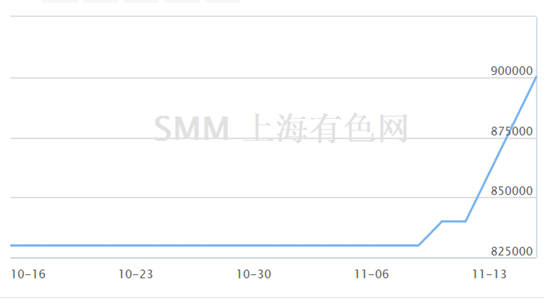
As one of the components of Li-battery, metal lithium has a good fundamentals. But concerning Li-battery concept stocks on Nov.15th, we found frustrated market on that day.

So what’s the reason of this slump of Li-battery stocks?

Market Insides says, this slump is probably related to news that the government is researching on new subsidy policy on new-energy cars, saying to bring forward 20% drop of subsidy from 2019 to 2018.

Probably caused by same news, auto stocks also slumps on Nov.15th. Up to closure, king Long Motors fell staying and FAW Car went down.

Sinolink Securities remarks on this rumor that this maybe the worst situation. Actually it should be better. Even if the rumor is true, the negative effect is far less influential than subsidy drop in 2017. Those companies having good prospect is still to be profitable with buoyant stock price.

Reasons are as follows:

Firstly, in 2017 after the subsidy dropped, the market spent quite a long time coordinating between upstream and downstream plants. It is estimated to have a much higher efficiency for this time.

Secondly, the cost of upstream plants are declining continuously with rigid demand and high price acceptance of downstream clients. Output in 2017 is expected to rise greatly compared with 2017. Gross profit rate of companies will not change a lot.

Thirdly, dropping subsidy is overall a negative news to the industry but it may lead to an intensive assembly of new-energy cars in the fourth quarter. Also, the demand of new-energy coach is expected to improve greatly next year.

Besides, Cui Dongshu, industrial analyst says, national subsidy for new-energy cars during recent years drives output of new-energy cars, especially for coach. Hence participants and capacity of new-energy cars surges greatly but technical progress is not apparent.  In 2018 the core adjustment of subsidy policy is about key indicators as battery energy density and endurance mileage rather than the drop amount of subsidy. The key of new-energy cars is improvement of battery and overall design to realize high-energy-density, long life, high efficiency, low internal resistance and good conformity.

If new subsidy policy can facilitate enterprises to choose better battery and improve technical level as subsidy drops in 2018, this will be the best way to strengthen new-energy cars enterprises. Otherwise domestic new-energy cars will face fierce competition with high-level products of foreign brands.


For news cooperation, please contact us by email: gaotian@smm.cn or service.en@smm.cn. 

Data Source Statement: Except for publicly available information, all other data are processed by SMM based on publicly available information, market communication, and relying on SMM's internal database model. They are for reference only and do not constitute decision-making recommendations.

For any inquiries or for more information, please contact: lemonzhao@smm.cn
For more information on how to access our research reports, please contact:service.en@smm.cn
Related News
[SMM Cobalt Morning Meeting Summary] Raw material costs weaken, demand is sluggish, and the price center continues to shift downward
2 hours ago
[SMM Cobalt Morning Meeting Summary] Raw material costs weaken, demand is sluggish, and the price center continues to shift downward
Read More
[SMM Cobalt Morning Meeting Summary] Raw material costs weaken, demand is sluggish, and the price center continues to shift downward
[SMM Cobalt Morning Meeting Summary] Raw material costs weaken, demand is sluggish, and the price center continues to shift downward
The industry chain remained in the doldrums overall this week, with some products stabilizing briefly, but demand-side improvement was limited. Electrolysis product prices stopped falling and rebounded, driven mainly by a phased increase in purchasing, though sustainability remains to be seen. The intermediate product market stayed in a stalemate, with upstream price-holding and low-price transactions intensifying the standoff; if low-priced supply persists, the price center still faces downside risk. Cost support for salt products continued to weaken, as low-cost recycled materials and low-price selling by some enterprises intensified market competition, while downstream purchase willingness remained cautious, leaving prices clearly under pressure. Co3O4 and cobalt chloride were broadly stable, but with both supply and demand weak and inventory digestion slow, there was little upward momentum in the short term. Cobalt powder quotations continued to edge lower, dragged down by weak demand from the cemented carbide sector. Ternary cathode precursors and ternary cathode materials continued to weaken under the impact of falling nickel and lithium raw material prices and reduced end-user orders, with production schedules also trending downward. LCO's traditional peak season performance fell short of expectations, with weak end-user stockpiling; falling costs and insufficient demand created dual pressure, and the market is expected to consolidate on a weak note in the short term.
2 hours ago
【Flash | Mongolia’s Jan–Jul Molybdenum Output Rises 9.3% YoY】
3 hours ago
【Flash | Mongolia’s Jan–Jul Molybdenum Output Rises 9.3% YoY】
Read More
【Flash | Mongolia’s Jan–Jul Molybdenum Output Rises 9.3% YoY】
Mongolia’s NSO reported molybdenum concentrate output, on a contained-metal basis, of 424.4 tonnes in July 2026, down 1.3% MoM and 17.0% YoY. Jan–Jul output totaled 3,290.5 tonnes, up 9.3% YoY.
3 hours ago
[SMM Chromium Flash] Global Chrome Ore Departures Fall 30.66% WoW to 479,700 mt, Richards Bay and Beira Both Halt
18 hours ago
[SMM Chromium Flash] Global Chrome Ore Departures Fall 30.66% WoW to 479,700 mt, Richards Bay and Beira Both Halt
Read More
[SMM Chromium Flash] Global Chrome Ore Departures Fall 30.66% WoW to 479,700 mt, Richards Bay and Beira Both Halt
[SMM Chromium Flash] Global Chrome Ore Departures Fall 30.66% WoW to 479,700 mt, Richards Bay and Beira Both Halt
Global chrome ore departures from major export ports totaled 479,700 mt in the week ended September 11, down 30.66% week-on-week, according to SMM's latest data. The pullback unwinds a portion of the prior week's surge, with the broad-based recovery seen across Maputo, Richards Bay, Mersin, and Beira proving short-lived. Maputo again absorbed the bulk of activity, with departures easing to 438,700 mt from 512,100 mt, a 14.33% decline that nonetheless lifted the port's share of total departures to roughly 91%, its highest level in the current data series. The port's relative resilience against a steeper market-wide contraction underscores its continued role as the primary anchor of regional chrome ore exports. Mersin departures fell more sharply, down 70.18% to 25,200 mt from 84,500 mt, while Richards Bay and Beira both reverted to zero departures after last week's rebound to 57,800 mt and 29,500 mt, respectively. The renewed halt at Richards Bay and Beira, following just one active week apiece, points to the intermittent, non-continuous nature of loadings at these secondary corridors rather than a sustained recovery in export activity. With Maputo now accounting for the near-totality of major-port volumes, the latest data reflects a reversion to the more concentrated flow pattern observed in the weeks preceding early September's broader pickup.
18 hours ago