Rare Earths MMI: Chinese Production Will Increase Even More

Published: Oct 11, 2016 10:08
Our Rare Earths MMI was flat for a fourth straight month as the market remains oversupplied and stale ever since China lifted quotas on the magnetic and energy storage metals, the end of a long-runnin

by Jeff Yoders on OCTOBER 10, 2016

Our Rare Earths MMI was flat for a fourth straight month as the market remains oversupplied and stale ever since China lifted quotas on the magnetic and energy storage metals, the end of a long-running World Trade Organization dispute.
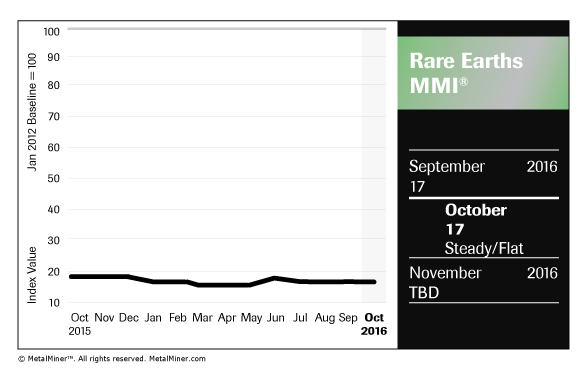
That happened in January 2015 and rare earths have not moved much since. The elements are still highly important for defense, power and green energy applications but prices show no signs of jumping due to Chinese export embargoes or, really, anything else.

This has caused a somewhat dangerous lack of urgency about fixing domestic supply problems as there’s currently no real urgency to create another U.S. supplier likeMolycorpU.S. Rare Earths Inc. looks like the only viable option for the foreseeable future.

This is by design, too, as China is still consolidating its rare earths industry and will likely drive prices even lower during that process.

What Does Consolidation Mean?

A report from BMI Research says the Chinese government will continue to ramp up exports even as it consolidates companies and shuts down some mines. Better management allowing better production at underperforming operations is what Beijing envisions.

Dysprosium and cerium have seen prices fall from $65,865 a metric and $883 per mt, respectively in May 2015, to $37,524 per mt and $685 per mt by September, according to BMI. If you’re not already a member, join MetalMiner membership to see how closely that mirrors or MetalMiner IndX values. See below for those of you in the know.

BMI expects that, in a bid to regain pricing power, the Chinese government will pursue a strategy of consolidating the country’s domestic rare earths sector and increasing exports over the coming quarters. That means even lower prices than what we’ve seen over the last two years.

BMI believes that Australia, Russia, Greenland and the U.S. (U.S. Rare Earths) hold significant rare earths output growth potential over the long term. The analysts from BMI do not expect that these countries will be able to overtake China’s market share any time soon due to the low-price environment.
Data Source Statement: Except for publicly available information, all other data are processed by SMM based on publicly available information, market communication, and relying on SMM‘s internal database model. They are for reference only and do not constitute decision-making recommendations.

For any inquiries or to learn more information, please contact: lemonzhao@smm.cn
For more information on how to access our research reports, please contact:service.en@smm.cn
Related News
Frontier Secures $20 Million and Signs Rare Earth Offtake Agreement
21 hours ago
Frontier Secures $20 Million and Signs Rare Earth Offtake Agreement
Read More
Frontier Secures $20 Million and Signs Rare Earth Offtake Agreement
Luxembourg-based Frontier Rare Earths today announced it successfully obtained a $20 million investment from South Africa's Industrial Development Corporation (IDS) and signed an offtake agreement with France's Carester. The company has now initiated the final feasibility study for its South African magnet-use rare earth and battery-grade manganese project. Frontier Rare Earths is currently advancing the development of the Zandkopsdrift project in South Africa. The project is expected to achieve an annual capacity of approximately 3,038 mt of Pr-Nd oxide, 114 mt of dysprosium oxide, and 25 mt of terbium oxide over the first 25 years.
21 hours ago
US Provides $565 Million in Financing for Brazilian Rare Earth Project
22 hours ago
US Provides $565 Million in Financing for Brazilian Rare Earth Project
Read More
US Provides $565 Million in Financing for Brazilian Rare Earth Project
Serra Verde, a Brazilian rare earth element producer, announced today that the US International Development Finance Corporation (DFC) offered it a financing package worth $565 million, which also includes an option for the US government to acquire a minority stake in the company. Serra Verde’s Pela Ema ionic clay deposit in Brazil is scheduled to begin commercial production in 2024, with an expected annual output of 5,000 mt of total rare earth oxides, including dysprosium, erbium, neodymium, and praseodymium. Serra Verde plans to use the funds to refinance existing loan facilities and expand production capacity. The project aims to increase total rare earth oxide production to 6,500 mt per year by 2027.
22 hours ago
US DFC Offers $565M Financing to Brazilian Rare Earth Project
22 hours ago
US DFC Offers $565M Financing to Brazilian Rare Earth Project
Read More
US DFC Offers $565M Financing to Brazilian Rare Earth Project
[SMM Flash: US Provides $565 Million in Financing for Brazilian Rare Earth Project] Serra Verde (a Brazilian rare earth element producer) announced today that the US International Development Finance Corporation (DFC) has provided it with a financing package worth $565 million, which also includes an option for the US government to acquire a minority stake in the company. Serra Verde's Pela Ema ionic clay deposit in Brazil is scheduled to commence commercial production in 2024, with an expected annual output of 5,000 mt of total rare earth oxides, including elements such as dysprosium, erbium, neodymium, and praseodymium. Serra Verde plans to use the funds to refinance existing loan facilities and expand production capacity. The project aims to increase the annual production of total rare earth oxides to 6,500 mt by 2027.
22 hours ago
Rare Earths MMI: Chinese Production Will Increase Even More - Shanghai Metals Market (SMM)