Rare Earths MMI: Chinese Production Will Increase Even More

Published: Oct 11, 2016 10:08
Our Rare Earths MMI was flat for a fourth straight month as the market remains oversupplied and stale ever since China lifted quotas on the magnetic and energy storage metals, the end of a long-runnin

by Jeff Yoders on OCTOBER 10, 2016

Our Rare Earths MMI was flat for a fourth straight month as the market remains oversupplied and stale ever since China lifted quotas on the magnetic and energy storage metals, the end of a long-running World Trade Organization dispute.
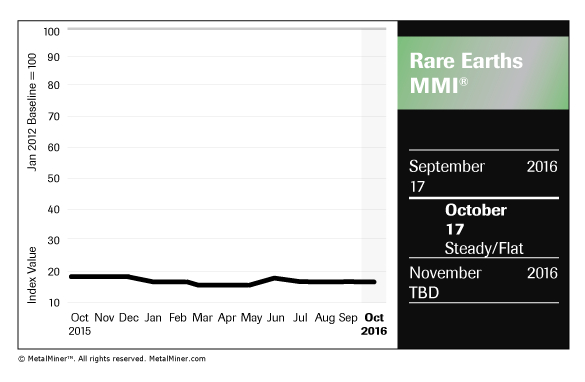
That happened in January 2015 and rare earths have not moved much since. The elements are still highly important for defense, power and green energy applications but prices show no signs of jumping due to Chinese export embargoes or, really, anything else.

This has caused a somewhat dangerous lack of urgency about fixing domestic supply problems as there’s currently no real urgency to create another U.S. supplier likeMolycorpU.S. Rare Earths Inc. looks like the only viable option for the foreseeable future.

This is by design, too, as China is still consolidating its rare earths industry and will likely drive prices even lower during that process.

What Does Consolidation Mean?

A report from BMI Research says the Chinese government will continue to ramp up exports even as it consolidates companies and shuts down some mines. Better management allowing better production at underperforming operations is what Beijing envisions.

Dysprosium and cerium have seen prices fall from $65,865 a metric and $883 per mt, respectively in May 2015, to $37,524 per mt and $685 per mt by September, according to BMI. If you’re not already a member, join MetalMiner membership to see how closely that mirrors or MetalMiner IndX values. See below for those of you in the know.

BMI expects that, in a bid to regain pricing power, the Chinese government will pursue a strategy of consolidating the country’s domestic rare earths sector and increasing exports over the coming quarters. That means even lower prices than what we’ve seen over the last two years.

BMI believes that Australia, Russia, Greenland and the U.S. (U.S. Rare Earths) hold significant rare earths output growth potential over the long term. The analysts from BMI do not expect that these countries will be able to overtake China’s market share any time soon due to the low-price environment.

Data Source Statement: Except for publicly available information, all other data are processed by SMM based on publicly available information, market communication, and relying on SMM's internal database model. They are for reference only and do not constitute decision-making recommendations.

For any inquiries or for more information, please contact: lemonzhao@smm.cn
For more information on how to access our research reports, please contact:service.en@smm.cn
Related News
SMM Rare Earth Afternoon Trading Comment for September 18
15 hours ago
SMM Rare Earth Afternoon Trading Comment for September 18
Read More
SMM Rare Earth Afternoon Trading Comment for September 18
15 hours ago
South American Legislation Reshapes Supply, Europe Accelerates Magnet Delivery and Military-Civil Separation [SMM Rare Earth Overseas Weekly Review]
17 hours ago
South American Legislation Reshapes Supply, Europe Accelerates Magnet Delivery and Military-Civil Separation [SMM Rare Earth Overseas Weekly Review]
Read More
South American Legislation Reshapes Supply, Europe Accelerates Magnet Delivery and Military-Civil Separation [SMM Rare Earth Overseas Weekly Review]
This week, rare earth prices outside China remained generally stable, with terbium oxide and terbium metal both down $12/kg. On the policy front, Argentina and Brazil advanced legislation on national rare earth strategies, strengthening sovereign resource review and local processing requirements. On the industrial front, Neo’s Estonia magnet plant achieved its first commercial shipment of EV traction motor magnets; Saudi Arabia discovered 114 million mt of rare earth-uranium resources; Ucore received additional funding from the US Department of Defense to advance samarium and gadolinium separation. Overall, the ex-China supply chain is accelerating its transition from “resource competition” to a realization phase of “policy rights confirmation + separation scale-up + magnet delivery.”
17 hours ago
Rare earth market prices continue to run in the doldrums, with limited actual transaction volume expansion [SMM Rare Earth Daily Review]
20 hours ago
Rare earth market prices continue to run in the doldrums, with limited actual transaction volume expansion [SMM Rare Earth Daily Review]
Read More
Rare earth market prices continue to run in the doldrums, with limited actual transaction volume expansion [SMM Rare Earth Daily Review]
[SMM Rare Earth Daily Review: Rare earth market prices continue to run in the doldrums, with limited actual transaction volume growth] Overall, the market today showed a divergent pattern of "oxides fully stable, metals alone declining": the Pr-Nd series has seen no changes for two consecutive days, while gadolinium, holmium, erbium, and other previously adjusted varieties have entered consolidation, with only dysprosium-iron alloy and terbium metal continuing to concede on price; the transaction side has yet to recover, with buyers and sellers still locked in a standoff at low levels, and metal producers' price concessions have brought only limited improvement in actual shipments. Downstream players are mainly engaged in price-comparison inquiries and just-in-time procurement, and the actual implementation of pre-holiday stockpiling remains the biggest variable at present.
20 hours ago