

Executive Summary
Indonesia is currently navigating a confluence of climate-driven supply disruptions, the most consequential of which is the El Niño-induced water shortage affecting the Indonesia Morowali Industrial Park (IMIP) and the broader Kalimantan coal corridor. While IMIP's steel producers have absorbed some of the impact, coking coal and coke producers have been hit disproportionately harder, given the water-intensive nature of the coking process.
SMM assesses that El Niño reached peak intensity in August 2026, with the Niño 3.4 index approaching 3.0 — a reading consistent with a "very strong" episode. Rainfall across Kalimantan and the IMIP catchment has remained suppressed at 0–50 mm through September, which has been limiting coking coal production (estimated to have fallen by 30–40 per cent, with some estimates suggesting a shortfall of more than 40 per cent due to a lack of water in the coking process) and river-based logistics, as reflected in the Barito River's water level of 0.6 meters against a normal range of 5.0–11.5 meters.
Given that coking coal accounts for approximately 30% of finished steel product cost under a typical 4:2:1 (iron ore:coking coal:limestone) input ratio, and that domestic coke output has reportedly fallen by around 40% from normal levels, the resulting cost-push pressure — reinforced by a parallel coking coal price rally in China — has driven a sustained repricing of Indonesian HRC. FOB Indonesia HRC has risen from a two-month low of 495 USD/tonne on August 7 to 525 USD/tonne by September 2, before easing modestly to 520 USD/tonne as buyer inventories reach saturation. SMM expects BMKG's projected rainfall normalization from October onward to be the key catalyst determining whether current price levels are sustained or unwind.
I. El Niño Intensity and Trajectory: Niño 3.4 Index Points to an August Peak, with Relief Expected from October
El Niño refers to the periodic warming of sea surface temperatures across the central and eastern equatorial Pacific, driven by a weakening of easterly trade winds and a corresponding eastward shift in the Walker Circulation. This shift suppresses convective cloud formation over the Indonesian archipelago and reduces regional rainfall. The Niño 3.4 index — which tracks sea surface temperature anomalies across approximately 5°N–5°S, 170°W–120°W — is the standard reference metric used to classify episode severity.
Source: BMKG, SMM
Source: BMKG
According to data compiled from Indonesia's Meteorology, Climatology, and Geophysics Agency (BMKG) and SMM, measurable El Niño effects began to register in Indonesia around April 2026, when the index remained within the "weak" classification. The index accelerated sharply thereafter, peaking in August 2026 at a level approaching 3.0 — indicative of a "very strong" event. As of September 2026, conditions remain classified as a significant threat to coal-producing regions, with rainfall around Kalimantan Island and the IMIP catchment still running at just 0–50 mm. Prof. Ir. Teuku Faisal Fathani, Ph.D., Head of BMKG, has indicated that September represents the anticipated peak of the current El Niño episode, with a transition toward more normal rainfall patterns forecast to begin in October as the broader climate pattern shifts.
Source: BMKG
II. Operational Impact at Coal Producers: Production and Logistics Under Simultaneous Strain
Production-side disruption
Dedy Kurniawan, Head of the Media Department at PT IMIP, has confirmed that water availability within the industrial park is now in shortage. Water is a critical input across multiple stages of the IMIP value chain, including coke production and steam-based power generation (PLTU) supporting park operations. Per Kurniawan's guidance, El Niño-related shortages are expected to reduce production by approximately 30–40% relative to normal levels, with some industry sources suggesting the shortfall could exceed 40%—underscoring the outsized role water plays in sustaining throughput.
Logistics-side disruption
The impact extends beyond the factory gate. Reduced river water levels are directly constraining barge and vessel logistics, a dynamic also flagged by Kurniawan. The effect is most acute in Kalimantan, which holds an estimated 69.3% of Indonesia's total coal resources and functions as the primary shipping origin for coal distributed nationwide. Current logistics data point to a 21.4% reduction in cargo carried per trip, as vessels are unable to load to normal capacity given reduced draft clearance. This has already begun to push up logistics costs — and, by extension, coal prices. Separately, the Barito River, a key logistics artery especially for coal, is currently running at a water level of approximately 0.6 meters, against a normal range of 5.0–11.5 meters—a shortfall that materially constrains vessel movement and is expected to place further upward pressure on both freight costs and coal pricing.
III. Coking Coal's Structural Weight in Steel Costs: Why a Water Shortage Becomes a Steel Price Event
To produce finished steel products — long, flat, and tubular products alike — three primary raw material inputs are required: iron ore (the iron-bearing feedstock), coking coal (used as fuel in the ironmaking process), and limestone (used as a flux). These inputs are typically combined in an approximate 4:2:1 ratio, meaning coking coal alone is responsible for roughly 30% of finished steel product cost.
Source: SMM
Critically, coke production is itself highly water-intensive. Water is used at the front end of the process to wash raw coal and remove impurities, and again at the back end, where coke — baked at temperatures around 1,000°C — must be water-quenched before it can be handled and transported. A sustained water shortage therefore constrains coke output directly, independent of any constraint on coal mining itself.
Transportation compounds the exposure. Steel mills, like coke producers, rely on river-based shipping to move raw materials and finished product. Should water levels fall below operable thresholds, Indonesian producers face a risk analogous to the disruption previously experienced at thyssenkrupp's Duisburg plant in Germany, where low Rhine water levels forced manufacturers to curtail production rather than accept extended logistics delays. This dynamic has also contributed to a broadly bullish market sentiment, which has in turn slowed overall trading activity as participants reassess near-term price direction.
Based on current conditions, domestic coke production has fallen by an estimated above 40% relative to normal output. Given coking coal's ~30% weighting in finished steel cost, and citing ICI (Indonesian Coal Index) data showing a 5–8% increase in input costs, Indonesian mills have limited commercial rationale to lower prices — irrespective of broader market sentiment — as doing so would compress margins on an already elevated cost base.
IV. Price Transmission: From Coking Coal Scarcity to HRC Repricing
Market reaction and buyer behavior
As early reports of water shortages circulated, buyers responded by front-loading purchases, driven by resilient local demand and concern that prices would move higher still. This buying pattern gave mills the confidence to raise offers even as the underlying supply constraint continued to build. The move was reinforced when coking coal prices began rising not only domestically but globally — including in China, whose steel pricing continues to function as the reference benchmark across the Southeast Asian region. As Chinese coking coal costs rose, Indonesian mills gained additional confidence to lift domestic offers in parallel.
Logistics response
On the delivery side, mills have extended lead times to as far out as December 2026 — a deliberate strategy to manage the current shortage without resorting to a further round of price increases so soon after the recent run-up. Having already raised prices materially over a two-week window, mills view repeated increases as commercially unsustainable in the near term; deferring delivery to December aligns with BMKG's own guidance that water levels should normalize by that point.
Source: SMM
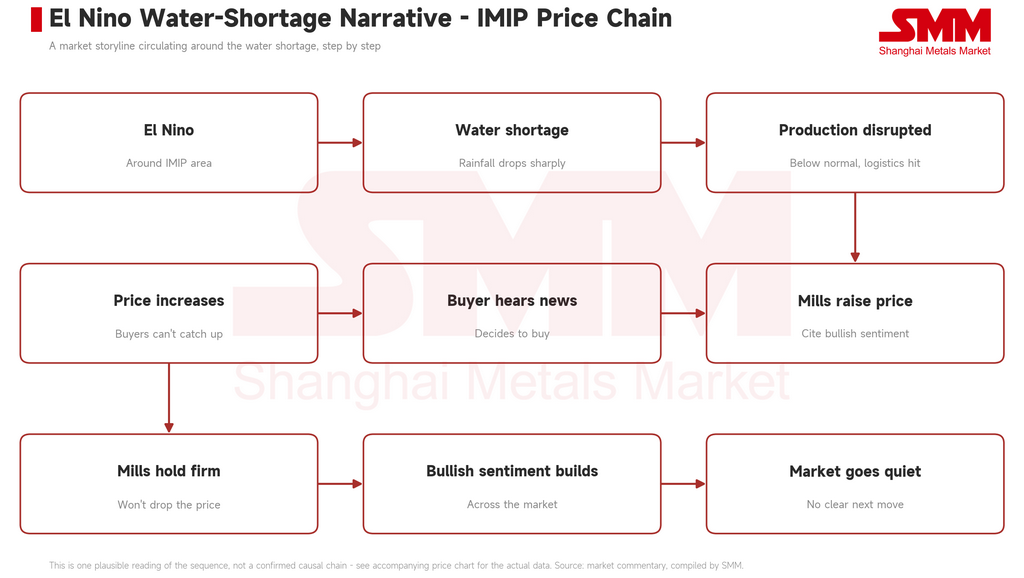
Synthesizing these market developments, the sequence indicates, the sequence indicates a clear, three-stage transmission mechanism: (1) initial price support from water-shortage headlines, (2) acceleration as global — and particularly Chinese — coking coal prices rose in parallel, reinforcing mill confidence, and (3) a stabilization phase as well-stocked buyers step back from the market as buyers exhibit resistance to further price hikes.
V. Outlook: A Standoff Between Mill Margins and Buyer Inventories
SMM's central view is that the water shortage is not the direct cause of the steel price increase, but rather the upstream trigger: constrained water availability curtailed coke and coking coal output, and it is the resulting cost inflation — responsible for an estimated 30% of HRC cost build — that has been passed through into finished steel pricing. This has been compounded by a parallel rise in Chinese coking coal prices stemming from production constraints in China, which has provided Indonesian mills with additional sentiment-based justification to raise offers.
Buyers, for their part, appear to have largely anticipated the move: with inventories now well-stocked following pre-emptive purchasing, there is limited near-term urgency to transact further at current elevated levels. This has produced a bullish but increasingly directionless market, with participants effectively waiting to see which side moves first — mills compressing margins to stimulate demand, or buyers accepting current price levels to secure required volumes. SMM characterizes this as a cascading, or "domino," effect: a discrete climate shock (water scarcity) propagating sequentially through coke production, coking coal cost, mill pricing strategy, and ultimately buyer purchasing behavior
Source: SMM
Key variables to monitor
-
Rainfall normalization timing — BMKG's projected transition from October 2026 is the key catalyst; any delay would extend the current cost-push pressure into Q4.
-
Barito River water levels — a sustained recovery toward the 5.0–11.5 meter normal range is a prerequisite for logistics costs to ease.
-
Chinese coking coal price direction — continued increases would reinforce the sentiment channel supporting Indonesian mill pricing; a reversal would remove a key pillar of current price support.
-
Buyer restocking behavior — the pace at which well-stocked buyers re-enter the market will determine whether current price levels (515–525 USD/tonne FOB) hold or correct.
-
Delivery execution through December — mills' ability to meet deferred delivery commitments will be an important signal of whether the supply-side constraint is easing on schedule.
Data Source Statement: Analysis compiled from BMKG and PT IMIP public statements, SMM market pricing data, and ICI (Indonesian Coal Index) references. Figures are for reference only and do not constitute investment or trading recommendations.
![[국내 철광석 브리핑] 랴오둥 지역 가격 보합세 전망](https://imgqn.smm.cn/usercenter/exdqc20251217171717.jpg)
![[SMM 강판 및 후판 일일 요약] 원가 측면 강세, 수요는 보통, 열연 가격 고점에서 횡보](https://imgqn.smm.cn/usercenter/ocJKj20251217171717.jpg)