SMM June 18 News:
In metals markets:
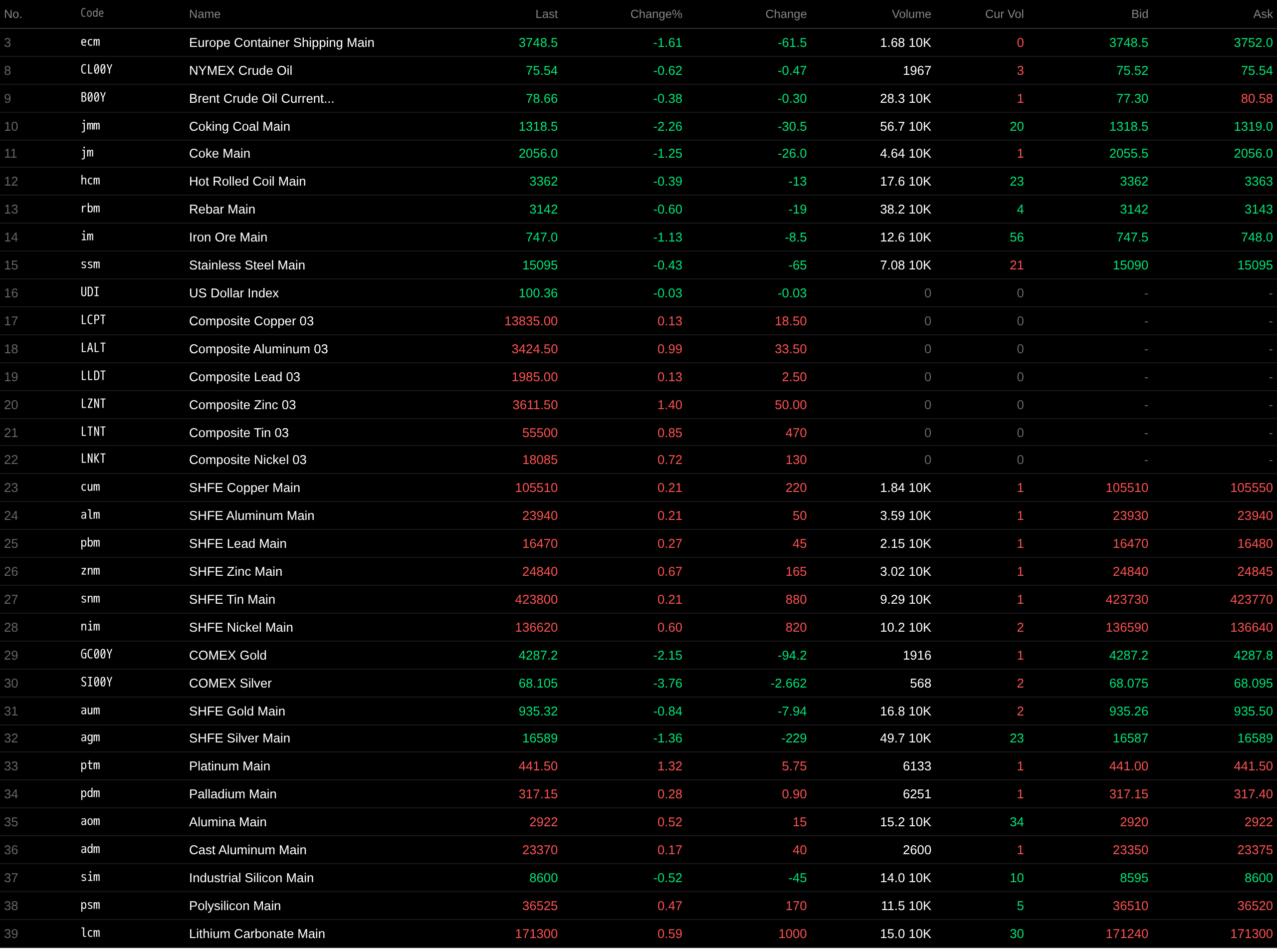
Overnight, base metals on both domestic and overseas markets collectively rose. LME zinc led the gains with a 1.4% increase, LME tin rose 0.85%, LME aluminum gained 0.99%, SHFE zinc climbed 0.67%, and SHFE nickel added 0.6%. All other metals saw small fluctuations. Alumina main contract rose 0.52% and aluminum casting main contract rose 0.17%.
Overnight, the ferrous metals complex generally fell. Iron ore dropped 1.13%, recording a three-day losing streak. HRC, rebar, and stainless steel all fell within 1%. Coking coal and coke both declined, with coking coal down 2.26% and coke down 1.25%.
Overnight in precious metals, COMEX gold fell 1.79% and COMEX silver fell 2.93%. Domestically, SHFE gold fell 0.84% and SHFE silver fell 1.36%.
Overnight closing prices as of 6:43 AM on June 18:
Macro Front
China:
[PBoC: Improve the Short-End Interest Rate Adjustment Mechanism] Pan Gongsheng, Governor of the People's Bank of China, stated that the short-end interest rate adjustment mechanism will be improved. Building on the temporary overnight repo and reverse repo tools established in July 2024, the mechanism for using the tools will be improved, and the operating rates will be adjusted to the 7-day reverse repo rate plus and minus 25 basis points, narrowing the corridor from 70 basis points to 50 basis points. The open market operations toolbox will be further enriched, and overnight reverse repo operation varieties will be added at appropriate times to better match the short-term liquidity needs of the banking system. (CCTV News)
[PBoC Optimizes the Mechanism for Temporary Overnight Repo and Reverse Repo Open Market Operations] To flexibly and efficiently utilize temporary overnight repo and reverse repo open market tools, the People's Bank of China decided to optimize the operational elements effective immediately. The operation time is adjusted to 15:00-15:30 on working days, and the operating rates are adjusted to the 7-day reverse repo rate minus 25bp and plus 25bp, respectively. The rules for using the tools are further clarified. When the money market overnight rate (DR001) is persistently lower or higher than the corresponding tool's operating rate, the People's Bank of China will initiate corresponding operations based on the needs of primary dealers. (People's Bank of China)
[Wu Qing‘s Speech at Lujiazui Forum: Expand the Scope of the Fifth Set of Standards to the AI Field, Support Hong Kong-Listed Companies for Domestic Listing] Wu Qing, Chairman of the China Securities Regulatory Commission, intensively released policy signals at the 2026 Lujiazui Forum on the 17th, covering reforms to the tech listing system, capital market opening-up, guiding long-term capital, and AI regulation, outlining the regulatory layer's policy blueprint for deepening capital market reforms. In his speech, Wu Qing said that the scope of the fifth set of listing standards will be expanded to the artificial intelligence field, actively supporting the listing of high-quality AI large model companies, and supporting qualified Hong Kong-listed companies to list domestically. He also stated that research on promoting RMB foreign exchange futures pilot programs will be accelerated. He further stated that efforts will be made to enhance cross-border regulatory collaboration, support legal and compliant cross-border investment and financing activities, and lawfully crack down on various cross-border illegal activities. Guiding opinions for regulating the development of capital market AI will be released in due course, with strict investigations and punishments for illegal activities such as riding hot topics, hyping concepts, or even market manipulation and insider trading in the name of technology.
US Dollar:
As of the overnight close, the US dollar index rose 0.82% to 100.38. The US Federal Reserve's monetary policy meeting this week stood pat as widely expected. The post-meeting statement emphasized the commitment to price stability by reducing high inflation, and the dot plot reflected a strong hawkish bias among Fed policymakers. On Wednesday, June 17 US Eastern Time, the Federal Reserve announced after its FOMC meeting that it would keep the target range for the federal funds rate unchanged at 3.50% to 3.75%. To date, after cutting rates at three consecutive meetings through last year-end, the FOMC has stood pat at all four monetary policy meetings in 2026. This decision was completely within market expectations.
This was the first FOMC meeting with Warsh as Fed Chairman. Judging from the rate decision, his first major act in the new role was to significantly shorten the statement, including the rate guidance. The new statement emphasized only the inflation side of the dual mandate on employment and inflation. Its assessment of inflation and other economic areas was consistent with the previous one, reiterating that inflation remains high and noting that the Middle East conflict brings high uncertainty to the economy. Compared with the statement, the dot plot released after the meeting reflected an even more pronounced hawkish tilt: half of the Fed officials providing rate forecasts projected at least one rate hike this year. Bloomberg rates strategist Ira Jersey commented that given half of Fed officials foresee hikes, the market focusing on the dot plot makes the bear-flattening of the Treasury yield curve look logical. Nick Timiraos, a veteran Fed correspondent known as the "new Fed wire," described the dot plot as "very hawkish." He pointed out in the article title that the Fed held rates steady, but more officials expect the next move to be a hike. (Wall Street CN)
According to CME "FedWatch": The probability that the Fed keeps rates unchanged in July stands at 64.0% (was 91.0% before the decision). The probability of a cumulative 25-basis-point rate hike is 35.1% (was 8.9%), and the probability of a cumulative 50-basis-point hike is 1% (was 0%). For December, the probability that the Fed holds rates steady is 14.2% (was 38.2%), with the chances for a cumulative 25-basis-point hike at 36.4% (was 43.0%), a 50-basis-point hike at 33.8% (was 16.2%), a 75-basis-point hike at 13.5% (was 2.4%), and a 100-basis-point hike at 2.1% (was 0.1%). (Jin10 Data App)
Data:
Today, China's May Swift RMB share in global payments, the US Federal Reserve's June 17 interest rate decision (upper bound), US initial jobless claims for the week ending June 13, the US Philadelphia Fed Manufacturing Index for June, and the US Conference Board Leading Index month-over-month change for May will be released. Also due are Switzerland's May trade balance and Swiss National Bank policy rate on June 18, the UK's ILO unemployment rate for the three months to April, UK May unemployment rate, UK May claimant count change, and the Bank of England‘s June 18 interest rate decision, as well as the Eurozone’s seasonally adjusted current account for April, among other data.
In addition, China will open a new refined oil product pricing window. The Fed's FOMC will release its interest rate decision and Summary of Economic Projections. Fed Chairman Warsh will hold a monetary policy press conference. The Swiss National Bank and the Bank of England will announce their interest rate decisions, with the BoE also releasing meeting minutes.
Notably, on June 18, there will be no night trading session on the Shanghai Gold Exchange, SHFE, Zhengzhou Commodity Exchange, and DCE in China due to the eve of the Dragon Boat Festival. On June 19, the NYSE will be closed for Juneteenth. On the same day, trading of precious metals, energy, foreign exchange, equity index, and US Treasury futures contracts on the US-based CME will close early at 01:00 Beijing Time on June 20 for Juneteenth. Also due to Juneteenth, trading of Brent crude oil futures contracts on the US-based ICE will close early at 01:30 Beijing Time on June 20.
Crude Oil:
As of the overnight close, both oil benchmarks fell. Brent crude fell 0.38% and WTI crude fell 0.35%. On June 17 local time, senior US officials read out the 14 terms of a US-Iran memorandum of understanding aimed at ending the war and promoting the reopening of the Strait of Hormuz to the media. According to the arrangement, both sides will begin 60 days of further negotiations this Friday (June 19) in Switzerland to reach a final agreement. The US commits that, effective immediately upon the signing of this memorandum and until sanctions are lifted, the US Treasury Department will issue exemption licenses for Iran's exports of crude oil, petroleum products, and derivatives, as well as related supporting services (including banking transactions, insurance, and transportation). (Jin10 Data App)
Amid the chain reaction from easing Middle East tensions, the International Energy Agency (IEA) judged in its monthly oil market report released Wednesday that if a peace arrangement proves sustainable, the global crude market could shift to a clear oversupply next year. The IEA systematically assessed the impact of the end of the Iranian conflict for the first time in this report. The agency analyzed that as oilfields shut down for months due to the conflict gradually resume production, supply from the Gulf region will show a "gradual" recovery trend this year. On this basis, global crude oil production is expected to increase by 8 million barrels per day by next year, reaching a total scale of 110 million barrels per day. In contrast, global demand growth is estimated at about 2 million barrels per day, described as "relatively mild." The IEA noted in the report that this supply-demand mismatch will lead to a "massive surplus," which it suggested "could provide a welcome breathing space for the market and an opportunity to replenish depleted stocks or build new strategic reserves." Currently, oil inventories in OECD countries have fallen to their lowest levels since 1990. (Jin10 Data)
The IEA also noted that oil prices experienced a sharp correction between May and mid-June, driven by market optimism about a peace deal and changes in Asian demand. Reduced crude oil procurement from Asia exerted clear downward pressure on prices. Affected by these combined factors, North Sea crude prices cumulatively fell by more than $40 per barrel during this period to around $82, indicating the market had already priced in expectations of increased supply and slowing demand. (Jin10 Data)
![[ByteDance ramps up procurement of domestic chips, as internet giants race to build computing power moats]](https://imgqn.smm.cn/usercenter/gePcx20251217171735.jpg)
![[Multiple Domestic High-Speed Optical Communication Chips Enter Mass Production; Domestic Optical Fiber Capacity Booked Through 2027]](https://imgqn.smm.cn/usercenter/yhuhG20251217171735.jpg)
![The most-traded SHFE tin contract moved sideways during the night session, while the overall trading atmosphere in the spot market was subdued [SMM tin morning briefing]](https://imgqn.smm.cn/usercenter/tyydv20251217171753.jpg)