Brief Analysis of Production Changes in China's Phosphorus-Based New Energy Materials, 2025

Published: Apr 15, 2026 15:41
Key takeaways: Rapid growth: LFP cathode materials (+60%), iron phosphate (+67%), and LiPF6 (+38%) saw significant production expansion, reflecting strong demand from power batteries and energy storage. New-type materials such as LMFP and composite sodium iron phosphate grew by over 90%, entering the commercialisation phase.

Key takeaways: Rapid growth: LFP cathode materials (+60%), iron phosphate (+67%), and LiPF6 (+38%) saw significant production expansion, reflecting strong demand from power batteries and energy storage. New-type materials such as LMFP and composite sodium iron phosphate grew by over 90%, entering the commercialisation phase. Solid-state battery lag: P₂S₅ production remained stable at 60,000 mt, up only 11.62%, indicating that sulphide solid-state batteries are still in the R&D stage and large-scale industrialisation will take time. The new energy transformation of phosphorus chemicals is accelerating, but volume breakthroughs for next-generation materials are yet to come.
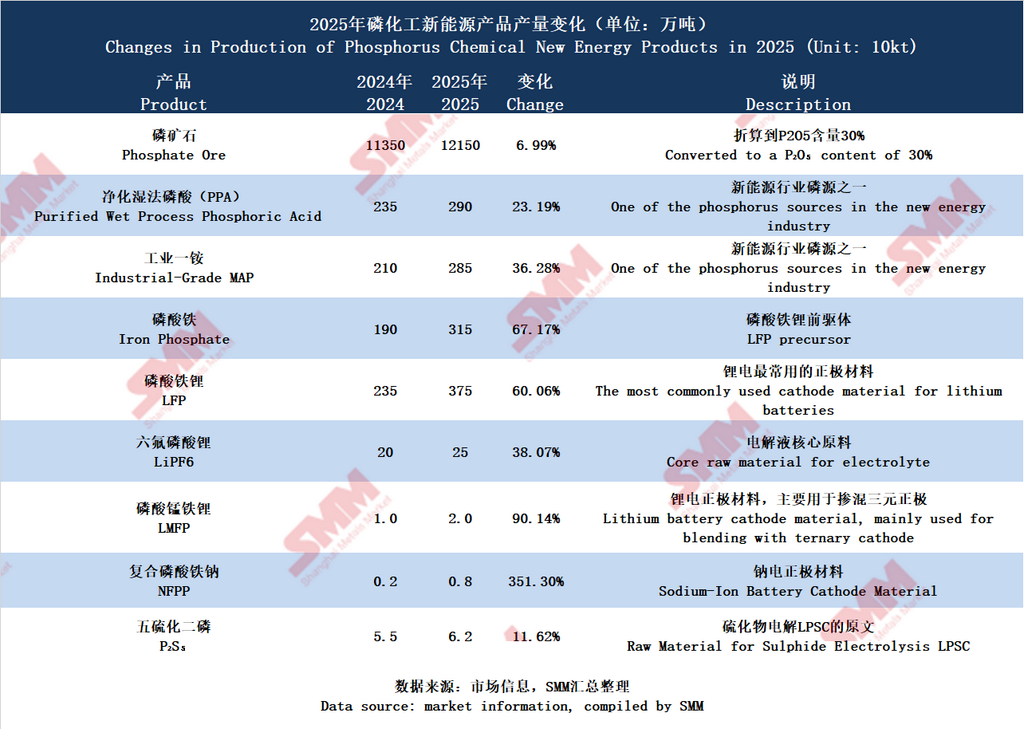
From 2024 to 2025, phosphorus-based chemical products closely linked to the new energy industry generally exhibited rapid growth.

Among them, cathode material and precursor iron phosphate (+67.17%) and LFP (+60.06%) posted the most significant increases, directly reflecting strong demand for LFP cathode materials from the power battery and ESS sectors. Raw materials industrial-grade MAP and purified wet process phosphoric acid grew by 36.28% and 23.19% respectively. As key phosphorus sources for LFP, their growth was broadly in line with the downstream expansion pace. LiPF6 grew by 38.07%, corresponding to the continued expansion of the electrolyte market. Although LMFP and composite sodium iron phosphate had relatively small bases, their growth rates were extremely high (exceeding 90% and 350% respectively), indicating that new-type cathode materials (blended ternary, sodium-ion battery) are entering the commercialisation phase. Solid-state battery side, P₂S₅ production remained stable at around 60,000 mt over the two years, increasing by only 11.62%. As a core raw material for sulphide solid electrolytes (e.g., LPSC), P₂S₅ production did not experience explosive growth, suggesting that sulphide all-solid-state batteries are still in the R&D or pilot-scale stage and have yet to generate large-scale industrialisation demand. Additionally, the growth of P₂S₅ applications in traditional industries was limited. Overall, phosphorus chemicals are accelerating their shift towards the new energy sector, while large-scale volume ramp-up of next-generation battery materials will still take time.

Note: If you have any additions or corrections to the details mentioned in this article, please feel free to contact us at any time. Contact information is as follows:

Tel: 021-20707860 (or add WeChat 13585549799) Yang Chaoxing, thank you!

Data Source Statement: Except for publicly available information, all other data are processed by SMM based on publicly available information, market communication, and relying on SMM's internal database model. They are for reference only and do not constitute decision-making recommendations.

For any inquiries or for more information, please contact: lemonzhao@smm.cn
For more information on how to access our research reports, please contact:service.en@smm.cn
Related News
[Lithium Battery: Times BAIC Battery Factory's First Cell Rolls Off Production Line]
5 hours ago
[Lithium Battery: Times BAIC Battery Factory's First Cell Rolls Off Production Line]
Read More
[Lithium Battery: Times BAIC Battery Factory's First Cell Rolls Off Production Line]
[Lithium Battery: Times BAIC Battery Factory's First Cell Rolls Off Production Line]
Recently, the first cell rolled off the production line at the battery factory of Times BAIC (Beijing) New Energy Technology Co., Ltd., marking the start of the mass production phase. Times BAIC was jointly invested in and constructed by CATL, BAIC Group, Beijing Energy Group, and Xiaomi Group. Currently, construction of the factory is nearing completion, with equipment for the second production line undergoing commissioning. Full-scale production is expected to commence in August. For the entire year of 2026, the factory is projected to produce 7.5 GWh of cells. Once the project reaches full capacity, it will form an annual power battery production capacity of 15 GWh, significantly enhancing the product strength and cost advantages for Beijing-Tianjin-Hebei vehicle manufacturers such as BAIC and Xiaomi.
5 hours ago
[Lithium Battery: Nation's Largest Single-Station Vehicle-To-Grid Flash Charging Demonstration Station Launches]
5 hours ago
[Lithium Battery: Nation's Largest Single-Station Vehicle-To-Grid Flash Charging Demonstration Station Launches]
Read More
[Lithium Battery: Nation's Largest Single-Station Vehicle-To-Grid Flash Charging Demonstration Station Launches]
[Lithium Battery: Nation's Largest Single-Station Vehicle-To-Grid Flash Charging Demonstration Station Launches]
On June 9, the second phase of the China Southern Power Grid Shenzhen Guangming Hongqiao Park Flash Charging Demonstration Station was officially put into operation, with the addition of 14 new V2G (vehicle-to-grid) charging piles. This station has become the largest single-station megawatt-level vehicle-to-grid flash charging demonstration station in the country. The maximum single charge/discharge power capacity of this demonstration station reaches 4.21 megawatts, capable of simultaneously accommodating 61 new energy vehicles for charging and discharging operations. Additionally, it is the first flash charging station under China Southern Power Grid to integrate an electric power inspection drone nest.
5 hours ago
General Motors plans to develop sodium-ion batteries.
6 hours ago
General Motors plans to develop sodium-ion batteries.
Read More
General Motors plans to develop sodium-ion batteries.
On June 9 local time, General Motors and US grid energy storage company Peak Energy announced that they would jointly develop and deploy next-generation sodium-ion battery cells purpose-built for grid energy storage. Under the agreement, General Motors will be responsible for sodium-ion cell R&D at its battery lab in Michigan and retain exclusive manufacturing rights for the cells; Peak Energy will integrate these cells into its proprietary energy storage systems.
6 hours ago