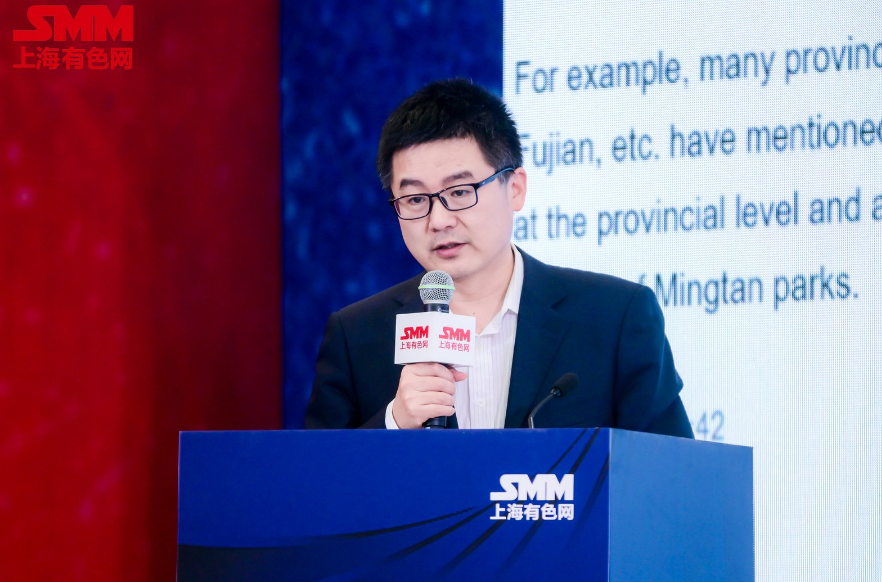
At the CLNB 2025 (10th) New Energy Industry Chain Expo - New Energy PV ESS Forum hosted by SMM Information & Technology Co., Ltd. (SMM), Liu Guohua, Chief Engineer of the EPC Division of the Power Grid Engineering Company of Northwest Electric Power Design Institute Co., Ltd. under China Power Engineering Consulting Group, shared insights on the topic "Zero-Carbon Industrial Parks: The Next Main Battlefield for Energy Storage."
Zero-carbon industrial parks are expected to experience explosive growth.
On December 12, 2024, the concept of "zero-carbon industrial parks" was first mentioned at the Central Economic Work Conference. The conference explicitly stated the establishment of a batch of zero-carbon industrial parks.
On December 13, 2024, Jin Zhuanglong, Party Secretary and Minister of the Ministry of Industry and Information Technology (MIIT), presided over an expanded Party group meeting. The meeting emphasized the need to deeply promote green and low-carbon development in the industrial sector, implement industrial energy-saving and carbon-reduction actions, and build a batch of zero-carbon factories and zero-carbon industrial parks.
From December 26 to 27, 2024, the National Industrial and Information Technology Work Conference was held in Beijing. The conference highlighted the need to intensify efforts in industrial energy-saving and carbon reduction, and to explore the construction of zero-carbon factories and zero-carbon industrial parks.
Green industrial park energy services are essential for achieving the "dual carbon" goals and implementing the high-quality development strategy. China has over 87,000 industrial parks, accounting for more than 30% of the country's total carbon emissions. The core of zero-carbon industrial parks lies in green energy and zero-carbon supply chains, forming a green and low-carbon manufacturing system and green output, which can strongly promote the low-carbon transformation of existing industrial parks.
Many regions have included the construction of zero-carbon industrial parks in their 2025 Government Work Reports. For example, the 2025 Government Work Report of Guangxi Zhuang Autonomous Region stated the need to strengthen energy-saving and carbon-reduction technological transformations in traditional industries, promote pilot projects for coordinated innovation in pollution and carbon reduction, and establish a batch of zero-carbon industrial parks. The 2025 Government Work Report of Yunnan Province emphasized the high-quality construction of zero-carbon industrial parks. The 2025 Government Work Report of Fujian Province pointed out the need to carry out circular transformation of industrial parks at or above the provincial level, explore coordinated innovation paths for cities, parks, and enterprises in pollution and carbon reduction, accelerate the construction of a batch of zero-carbon industrial parks, and support Meizhou Island in striving to become a "near-zero-carbon island" jointly built by the ministry and the province.
Green Factory vs. Zero-Carbon Factory
Definitions and Core Features
1. Green Factory
Definition: A green factory is a manufacturing unit based on the principles of "intensive land use, non-toxic raw materials, clean production, waste recycling, and low-carbon energy," aiming to achieve environmental friendliness and efficient resource utilization through energy-saving, circular economy, and green management measures.
Core Features:
- Adoption of high-efficiency energy-saving equipment (e.g., PV power generation, intelligent control systems);
- Promotion of resource recycling (e.g., wastewater and waste gas recovery);
- Use of environmentally friendly raw materials and establishment of a green management system.
2. Zero-Carbon Factory
Definition: A factory that achieves net-zero greenhouse gas emissions through self-reduction (e.g., energy substitution, process optimization), clean energy application, and carbon offset measures, covering Scope 1 (direct emissions) and Scope 2 (indirect energy emissions), with some enterprises extending to Scope 3 (supply chain emissions).
Core Features:
- High proportion of renewable energy (e.g., PV coverage ≥50%);
- Application of negative carbon technologies such as carbon capture, utilization, and storage (CCUS);
- Offsetting remaining emissions through carbon credits.
3. Differences and Connections
Differences: Green factories focus on comprehensive environmental protection, while zero-carbon factories emphasize precise carbon emission management; the former is evaluated based on national standards (GB/T 36132), while the latter relies on group standards (e.g., T/CECA-G 0171-2022).
Connections: Green factories serve as the foundation for zero-carbon factories, with their energy-saving measures supporting zero-carbon goals; both require ISO 14001 (environmental management) and ISO 50001 (energy management) certifications.
Current Status of Zero-Carbon Industrial Park Standards
Current Status: Local Standards Lead, National Standards on the Horizon
Currently, the construction of zero-carbon industrial parks in China is still dominated by local standards, with no unified national standards yet in place. As of March 2025, there are four local standards (Inner Mongolia, Fujian provincial standards, Xiong'an New Area, and Yancheng city standards) and nearly 30 group standards, covering planning, construction, and evaluation aspects.
Inner Mongolia has taken the lead in building a complete local standard system, releasing the "Zero-Carbon Industrial Park Construction Specification" and "Zero-Carbon Industrial Park Measurement and Evaluation Specification," specifying mandatory indicators such as a renewable energy usage ratio of no less than 80% and carbon emission accounting methods.
Xiong'an New Area, exemplified by the State Grid Energy Internet Innovation Center, has achieved an annual carbon reduction of 6,990 mt through technologies such as ground-source heat pumps, PV power generation, and intelligent control, with remaining carbon emissions offset through green electricity trading.
At the national level, the 2024 Central Economic Work Conference first proposed the establishment of a batch of zero-carbon industrial parks, with multiple departments including MIIT and the National Development and Reform Commission (NDRC) frequently addressing the issue, indicating that national unified standards are expected to be released soon.
Core Standard Framework
Core Standard Framework: Six Essential Systems from Energy Consumption to Management
Based on the "Zero-Carbon Industrial Park Creation and Evaluation Technical Specification" (group standard) and local practices, the standardized construction of zero-carbon industrial parks needs to cover the following dimensions:
1. Energy System: Renewable energy ratio ≥80% (e.g., Inner Mongolia standard), prioritizing PV, wind power, and hydrogen energy, with supporting energy storage and smart microgrids. Waste heat and pressure recovery utilization rate ≥90%.
2. Building System: New buildings must meet green building two-star standards or above, with existing building renovations adopting passive energy-saving technologies (e.g., PV tiles and smart facades in the Boao Demonstration Zone).
3. Transportation System: New energy vehicle ratio ≥50%, charging pile coverage rate 100%.
4. Production System: High-energy-consuming equipment elimination rate ≥30%, promoting "Energy Efficiency Star" technologies.
5. Management System: Establishment of a carbon emission monitoring platform for real-time data tracking (e.g., IoT screens in the Boao Demonstration Zone).
6. Carbon Offset Mechanism: Allowing the offset of remaining emissions through the purchase of green electricity, CCER, and carbon sinks, but prioritizing emission reduction over reliance on offsets.
Typical Cases of Zero-Carbon Industrial Parks
Ordos Zero-Carbon Industrial Park
Achieving the "dual carbon" goals, energy is the main battlefield. From the establishment of the world's first zero-carbon industrial park to the release of the first local standard for zero-carbon industrial parks in China, from resource-driven to innovation-driven, the Ordos Zero-Carbon Industrial Park, jointly developed by Inner Mongolia New Envision Group Co., Ltd. and Ordos Mengsu Economic Park, is setting an example for energy transformation and green manufacturing.
The AESC Ordos Battery Super Factory is the first project in the industrial park, dedicated to producing power batteries and ESS batteries with high energy density, high safety, and long cycle life. Envision Mengxin Group leverages its leading technological advantages and strong industrial driving capabilities to upgrade and extend the industry chain, promoting the transformation of the zero-carbon new industrial system, making the Ordos Zero-Carbon Industrial Park a global model for zero-carbon new industrial bases.
At the 2024 Ordos Zero-Carbon Industrial Conference, the Ordos Zero-Carbon Industrial Park announced its official entry into the 2.0 era. In 2025, the Ordos Zero-Carbon Industrial Park will ultimately form eight innovative demonstrations, including full green power supply, an intelligent IoT energy and carbon management platform, international zero-carbon industrial park standards, and a "wind-solar-hydrogen-storage-vehicle" zero-carbon industry chain cluster, helping the local area achieve approximately 300 billion yuan in green new industrial output, create about 100,000 green high-tech jobs, and achieve an annual carbon dioxide reduction target of approximately 100 million mt.
The local production and consumption of renewable energy attract enterprises to settle, forming an industrial aggregation ecosystem and promoting high-quality local economic development, with the value created far exceeding that of transporting it to other regions.
The Role of Energy Storage in Zero-Carbon Industrial Parks
Coordinating the Power Grid and Battery Energy Storage Systems
In zero-carbon industrial parks, renewable energy is extensively used. However, due to the inherent instability of solar and wind energy, power supply shortages or surpluses may occur. This is where energy storage systems come into play to balance supply and demand levels. Energy storage systems can collect excess electricity from solar and wind energy and supply it to the grid during peak usage times. This not only stabilizes the grid but also maximizes the utilization of renewable energy.
Providing Backup Power for Emergencies
In zero-carbon industrial parks, handling emergencies such as power outages or natural disasters is a hot topic. Without backup power, not only will the production of enterprises within the park be affected, but the normal lives of residents in the park will also be impacted. Therefore, it is essential to reserve a certain amount of power. Energy storage systems can provide backup power to the grid in emergencies to ensure the normal operation of the park.
Promoting Energy Development and Transformation
With the transformation of production methods, economic development and environmental protection have gradually become focal points of attention. To control carbon emissions, reduce energy consumption, promote low-carbon economic development, and alleviate increasingly tense energy issues, governments and enterprises worldwide have begun to vigorously promote energy storage technology. In zero-carbon industrial parks, energy storage, as a low-carbon and green technology, not only solves energy storage problems but also drives the development and transformation of the energy industry.
Applications of Energy Storage in Zero-Carbon Industrial Parks
Three Major Trends in Energy Storage for Zero-Carbon Industrial Parks in 2025
Trend 1:
Integration of energy storage systems, with "PV + energy storage + smart microgrid" integrated solutions accounting for over 60%, and top-tier enterprises such as Huawei and CATL launching customized energy management platforms.
Trend 2:
Diversification of business models. In addition to self-built energy storage, shared energy storage and energy storage leasing models are emerging, reducing initial investment costs for individual parks by over 40%.
Trend 3:
Cross-border integration of technologies, with digital twins and AI prediction algorithms deeply integrated with energy storage systems, achieving dynamic optimization of charge and discharge strategies and improving system efficiency by 20% - 30%.
Follow us for more information
LinkedIn: https://www.linkedin.com/company/98924065/admin/dashboard/
Facebook: https://www.facebook.com/profile.php?id=61572704694550
![[SMM 에너지저장 배터리 셀 시장 주간 리뷰 9.3] 동박 공급 부족으로 9월 생산 일정 제약, 에너지저장 배터리 셀 가격 견조 유지](https://imgqn.smm.cn/usercenter/tKgKv20251217171725.png)
![마그네슘 가격 3거래일 연속 상승! 원가 측면은 여전히 '뜨겁게 타오르는' 반면 수요 측면은 바통을 이어받기 어려워 [SMM 논평]](https://imgqn.smm.cn/usercenter/EutUV20251217171724.jpeg)