At the 2025 SMM Zero Carbon Path - PV and Energy Storage Summit hosted by SMM, SMM energy storage analyst Weijun Li shared insights on the topic "Opportunities and Challenges in the Global Energy Storage Market." He stated that, according to SMM forecasts, from 2025 to 2030, as global energy storage plans are completed, the energy storage market will shift from an incremental market to a stock market. The global energy storage market's growth rate from 2025 to 2030 is expected to be approximately 10%, with global energy storage demand potentially reaching around 477 GWh by 2030.

Global Energy Storage System Demand Forecast
Differences in Energy Transition Needs and Policies Across Countries
From 2024 to 2025, due to policy adjustments, the US global energy storage market's shipment demand is expected to decline, while other markets will maintain high growth rates.
In China, the government's cancellation of the "mandatory energy storage allocation on the generation side" policy has led to a transformation in energy storage market demand, with short-term demand expected to decline.
In the US, multiple tariff hikes have increased the cost of energy storage equipment, undermining project economic viability, and many energy storage projects may be delayed or canceled.
Other regions will continue to maintain high growth rates to accommodate new energy generation and support the power grid.
From 2025 to 2030, as global energy storage plans are completed, the energy storage market will shift from an incremental market to a stock market. SMM forecasts that the global energy storage market's growth rate from 2025 to 2030 will be approximately 10%, with global energy storage demand potentially reaching around 477 GWh by 2030.
From 2025 to 2030, the global energy storage market will transition to a stock phase, with most regions having completed energy storage planning. Policy subsidies will gradually decrease, but the continued decline in PV and battery energy storage system costs will sustain high economic viability, driving growth.
China's power market upgrade has been successfully completed, and demand will continue to maintain high growth. The US market will still have demand for energy storage, and energy storage is expected to maintain high growth rates once policies stabilize.
Impact of Policy Fluctuations on China's Energy Storage Market
China's Energy Storage Battery Demand Forecast (2024–2030)
From 2024 to 2025, SMM forecasts that the cancellation of the "mandatory energy storage on the generation side" policy under Policy No. 136 will lead to energy storage demand being primarily driven by the power market in the short term, with energy storage demand potentially pulling back.
From 2025 to 2028, the penetration rate of energy storage in multiple application scenarios will gradually increase. Combined with the improvement of the new energy power trading market mechanism, China's battery energy storage system demand is expected to achieve an annual growth rate of 8% over the next three years.
Outlook for the Key Period from 2028 to 2030: Driven by the carbon peak target, China's energy storage industry will enter a significant growth cycle, with an average annual compound growth rate expected to reach 11%. With the accelerated large-scale development of PV, cumulative installed capacity is expected to exceed 1,200 GW by 2030, which will simultaneously generate over 80 GW/160 GWh of new-type energy storage demand, opening up a trillion-yuan market space.
Comments and Outlook on China's Energy Storage Market
SMM forecasts that from 2024 to 2025, the annual shipment volume of grid-side energy storage may decline by approximately 15%, while the annual shipment volume of industrial and commercial energy storage may increase by approximately 50%, and household energy storage shipments may increase by approximately 7%.
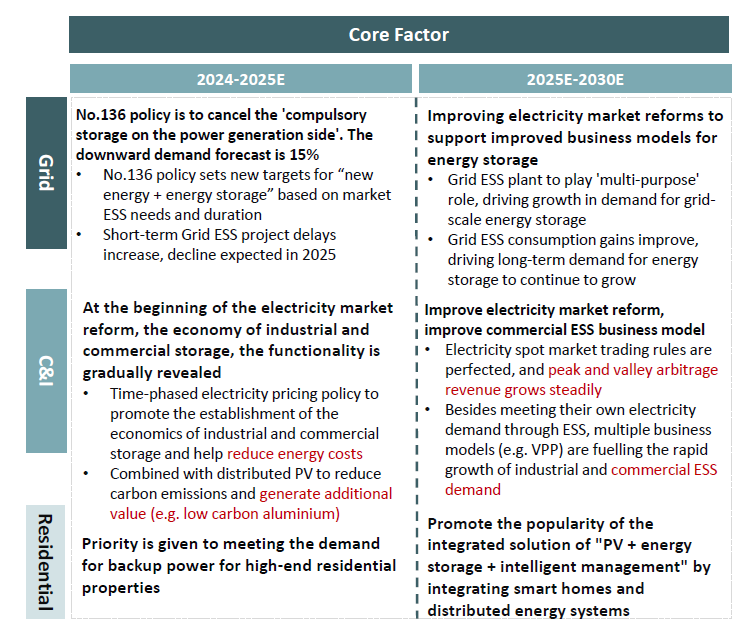
China's grid energy storage demand fluctuates with policy changes.
Policy No. 136 cancels "mandatory energy storage on the generation side."
Each province has formulated policies based on Policy No. 136 and their local conditions. Some provinces continue to implement mandatory energy storage allocation, while others have ceased mandatory energy storage allocation. Most provinces and municipalities are still in the process of policy formulation, and demand remains unclear.
By province:
Yunnan Province: New projects and the requirement to continue implementing mandatory storage allocation policies account for 10%.
Guizhou: Wind and solar projects must allocate at least 10% of installed capacity for energy storage lasting two hours, while delayed grid connection projects may face even higher energy storage allocation ratios (up to 30%).
Inner Mongolia: Power stations in this region are uniformly classified as standalone energy storage power stations. A capacity subsidy of $0.35 per kWh is provided, with a compensation period of up to 10 years.
Industrial and commercial energy storage will become the main source of demand growth in China's energy storage market.
As the peak-valley electricity price spread continues to widen, the economic benefits of industrial and commercial energy storage are becoming increasingly evident. According to the 2024 electricity price adjustment data released by various provinces, the peak-valley electricity price spread has continued to widen in multiple provinces and cities, with 16 provinces and cities already reaching a peak-valley electricity price spread of over 0.7 yuan per kWh.
By 2030, the demand for industrial and commercial energy storage is expected to reach approximately 30 GWh.
Factors Affecting Energy Storage Market Demand in the US
North American Energy Storage Battery Demand Forecast (2024–2030)
From 2024 to 2025, interstate power dispatch difficulties in the US and high pressure on intra-state new energy generation consumption will result in a high proportion of long duration energy storage demand. To maintain its advantage in new energy manufacturing, the US has imposed multiple tariff hikes in the short term, compressing and delaying energy storage demand.
From 2025 to 2028, the IRA and ITC tax credit policies significantly stimulated demand between 2022 and 2025. However, as the market gradually absorbs the policy dividends and the impact of tariff hikes, growth rates are slowing.
From 2028 to 2030, phased energy storage capacity installation targets set by various states, coupled with increased grid upgrade investments, will support larger-scale energy storage integration, with the energy storage market growing at a high rate of 15% during the recovery period.
Review and Outlook of the North American Energy Storage Market (Grid/Industrial and Commercial/Residential)
SMM forecasts that from 2024 to 2028, the growth rate of grid-side energy storage demand in North America may decline by approximately 5%, while the growth rate of industrial and commercial energy storage demand may reach approximately 130%, and residential energy storage may maintain a growth rate of approximately 8%.
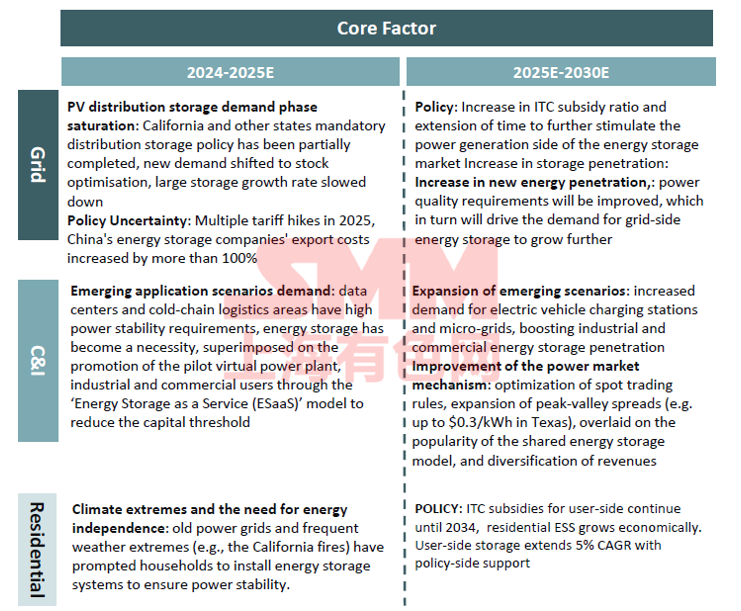
Excessive tariffs will increase investment costs for US owners, reduce profitability for Chinese suppliers, and lead to a decline in US energy storage demand.
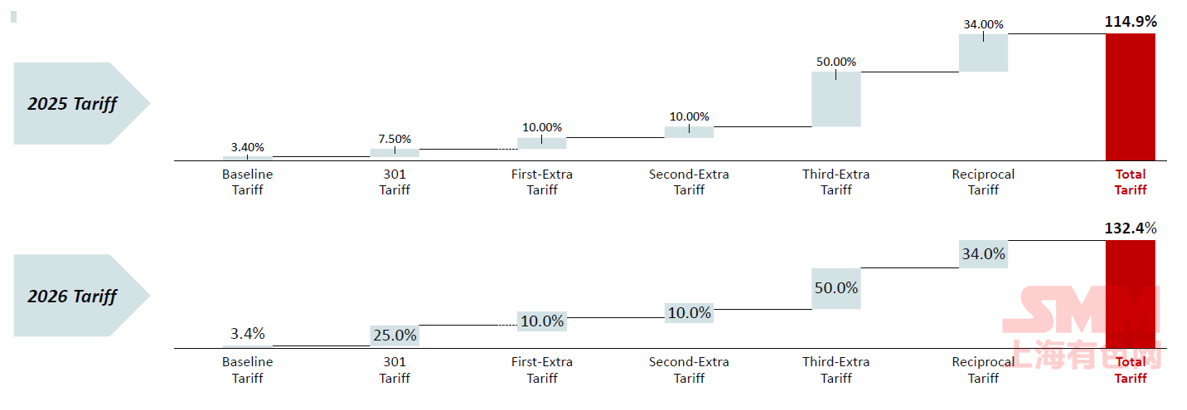
2025 Tariffs:
- In February, the first 10% tariff hike on Chinese products affected the delivery of energy storage batteries and battery energy storage systems, as well as signed orders.
- In March, a second 10% tariff hike on Chinese products brought the cumulative tariff increase to 20%, further impacting the delivery of energy storage batteries and battery energy storage systems, as well as future orders, and slowing overall shipment speeds. It is expected that US owners and Chinese suppliers will each bear half of the additional tariffs, which will become the mainstream scenario.
- In April, reciprocal tariffs (34%) and a third tariff hike (50%) were signed. The tariff increase policy has created extremely high trade barriers for US energy storage imports, severely compressing demand for US battery energy storage systems.
2026 Tariffs:
- The "Section 301" Act is expected to be implemented as planned in early 2026, with Section 301 tariffs increasing to 25% upon implementation.
ITC Subsidy Policy Extended to Promote Residential Energy Storage Demand
The ITC residential subsidy has been extended to 2034, enhancing the economic viability of residential energy storage. User-side energy storage will maintain a stable growth rate.
• Residential Electricity Prices: In recent years, US residential electricity prices have remained high, increasing from 12.55¢ per kWh in 2016 to 15.96¢ per kWh in 2024, a 27.2% increase. High electricity prices have driven demand for residential "PV + energy storage."
• ITC Policy: The ITC subsidy policy increased the subsidy ratio for residential energy storage in 2023 and extended it to 2034. This policy has enhanced the economic benefits of residential energy storage.
• Power Outage Risks: Aging US grid equipment makes power outages highly likely during peak usage periods. When summer temperatures soar, two-thirds of North America faces the risk of energy shortages. Therefore, as the penetration rate of new energy increases, residential energy storage, as a rigid demand, will also increase.
Changes in Energy Storage Market Demand in Europe
European Energy Storage Battery Demand Forecast (2024–2030)
From 2024 to 2025, led by the UK and Italy, the European grid energy storage market is expected to achieve a breakthrough in scale by 2025, with new demand projected to reach 28.5 GWh.
From 2025 to 2028, EU member states will accelerate the phase-out of coal power. Emerging countries such as Belgium and Spain are gradually implementing large-scale grid energy storage projects, enhancing economic benefits through capacity market transactions and ancillary services arbitrage. Energy storage will maintain high growth rates.
From 2028 to 2030, to achieve the goal of renewable energy accounting for 45% by 2030, energy storage has become a core tool for balancing the volatility of wind and solar energy. Additionally, the EU's carbon tariff policy is forcing the industry chain to transition to green practices, requiring enterprises to adapt to carbon footprint accounting standards. Energy storage demand will maintain rapid growth.
Review and Outlook of the European Energy Storage Market (Grid/Industrial and Commercial/Residential)
From 2024 to 2028, the growth rate of grid-side energy storage demand in Europe is expected to reach approximately 29%, while the growth rate of industrial and commercial energy storage demand may reach as high as 100%, and residential energy storage demand may grow by approximately 15%.
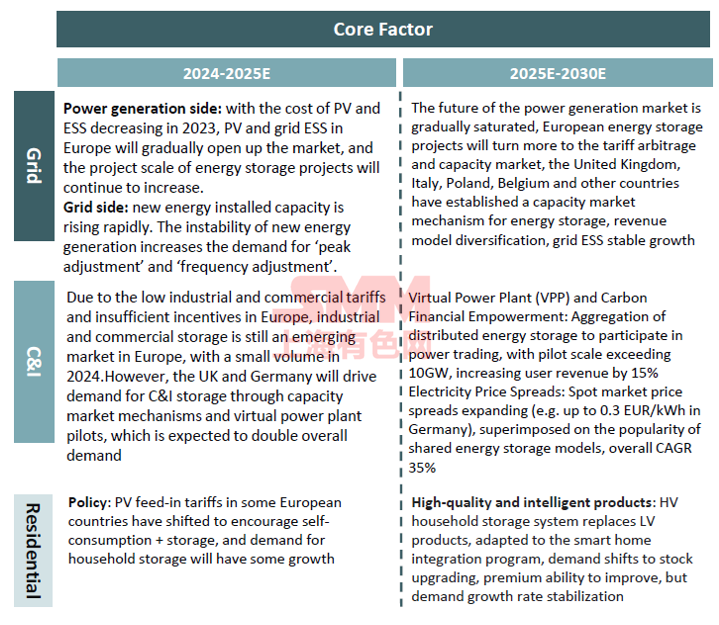
The European grid energy storage system is taking shape, and planning in multiple countries will drive future incremental growth.
According to SMM analysis, energy transition, volatile electricity prices, and policy incentives are driving large-scale grid energy storage in Europe into the fast lane.
Energy Structure: Over the past five years, the proportion of renewable energy in Europe has increased from 20% to 47%. While new energy generation has brought electricity, it has also increased the load on the grid, driving demand for grid energy storage to ensure stable power generation and transmission.
Energy Imports: Benefiting from Europe's new energy policies, the rapid growth of new energy generation and storage has reduced Europe's reliance on energy imports. Compared to 2021, energy imports in 2024 have decreased by 9.2%.
Policy Incentives: Led by the UK, Germany, Spain, and Poland, countries have introduced incentive policies to promote the development of the energy storage industry, including government subsidies, peak compensation, and frequency regulation compensation.
Policy Incentives for Energy Storage Market Demand in the Middle East
Middle Eastern Energy Storage Battery Demand Forecast (2024–2030)
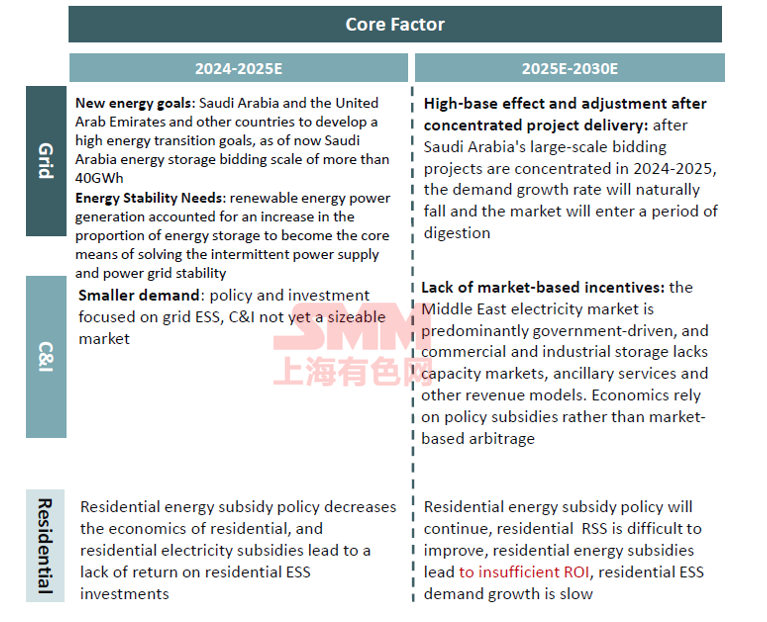
From 2024 to 2025, Saudi Arabia and the UAE have set ambitious energy targets. Combined with weak grid infrastructure, energy storage demand is surging.
From 2025 to 2028, after the concentrated delivery of large-scale grid energy storage projects in Saudi Arabia, demand growth will naturally decline, and the market will enter a digestion phase, with energy storage demand maintaining a compound annual growth rate of 9%.
From 2028 to 2030, new energy storage demand in major Middle Eastern countries will shift to inventory optimization and upgrades. Incremental space will shrink, with grid energy storage installations accounting for over 70%, and the market will approach saturation, relying on small- and medium-sized projects or user-side penetration for growth.
Review and Outlook of the Middle Eastern Energy Storage Market (Grid/Industrial and Commercial/Residential)
SMM forecasts that from 2024 to 2028, the growth rate of grid-side energy storage demand in the Middle East is expected to be approximately 90%, while the growth rates of industrial and commercial energy storage and household energy storage demand may be around 3%.
Click to view the special report on the 2025 SMM Zero Carbon Path - PV and Energy Storage Summit
![[SMM 분석] 코발트 시장 성수기 시작은 더디게: 수요 회복 탄력 못 얻어](https://imgqn.smm.cn/usercenter/olwlF20251217171731.jpg)
![재활용 응용 시장 안정, 탄산리튬 상승 후 하락, LFP 수요가 삼원계 능가 [SMM 주간 리뷰]](https://imgqn.smm.cn/usercenter/GVVKq20251217171728.jpg)
![[SMM 주간 리뷰] 습식제련 재활용 시장 이번 주: 순수 코발트 및 삼원계 블랙매스 시장 부진, LFP 가격 대체로 횡보, 2026.8.31-2026.9.3](https://imgqn.smm.cn/usercenter/fblvS20251217171729.png)