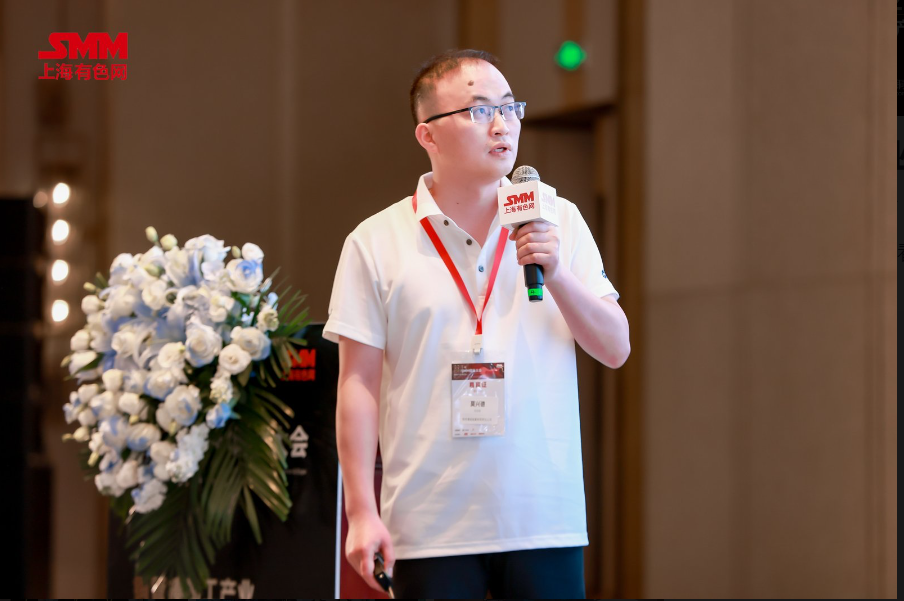
On April 22, at the CCIE 2025 SMM (20th) Copper Industry Conference & Copper Industry Expo - Copper Pipe and Billet Processing Industry Development Forum, hosted by SMM Information & Technology Co., Ltd., SMM Metal Trading Center, and Shandong Aisi Information Technology Co., Ltd., with Jiangxi Copper Corporation and Yingtan Land Port Holdings Co., Ltd. as the main sponsors, Shandong Humon Smelting Co., Ltd. as the special co-organizer, and Xinhuang Group and Zhongtiaoshan Nonferrous Metals Group Co., Ltd. as co-organizers, Mo Xingde, General Manager of Guilin Lijia Metals Co., Ltd., shared his insights on the "Current Status and Improvement Directions of Copper Alloy Tube Production Technology."
Current Status of Copper Alloy Tube Production Technology
1.1 Production and Main Application Areas of Copper Alloy Tubes
Alloy tubes possess characteristics such as high strength, wear resistance, corrosion resistance, good thermal conductivity, and excellent machinability. Copper alloy condenser/heat exchanger tubes, including cupronickel and brass, are applied in fields such as thermal power generation, nuclear power, petrochemicals, shipbuilding, and seawater desalination. Brass tubes are used in plumbing and water supply systems. Alloy tubes are also utilized in new application areas such as decorations, electrical appliances, machinery manufacturing, musical instrument manufacturing, and new energy.
1.2 Main Producers of Copper Alloy Tubes
He introduced the main producers of copper alloy tubes.
1.3 Production Processes of Copper Alloy Tubes
►Melting and Casting Processes
The main melting processes include mains frequency coreless induction melting, coreless induction melting, and vacuum induction furnace melting. The main casting processes include vertical semi-continuous casting, vertical continuous casting, horizontal continuous casting, and upward continuous casting.
The main casting processes include vertical semi-continuous casting, vertical continuous casting, horizontal continuous casting, and upward continuous casting.
►Processing Processes
Production methods include extrusion, planetary rolling, cold rolling, straight bar drawing, and coil drawing.
1.4 Main Production Equipment for Copper Alloy Tubes
Vertical semi-continuous casting units, horizontal extruders, hydraulic drawing machines, and tube rolling mills.
1.5 Main Issues Faced by Copper Alloy Tube Production Technology
1. Long production processes and low production automation levels; 2. Nearly two decades without breakthrough progress in the technological process; 3. Facing substitution by stainless steel tubes and other products.
Improvement Directions for Copper Alloy Tube Production Technology
2.1 Material Innovation and High Performance: With the growth of China's aerospace, electronics, communications, new energy, and high-speed railway industries, coupled with the need for domestic substitution of materials, the demand for copper alloy tubes continues to increase. This also imposes higher and stronger performance requirements on the materials themselves, thereby accelerating material innovation and driving the development towards high strength, high conductivity, high wear resistance, high corrosion resistance, and energy-saving and environmentally friendly directions. Typical materials include copper-chromium-zirconium, dispersion-strengthened copper alloys, copper-nickel-tin, copper-titanium, copper-iron alloys, bismuth brass, and silicon brass.
2.2 Improvement and Enhancement of Short Processes: The "upward continuous casting—cold rolling" and "horizontal continuous casting—planetary rolling" processes without extrusion have their own limitations in alloy tube production. Currently, they are being further improved, refined, and continuously innovated to be applicable to more grades, representing the development direction of copper alloy precision tube production processes.
2.3 Equipment Upgrades:
Equipment advancements have been the main improvement direction for copper alloy tube production technology over the past two decades.
Melting and Casting Equipment: Increasing furnace capacity and melting efficiency, reducing energy consumption, extending furnace lining life, enhancing automatic control levels, developing and applying new-type crystallisers, and achieving continuous and automated casting production.
Processing Equipment: Developing high-speed rolling mills and multi-strand rolling mills, efficient hydraulic drawing machines, multi-strand, high-speed, and automated drawing machines, automated pickling equipment, and automated, high-precision, and intelligent detection equipment.
2.4 Intelligence and Digitalization:
Production Management and Control: Applying intelligent and digital technologies to achieve production process control and optimize production processes.
Intelligent Detection Systems: Utilizing machine vision and ultrasonic flaw detection technologies to achieve automated defect detection and improve product consistency.
In addition, he also introduced the basic information, development history, product characteristics and advantages, product dimensions and production volume, existing production equipment, issues and improvement ideas, as well as the 16000T copper-based new material production line technological transformation project of Guilin Lijia Metals Co., Ltd.
![Copper price rise curbs purchases; North China premiums pull back slightly [SMM North China spot copper]](https://imgqn.smm.cn/usercenter/xKfXl20251217171711.jpg)