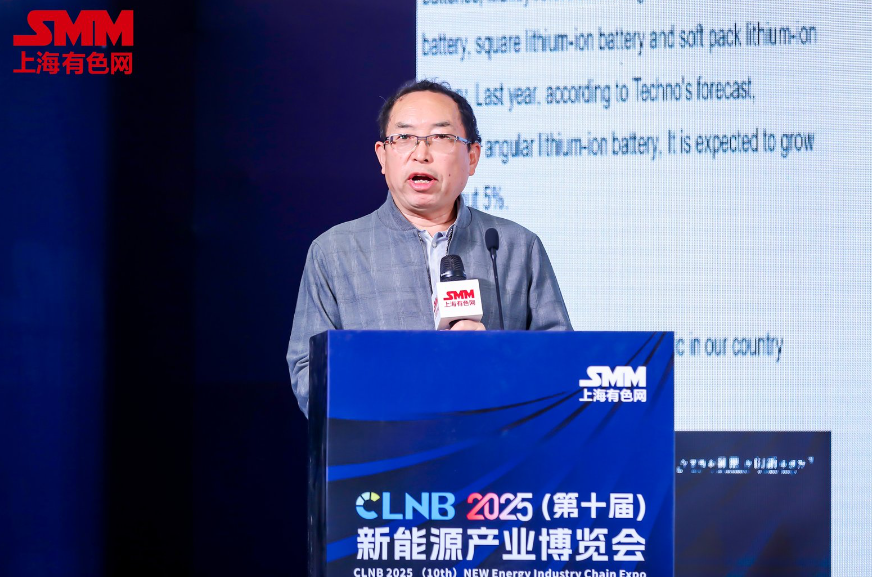
At the CLNB 2025 (10th) New Energy Industry Chain Expo - All-Solid-State Battery Forward-Looking Technology Forum hosted by SMM Information & Technology Co., Ltd., Yanlong Liu, former Secretary General of the China Industrial Association of Power Sources, discussed the current status and trends of China's lithium-ion battery industry development.
He stated that the global demand for lithium-ion batteries will be enormous in the future. New energy vehicles (NEVs) represent the largest application market for lithium-ion batteries, and the demand for lithium-ion batteries in energy storage systems (ESS) is also rapidly expanding.
China holds an absolute competitive advantage in the lithium-ion battery industry chain, but the industry faces intense competition, slowing growth, and low capacity utilization rates. Industry consolidation is ongoing, and enterprises need to achieve cost reduction and efficiency improvement through continuous technological innovation and digital and intelligent upgrades to find opportunities for survival in the fierce competition. To address new global changes, Chinese lithium battery industry chain enterprises are actively expanding overseas by establishing manufacturing bases and accelerating their integration into the global market.
China is the world's largest producer of lithium-ion batteries.
The global lithium-ion battery products are mainly produced by companies from China, Japan, and South Korea. Driven by China's vigorous development of NEV policies, the scale of China's lithium-ion battery industry began to grow rapidly from 2015, surpassing South Korea and Japan to become the global leader, and gradually widening the gap. In 2021, China's total lithium-ion battery production was 324 GWh, accounting for 57% of the global total. In 2022, China's lithium-ion battery production reached 738 GWh, with the global market share increasing to 68.3%. In 2023, China's lithium-ion battery production was 910 GWh, accounting for 71% of the global market. In 2024, China's lithium-ion battery production reached 1,170 GWh, up 28.6% YoY, with the global market share expanding to 76%.
China's Lithium-Ion Battery Market Size in 2024
According to data from the MIIT and analysis and forecasts from industry associations, China's total lithium-ion battery production in 2024 reached 1,170 GWh, up 24% YoY from 940 GWh in 2023. Among this, the production of power lithium-ion batteries from January to December was 823 GWh, up 23.9% YoY from 664.3 GWh in 2023, accounting for 70.3% of the total lithium-ion battery production. The production of small lithium-ion batteries for consumer products was 94 GWh, up 3.3% YoY from 91 GWh in 2023, accounting for 8% of the total production. The production of lithium-ion batteries for ESS was 254 GWh, up 64% YoY from 154.7 GWh in 2023, accounting for 21.7% of the total production. The sales revenue of lithium-ion batteries in 2024 is expected to be 700 billion yuan, down 11.4% YoY from 790 billion yuan in 2023. According to customs data, China's lithium-ion battery export value in 2024 is expected to be 434.874 billion yuan, down 5% YoY from 457.364 billion yuan in 2023 (equivalent to $61.121 billion, down 6% YoY).
Production and Sales of Power and Other Lithium-Ion Batteries in China in 2024
From January to December 2024, the total production of power and other batteries in China reached 1,096.8 GWh, up 41% YoY. From January to December 2024, the total sales of power and other batteries in China amounted to 1,039.5 GWh, up 42.4% YoY. Among them, the sales of power batteries were 791.3 GWh, up 28.4% YoY, accounting for 76.1% of total sales, while the sales of other batteries were 248.2 GWh, up 118.8% YoY, accounting for 23.9% of total sales. From January to December 2024, the total exports of power and other batteries from China reached 197.1 GWh, up 29.2% YoY, accounting for 19% of the sales in the first 12 months. Among them, the exports of power batteries were 133.7 GWh, up 5% YoY, accounting for 67.8% of total exports, while the exports of other batteries were 63.4 GWh, up 151.6% YoY, accounting for 32.2% of total exports.
Top 10 Power Battery Installations in China in 2024
From January to December 2024, a total of 55 power battery enterprises in China's NEV market achieved installations, an increase of 4 compared to the previous year. The total installations reached 548.4 GWh, up 41.5% YoY. Among them, ternary battery installations were 139.0 GWh, accounting for 25.3% of the total installations, up 10.2% YoY, while LFP battery installations were 409.0 GWh, accounting for 74.6% of the total installations, up 56.7% YoY.
The top 3, 5, and 10 power battery enterprises had power battery installations of 417.5 GWh, 461.2 GWh, and 524.1 GWh, respectively, accounting for 76.1%, 84.1%, and 95.6% of the total installations.
In 2024, 6 out of the top 10 global power battery enterprises by installations were from China.
According to data from the South Korean market research firm SNE, the global power battery installations from January to December 2024 totaled 894.4 GWh, up 27.2% YoY. Among them, the total market share of six Chinese enterprises reached 67.1%, an increase of 3.7 percentage points YoY. The combined market share of three South Korean enterprises declined to 18.4%, down 4.7 percentage points YoY, further widening the gap with Chinese enterprises to 48.7 percentage points. The installation growth rate of Panasonic, a Japanese enterprise, dropped by 18%, and its market share fell to 3.9%, ranking sixth.
According to SNE, the main reason for the decrease in Panasonic's vehicle installations was the slowdown in sales due to partial changes in the Tesla Model 3 car model. Samsung SDI's battery usage showed a downward trend, primarily due to reduced demand for batteries from major automakers in Europe and North America. Additionally, the increased installation of LFP batteries by European and American automakers is also one of the reasons for the decline in market share of Japanese and South Korean companies. Three Korean companies are accelerating the construction of LFP battery production lines, aiming to start production by the end of 2025 or early 2026.
2024 Global ESS Battery Shipment Rankings
According to InfoLink's global ESS supply chain database, global ESS battery shipments in 2024 reached 314.7 GWh, up 60% YoY. The industry concentration remained high in 2024, with the top 10 companies accounting for 90.9%. Among the top 10 companies, the first nine were all Chinese companies, with CATL maintaining a clear market leadership and securing the top position in the industry. EVE has consistently ranked second in the industry since Q1 2024. Global utility ESS battery shipments for the full year of 2024 were 283.0 GWh, accounting for 89.9% of the total, up 68.0% YoY. In the utility ESS market, the top 5 companies were CATL, EVE, Hithium, BYD, and CALB. The CR5 in the utility ESS market exceeded 75%, indicating a highly concentrated market with limited growth space for new entrants. Batteries with 300Ah+ accounted for more than half, and top-tier enterprises' 500Ah+ batteries are expected to enter mass production in H2 2025. Global Behind-the-Meter ESS battery shipments for the full year of 2024 were 31.7 GWh, accounting for 10.1% of the total, up 12.4% YoY. In the Behind-the-Meter ESS market, the top 5 companies were EVE, REPT Battero, Ampace, Great Power Energy, and Gotion High-tech. Competition in the Behind-the-Meter ESS industry remains intense, with the CR5 approaching 65%.
Global Production of Small Lithium-Ion Batteries, 2022-2024
Small lithium-ion batteries mainly refer to cylindrical lithium-ion batteries (limited to 18650 and 21700), small prismatic batteries, and small pouch batteries. They are primarily used in mobile phones, laptops, tablets, wearable devices, power banks, power tools, vacuum cleaners, portable ESS, household ESS, electric two-wheelers, and EVs. According to the latest statistics from EV-Tank, the global shipments of cylindrical lithium-ion batteries (including 18,650, 21,700, and various large cylindrical batteries) reached 12.82 billion units in 2024, up 3.6% YoY.
Changes in Demand for Small Lithium-Ion Batteries in Major Markets
Other markets mainly include EVs, ESS, BBU/UPS, and power banks. In Q4 2023, the EV market accounted for 70%, power banks 4.3%, and BBU/UPS 2.7%. According to EVTank, the structure of cylindrical lithium-ion battery shipments changed significantly in 2024. Affected by the decline in Tesla's sales, global EV power cylindrical battery shipments fell 11.0% YoY, while power tool cylindrical battery shipments rose 25.4% YoY, and electric two-wheeler cylindrical battery shipments increased 34.6% YoY.
Shipments of Small Lithium-Ion Batteries by Major Enterprises (Million Units)
According to Techno, in 2023, Japanese companies accounted for 26% of small lithium-ion battery shipments, South Korean companies for 38.9%, and Chinese companies for 35.1%.
According to EVTank, the shipments of cylindrical batteries from companies such as Panasonic and LGES declined significantly in 2024. SDI and Murata were also affected by large-scale customer adoption of Chinese cylindrical batteries, resulting in substantial YoY declines. Against the backdrop of varying degrees of decline in shipments from Japanese and South Korean companies, Chinese companies experienced large-scale growth, with Tenpower ranking first in growth rate with over 100% increase. In the context of "one increase and one decrease" in shipments between Chinese and overseas companies, the market share of Chinese companies in global cylindrical batteries rose to 43.6% in 2024.
Lithium-ion batteries have become the largest category in China's battery export value.
According to statistical analysis of customs export data, over the past nine years, lithium-ion battery products have consistently been the main category of China's battery exports, with their export value accounting for over 50% and showing rapid annual growth. From an export value of $6.84 billion in 2016, accounting for 56.7%, it quickly rose to $61.12 billion in 2024, accounting for 91.3%. In 2024, China's cumulative export value of lithium-ion batteries was $61.12 billion, compared to $65.007 billion in the same period of 2023, down 6% YoY. The cumulative export volume of lithium-ion batteries in 2024 was 3.914 billion units, up 8.1% YoY.
The structure of China's lithium-ion battery export products has undergone changes.
By analyzing the changes in the average unit price of China's lithium-ion battery exports between 2016 and 2024, we can infer the shifts in export products and application markets. In 2016, the lithium-ion battery market was primarily dominated by consumer products. By 2024, in addition to traditional consumer products, the ESS and NEV markets experienced rapid development.
From the differences in the average unit price of products exported to the top ten countries and regions in 2024, we can infer significant variations in the product structure exported to different countries and regions. South Korea, Vietnam, and India mainly imported lower-priced batteries for consumer products, while the US, Germany, the Netherlands, Japan, Australia, and Spain primarily imported mid-to-high-end consumer, NEV, and ESS batteries.
China is the world's largest producer of lithium-ion battery materials.
The production of cathodes, anodes, electrolytes, and separators in China accounts for over 90% of the global share (excluding ternary and LMO in cathodes). China is the most competitive country in the lithium-ion battery industry chain. With the rapid growth in production and sales of new energy vehicles in China and globally, the export scale of lithium-ion batteries and materials from China will continue to grow steadily.
Operation Status of the Lithium-Ion Battery Industry in 2024
The entire industry chain was experiencing severe capacity surplus and oversupply. Top-tier enterprises, leveraging their technological, financial, and scale advantages, dominate the market competition, showing significant profit growth. Second and third-tier enterprises, struggling to survive, sell products below cost, placing them at a disadvantage against top-tier enterprises, compressing their profit margins and resulting in severe losses.
According to the H1 2024 semi-annual reports of 121 publicly listed lithium battery firms, the total operating revenue of the entire lithium battery industry chain was 470.81 billion yuan, down 20.2% YoY. The overall gross margin was 18.9%, a decrease of 2.26 percentage points YoY. Specifically, among the 15 sub-sectors of the lithium battery industry chain, 10 sub-sectors saw operating revenue declines of over 10% in H1. The three fastest-declining sub-sectors were upstream lithium resources (operating revenue down 56.88% YoY), cathode material (down 40.11% YoY), and electrolyte and materials (down 29.82% YoY).
In the frenzy of price wars, there are almost no winners, and even industry leaders may face severe impacts. Considering the 2024 industry trends and changes, the competition and differentiation in the power and ESS battery industry chains will further intensify, and many enterprises may not survive this round of industry reshuffling.
Industry competition intensified, and intellectual property disputes increased.
The lithium battery industry is in a period of cut-throat competition. As intellectual property litigation is an extension of market and technological competition, conflicts over intellectual property among enterprises are inevitable.
In 2019, LG and SKI engaged in a series of disputes over trade secrets and patents in the US and South Korea, which were ultimately resolved with SKI paying LG $1.8 billion and both parties agreeing not to sue each other for ten years.
On October 18, 2023, EVE announced a global settlement with Varta regarding patent litigation for coin cell lithium batteries.
Currently, patent lawsuits between CATL and CALB, as well as between ATL and CosMX Battery, are still ongoing.
In 2024, Tulip in Hungary, as the administrator of patent licensing, aggregated over 5,000 patents from 1,500 global patent families from LG and Panasonic. These patents cover a wide range of materials and processes related to cathodes, anodes, electrolytes, separators, and electrodes, as well as structures and processes related to cells, modules, and packs. Tulip has issued patent licensing demands to several domestic power and consumer lithium-ion battery companies, which should be taken seriously and actively addressed by the domestic industry.
Innovation is an effective way to cope with cut-throat competition.
Under the existing mature technology paths, rapid capacity expansion has led to severe supply surplus, intense homogeneous competition, and significant cost pressure, making it difficult to ensure profits. Therefore, innovation is an effective path to cope with cut-throat competition.
In terms of materials, the cathode includes LFMP and high-nickel ternary materials; the anode is represented by silicon-based anodes, silicon-oxygen anodes, hard carbon anodes, and lithium metal anodes; innovations in electrolytes include ionic liquid electrolytes, polymer electrolytes, and solid polymer electrolytes; in separators, the focus is on developing thinner and higher-strength base films, with coated separators mainly developing ultra-thin, high-heat-resistant coatings.
In terms of batteries, on one hand, existing lithium-ion battery technologies need to be optimized, including increasing single-cell capacity, 46-series large cylindrical cells, long and thin blade batteries, and 4C ultra-fast charging batteries; on the other hand, R&D efforts should focus on half-solid-state batteries, all-solid-state batteries, and sodium-ion batteries.
China's Lithium-Ion Battery Exports Affected by Trade Protection Policies
In 2024, the international competitiveness of China's lithium-ion battery industry continued to strengthen, further expanding its share in the global power and energy storage markets. The US, Europe, and other countries and regions have increased tariffs on lithium-ion batteries and NEVs imported from China.
As of April 9, 2025, the US imposed tariffs of 82.4% on power lithium-ion batteries and 57.4% on energy storage and consumer lithium-ion batteries imported from China (which will increase to 82.4% on January 1, 2026), severely hindering the export of China's lithium-ion battery products.
On October 29, 2024, the EU announced that it would impose a five-year definitive countervailing duty on pure EVs imported from China starting October 31, with a maximum tariff of 35.3%. When combined with the existing 10% tariff, the maximum tariff could reach 45.3%.
Other regions, including Turkey and Canada, have also proposed tariff hikes on NEVs imported from China.
The internationalization of raw materials and core parts has also faced strict regulations. The EU alone has successively enacted the New Battery Act, the Critical Raw Materials Act, and the Net-Zero Industry Act (NZIA), imposing restrictions on battery passports, carbon footprints of EV batteries, battery labels, and markings.
Accelerated Internationalization of China's Power Battery Industry Chain Enterprises
The rapid rise of electrification markets in Europe and the US has driven a significant expansion in overseas demand for power batteries. However, the lack of a true rise in local battery producers has provided Chinese companies with a window of opportunity to seize market share. Since 2021, the capacity construction of Chinese power battery enterprises overseas has entered a substantive promotion phase. In 2022, the pace of product exports, overseas factory construction, or investments by Chinese battery producers significantly accelerated, mostly driven by securing large battery orders from international automakers. To provide local support and avoid high tariffs, many chose to build factories overseas, such as CATL, Gotion High-tech, EVE, AESC, CALB, Sunwoda, Farasis Energy, and SVOLT Energy Technology.
Simultaneously, the large-scale expansion of power battery enterprises has led to a surge in demand for materials and equipment. A group of globally competitive Chinese battery material and equipment enterprises is accelerating their "going global" strategy, establishing factories and layouts worldwide. Examples include Tinci Materials, Capchem, Guotai Huarong, Kedali, Tiannai Technology, BTR, Huayou Cobalt, B&M, Easpring Technology, Ronbay Technology, XTC New Energy Materials (Xiamen), CNGR, Lopal, Enjie, Shenzhen Senior Technology Material, and other lithium battery material enterprises; as well as leading equipment enterprises such as Lead Intelligent Equipment, KATOP, Lyric, Hymson Laser, and UW Laser.
The NEV is the largest market for lithium-ion batteries.
China's NEV production and sales have ranked first in the world for nine consecutive years. In 2024, it continued to lead the global market. By the end of 2024, China accounted for over 70% of the global passenger NEV market, driving the rapid development of China's lithium-ion battery industry. China's share of the global power lithium-ion battery market also exceeded 70%, with the top six companies accounting for 67.1% in the first half of 2024.
The International Energy Agency's "Global EV Outlook 2023" predicts that by 2030, global EV sales will exceed 70 million units, and ownership will reach 380 million units. The global annual new car penetration rate is expected to reach 60%. By then, the total global car sales for that year will reach 117 million units.
According to EV-volumes, global BEV+PHEV sales in 2024 were 17.79 million units, with a power battery installation of 870 GWh. It is projected that by 2030, global BEV+PHEV sales will reach 42 million units, and the demand for power batteries will reach 2,772 GWh.
Lithium-ion batteries dominate the electrochemical energy storage market.
In 2023, China's ESS new installations reached approximately 26.6 GW. Among them, new-type energy storage new installations accounted for about 21.3 GW, which was 3.6 times the new installations of new-type energy storage in 2022, representing approximately 80.3% of the total ESS new installations in 2023. Pumped hydro storage new installations were about 4.9 GW, accounting for 18.3% of the total new installations in 2023. Thermal and cold storage new installations were approximately 0.38 GW, representing 1.4% of the total new installations in 2023. In China's new-type energy storage new installations in 2023, the distribution by technology was as follows: lithium-ion batteries accounted for 97.5%, flywheel storage for 0.7%, lead-acid batteries for 0.4%, and flow batteries for 0.2%.
In 2024, China's new-type energy storage new installations reached 42.46 GW/109.58 GWh, up 131.86% (power) and 163.8% (capacity) YoY. Among them, lithium-ion battery ESS projects accounted for 39.38 GW/91.64 GWh, representing 92.64% of the power, remaining the mainstream technology. Flow battery ESS projects entered the GWh level. Five compressed air energy storage projects were added, with the Yingcheng, Hubei and Feicheng, Shandong projects both at the 300 MW level. Additionally, the Hebei Jiantou ESS liquid air energy storage power station successfully completed grid connection trial operation. The first 100 MWh-level sodium-ion battery ESS project was connected to the grid, and the first 100 MW-level half-solid-state battery ESS project was put into operation. The Changzhi 30 MW flywheel energy storage independent frequency modulation power station was connected to the grid.
Trends in the Lithium-Ion Battery Industry
With the accelerated implementation of China's "carbon peak, carbon neutrality" goals and the enforcement of dual control targets for carbon emissions, there has been an explosive growth in battery demand from various downstream application markets. In this wave of zero-carbon economy, the battery industry not only plays a pioneering role in the carbon neutrality revolution but also faces enormous pressure to reduce carbon emissions. The battery sector will accelerate its transformation towards greener, lower-carbon, and more intelligent directions to meet the new requirements of high-quality economic development in China.
(1) Greening: This refers to the entire industry chain of batteries having attributes of disassembly recycling and sustainable development. Through breakthroughs in green battery technology and the implementation of circular business models, it aims to reduce energy consumption and carbon emissions throughout the product life cycle, achieve effective resource recovery and recycling, and promote the green and sustainable development of the battery industry.
(2) Decarbonization: During the production process of battery products, adjusting the energy structure, improving energy utilization rates, enhancing production efficiency and yield can significantly reduce carbon dioxide emissions, achieving low carbon. The remaining small portion of emissions needs to be addressed through technological innovation or carbon offset technologies to truly reach zero carbon. This requires that all supporting materials for batteries must accelerate their transition to low and zero carbon.
(3) Intelligence: With the rapid development of the new energy automotive industry, the large-scale and high-quality manufacturing of power batteries have become bottlenecks constraining the development of China's lithium battery industry and electric vehicles. The production and manufacturing of lithium power batteries are undergoing a new round of industrial upgrading centered on automation, digitalization, and intelligence. Intelligence is based on intelligent equipment, applying advanced network and information technologies, integrating big data-based intelligent analysis and decision support methods, to achieve automated, digitized, and intelligent management throughout the entire production process of lithium batteries.
Lithium-Ion Battery Market Development Trends
(1) Power Batteries: Low-cobalt and high-nickel materials remain the two primary directions for power battery material development; low-cost, high-safety power batteries will be applied in various scenarios. It is estimated that by 2030, China's power battery annual compound growth rate will be 20%, with production reaching 2,450 GWh.
(2) Small Lithium-Ion Batteries (Including Consumer Batteries and Small Power Batteries): With advancements in 5G, IoT, AI, and other technologies, traditional consumer areas such as mobile phones, laptops, and tablets will continue to increase slightly, while emerging consumer fields like smart wearables, drones, robots, BBU/UPS, as well as power tools and electric two-wheelers, will bring significant growth opportunities for consumer batteries. It is projected that by 2030, small lithium-ion batteries will maintain a 5% annual compound growth rate, with production exceeding 126 GWh.
(3) As the "dual carbon" policy is implemented, along with domestic economic transformation and rapid development of green energy, a more favorable market environment will be created for domestic ESS development, leading to broader prospects for the ESS industry. Additionally, as European and American countries promote green, low-carbon, and environmental protection policies, the demand for ESS batteries will significantly increase. It is forecasted that by 2030, China's ESS battery will maintain an annual compound growth rate of over 30%, with production expected to reach 1,226 GWh.
It is predicted that by 2030, China's total lithium-ion battery production will reach 3,800 GWh.
Fast Charging of Power Batteries Becomes a Development Trend
Currently, with driving ranges reaching 500-600 kilometers and EVs with a 1,000-kilometer range already on the market, solving charging speed issues and developing fast charging technology have become the industry's driving force. Leading battery manufacturers such as CATL and SEVB are increasing their R&D and capacity investments in fast-charging battery products. 3C-6C ultra-fast charging products are gradually entering the market, and automakers like NIO and XPeng have already started using fast-charging batteries and have launched 800V high-voltage fast-charging platforms.
As the penetration rate of NEVs continues to rise, the demand for fast-charging batteries will further increase. Battery companies with fast-charging technology and products will gain significant advantages.
There is a need to accelerate the development and industrialisation of cathodes, anodes, electrolytes, and separators that meet fast-charging requirements.
All-Solid-State Batteries Become the Focus of Future Power Battery R&D
Due to advantages such as high energy density and safety, all-solid-state batteries are considered the core of future rechargeable battery technology. As the core technology of all-solid-state batteries, solid-state electrolytes based on polymers, oxides, sulphides, and halides have garnered widespread attention. Each technical route for all-solid-state batteries has its pros and cons, with sulphide-based all-solid-state batteries being the primary route internationally.
Currently, the all-solid-state battery industry is generally in the R&D and pilot stage. Japan has been working in the all-solid-state battery field for many years, with technological innovation accelerating. The country is mobilising national efforts to promote the commercialisation of all-solid-state batteries, with automakers like Toyota and Honda planning to gradually mass-produce them from 2026-2027. South Korea continues to invest in R&D and has started building all-solid-state battery production lines. In the US, startups are leading the way, collaborating with European automakers to innovate in the all-solid-state battery industry. On February 21, 2025, Mercedes-Benz cars equipped with Factorial Energy's all-solid-state batteries began road tests in the UK.
China's solid-state battery technology routes are diversified, with early deployment of solid-liquid hybrid batteries and a complete industry chain. Companies are gradually equipping vehicles with these batteries. Technical solutions include using solid-state electrolytes as electrode additives or coating cathodes, applying solid-state electrolytes to separators, and in-situ polymerisation/curing.
China's all-solid-state battery industrialisation pace accelerated in 2024: the government invested 6 billion yuan to support six companies, including CATL, BYD, and WELION New Energy, in accelerating all-solid-state battery development. Prototype vehicle testing is expected to be completed by 2026, and 1,000 vehicles are planned to be equipped and on the road by 2027.
Sodium-Ion Batteries Show Potential in NEV and ESS Sectors
Facing a vast ESS market, sodium-ion batteries, with their low cost, long lifespan, and high safety, are expected to rapidly develop as a beneficial complement to lithium-ion batteries in various fields such as low-speed EVs, electric boats, data centers, communication base stations, home/industrial ESS, large-scale renewable energy integration, and smart grids, enhancing China's competitiveness and influence in ESS technology.
China is internationally leading in sodium-ion battery R&D, with fully independent intellectual property rights in core material systems, and some patents have been authorised in the US, Japan, and the EU. In addition to R&D of key materials, related companies are steadily advancing the scale-up preparation and production of key materials, battery cell design and development, and modular integration and management, driving the commercialisation process of sodium-ion batteries.
Currently, sodium-ion battery technology is still developing. An integrated approach across the entire industry chain is needed, focusing on cost, low-temperature performance, safety, and C-rate performance to develop niche markets.
Conclusion
In the future, there will be a huge global demand for lithium-ion batteries. NEVs represent the largest application market for lithium-ion batteries, and the demand for lithium-ion batteries in ESS is also rapidly expanding.
China holds an absolute competitive advantage in the lithium-ion battery industry chain. However, the industry faces intense competition, slowing growth, and low capacity utilization rates. Industry consolidation is ongoing, and companies must achieve cost reduction and efficiency improvement through continuous technological innovation and digital and intelligent upgrades to find opportunities for survival in the fierce competition.
To address new changes in globalization, Chinese lithium battery industry chain companies are actively expanding overseas by establishing manufacturing bases, accelerating their integration into the global market.
![[SMM 분석] 두 달 만에 두 번째 중단: 시그마 리튬, 허가 다시 보류되며 증설 차질](https://imgqn.smm.cn/usercenter/ipFFo20251217171725.jpg)
![[Lake Resources의 Kachi 프로젝트, 환경 승인 획득]](https://imgqn.smm.cn/usercenter/HySQT20251217171731.png)
![[차이나 유니언 홀딩스: 캐나다 FIRES, 리튬 염수 투자 추가 심사 예정]](https://imgqn.smm.cn/usercenter/jZvMC20251217171729.jpg)