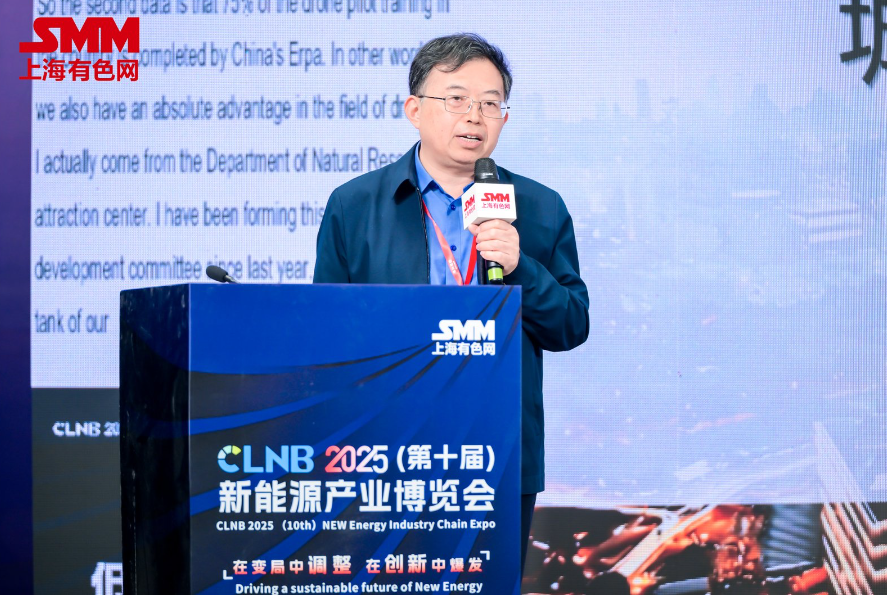
At the CLNB 2025 (10th) New Energy Industry Chain Expo - Low-Altitude Economy Forum hosted by SMM Information & Technology Co., Ltd. (SMM), Chen Congxi, Director of the Low-Altitude Economy Committee and Researcher at the Aircraft Owners and Pilots Association of China, introduced the topic of "Solutions for the Development of Urban Low-Altitude Economy."
Current Development Status of Low-Altitude Economy at Home and Abroad
Development Status of Low-Altitude Economy Abroad
The global low-altitude economy market is currently in its early stages of cultivation. With the increasing maturity of related technologies, the gradual advancement of standardized regulatory measures, and the continuous emergence of mature application scenarios, its future prospects are highly promising.
It is predicted that the market size is expected to reach RMB 4 trillion in the next five years. (Data source: Qianzhan Industry Research Institute)
Domestic Low-Altitude Economy Policies
Domestic Low-Altitude Economy Policies - Anhui
"Implementation Plan and Several Measures for Accelerating the Cultivation and Development of the Low-Altitude Economy in Anhui Province (2024-2027)" (April 2024, Provincial Development and Reform Commission)
[Development Goals]
By 2025, the construction of low-altitude infrastructure will be accelerated, and a batch of application demonstration scenarios will be established.
By 2027, low-altitude infrastructure will be further improved, application scenarios will continue to expand, and the scale and innovation capabilities of the low-altitude economy will reach a leading level nationwide. Hefei and Wuhu will be built into two core cities for the low-altitude economy, leveraging the supporting advantages of low-altitude manufacturing industries in cities such as Lu'an, Chuzhou, and Ma'anshan, and highlighting the characteristics of low-altitude service industries in cities such as Anqing and Xuancheng.
[Development Tasks]
1. Coordinate and jointly build intelligent and interconnected low-altitude infrastructure.
2. Enhance the leading role of low-altitude scientific and technological innovation.
3. Promote the clustered development of the low-altitude manufacturing industry.
4. Drive the development of low-altitude service industries through application-oriented approaches.
5. Improve the level of low-altitude flight support.
6. Foster an ecosystem for the development of the low-altitude economy.
Discussion on Current Issues in the Development of the Domestic Low-Altitude Economy
Analysis and Discussion of Existing Issues:
1. Inadequate policy and regulatory framework
It has not yet been elevated to the legal level, with most existing measures being regulations, ordinances, and policies; it has not been included in national territorial spatial planning.
2. Unclear management functions and law enforcement powers for different types and levels of airspace, with many operational restrictions and unclear ownership issues in airspace management
For example, airspace from 0-300 meters is under the jurisdiction of local governments, but the specific law enforcement department responsible for regulatory functions has not been clarified.
3. Lack of tailored top-level design for local regional development, with a lack of industrial uniqueness and novelty, and severe homogenization
4. Insufficient and uneven construction of low-altitude infrastructure, lacking coordinated planning
5. Technological bottlenecks, insufficient innovation, and a large talent gap
According to estimates by the Ministry of Human Resources and Social Security, there is currently a shortage of over 1 million drone pilots. Drone R&D and manufacturing enterprises are unevenly distributed, with a small number and few patents.
6. Insufficient market demand and limited application scenarios
Currently, the application scenarios of the low-altitude economy are mainly concentrated in areas such as drone logistics and aerial sightseeing, and have not yet formed large-scale and diversified market demand. Business models are still in the exploratory stage.
Analysis of Pathways for Urban Development of the Low-Altitude Economy
The development of the urban low-altitude economy should follow a "six-step strategy."Step-1: Prioritize top-level design and development planning
Step-2: Conduct airspace survey and capacity assessment simultaneously
Based on the distribution of military and civil aviation airports, airspace, flight routes, and obstacles surrounding local cities and counties, systematically sort out the airspace usage requirements for different types of flight activities to accurately reflect the regional air traffic airspace environment.
Coordinate terrain, landforms, airports, airspace, and other limiting factors, and use spatial grid technology to design and plan an optimized airspace structure scheme through shared use, staggered peak usage, and layered utilization.
Clarify which airspace ranges and altitude layers are suitable for developing which low-altitude industries, and carry out targeted urban development and three-dimensional transportation layout planning, as well as targeted investment attraction for low-altitude industries.
The airspace survey and capacity assessment work serve as the foundation and top-level guidance for development.
Implementation path: Professional teams with military and civil aviation qualifications and experience can be entrusted to conduct the airspace survey and capacity assessment work in advance to gain a clear understanding of airspace resources.
Step-3: Low-altitude infrastructure construction
Implementation path:
Led by local state-owned enterprises, multiple social forces will collaborate in the construction and governance, exploring a new-type digital and information-based BOT (Build-Operate-Transfer) model.
1. Based on the scientific data from the airspace resource survey, further plan the layout of airport runways, takeoff and landing points, temporary takeoff and landing points, UAV takeoff and landing points, parking positions, flight camps, etc.;
Urban three-dimensional transportation connectivity.
2. New low-altitude digital infrastructure
Information infrastructure: communication, navigation, surveillance, meteorological monitoring, etc.;
Low-altitude flight operation centers/flight service stations, etc.
Step-4: Low-altitude navigation service support
Implementation path:
Professional support will be provided by technical service teams with industry qualifications and experience.
Step-5: Investment attraction and aggregation of low-altitude industries
Based on the aforementioned low-altitude airspace planning and navigation service support, determine the low-altitude industries suitable for development in the region, and simultaneously attract investment in the upstream, midstream, and downstream sectors to form industrial scale;
New, renovated, or expanded low-altitude economic industrial parks with different themes or fields can be established to form a regional industrial aggregation effect, thereby promoting local GDP growth.Step-6: Vigorously cultivate regional low-altitude consumption
Typical low-altitude consumption scenarios: urban aerial sightseeing, aerial photography, development and utilization of cultural tourism in scenic spots, low-altitude UAV delivery, and low-altitude rural revitalization.
Notes: Principles for the development of the urban low-altitude economy
Follow Us For More Information
LinkedIn: https://www.linkedin.com/company/98924065/admin/dashboard/
Facebook: https://www.facebook.com/profile.php?id=61572704694550
![[SMM 에너지저장 배터리 셀 시장 주간 리뷰 9.3] 동박 공급 부족으로 9월 생산 일정 제약, 에너지저장 배터리 셀 가격 견조 유지](https://imgqn.smm.cn/usercenter/tKgKv20251217171725.png)
![마그네슘 가격 3거래일 연속 상승! 원가 측면은 여전히 '뜨겁게 타오르는' 반면 수요 측면은 바통을 이어받기 어려워 [SMM 논평]](https://imgqn.smm.cn/usercenter/EutUV20251217171724.jpeg)