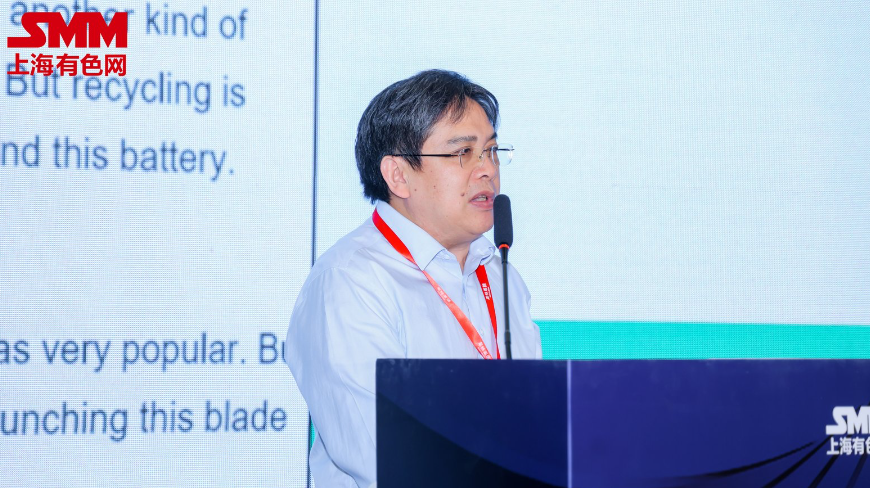
At the Lithium Battery Recycling Forum of the CLNB 2025 (10th) New Energy Industry Chain Expo hosted by SMM Information & Technology Co., Ltd. (SMM), Ai Wuyun, the founder and chairman of Shenzhen Xinmao New Energy Technology Co., Ltd., shared insights on the topic of "Progress in Cathode and Anode Material Restoration and Recycling."
Purpose and Significance of Lithium Battery Recycling
Recycling Purpose:
Efficient Resource Utilization: Reduce reliance on primary ore sources and alleviate resource shortage pressures;
Reduce Environmental Pollution: Minimize environmental pollution risks;
Cost Reduction: Address the industry's need for cost reduction;
Technological Breakthroughs: Solve issues of low recycling rates and performance degradation;
Recycling Significance:
Promote the circular economy; Support the sustainable development of the new energy industry; Foster the growth of emerging industries; Enhance strategic resource security; Save energy and reduce carbon emissions; Fulfill international responsibilities; Enable high-value utilization.
LFP Batteries to Account for Over 80% in the Future
Rapid Growth of NEV Battery Installations in China
Build a clean, low-carbon, safe, and efficient energy system; In 2024, the penetration rate of NEVs in China reached 40%, accounting for 70.5% of the global market.
Continuous Improvement in LFP Batteries
Since 2021, LFP has gradually taken the lead; In 2024, it accounted for over 70% (reaching 74.6%), with further growth expected in the future.
Future Battery Waste Recycling to Focus on LFP
According to media data, LFP accounted for 61.2% of the recycling volume in 2024.
It is projected that by 2029, the recycling volume of LFP may reach 2.531 million mt, that of ternary batteries may reach 1.0404 million mt, and that of LCO may reach 75,400 mt.
The recycling volume of LFP is expected to grow significantly in the future, while that of LCO is expected to remain basically flat.
Recycling and Utilization Routes for Waste LFP Batteries
The core competitiveness of recycling technology lies in cost control during the recycling process, primarily focusing on yield, performance, quality, carbon reduction, energy conservation, and environmental friendliness.
Advantages of Physical Restoration
Current Status: Hydrometallurgy is the primary method (accounting for over 99%), with restoration serving as supplementary approaches.
Future Projection: Restoration will become the primary method, with hydrometallurgy serving as a supplementary approach; The recovery rates of various components in waste batteries will gradually approach theoretical values.
Progress in LFP Recycling
Secondary LFP - Product Iteration
Improvement Measures
Technological Innovation: Enhance product performance
Improve Raw Material Screening: Implement multiple screenings of raw materials, increase automated identification, and reduce the risk of foreign matter contamination;
Optimize Production Processes: Establish roasting process windows, define reaction atmospheres and partial pressures, and minimize process interruptions;
Develop Demagnetization Equipment: Develop demagnetization equipment suitable for the recycling of waste LFP materials to remove magnetic substances from powders;
Further Environmental Optimization: Remove magnetic substances and dust from the environment.
Secondary LFP - Improvement in Magnetic Substances
The magnetic substances have decreased and remained relatively stable after improvement.
a. The average value decreased by 56% after improvement.
b. Sigma (σ) decreased by 40%.
Secondary LFP - Improvement in Magnetic Metal Particles
The magnetic particles in the improved products have decreased significantly: After improvement, magnetic particles decreased by 46.67%, with all values ≤50Pcs/kg.
Secondary LFP - Improvement in Impurity Elements (Ni, Mn, Co, Cu, Al)
Secondary LFP - Battery K-value Before and After Improvement
The battery K-value has decreased significantly, further enhancing product quality. After dismantling pouch batteries, no abnormalities were found in the separators.
Progress in Graphite Recycling
Technological Innovation
The complex composition of impurities makes graphite purification a significant challenge.
Xinmao has designed box-type furnaces and internal series furnaces, increasing the furnace loading capacity by more than three times compared to traditional high-temperature furnaces. This significantly improves consistency, reduces costs, and lowers carbon emissions.
The purity of secondary graphite after purification reaches 99.95%, significantly enhancing its industrial application value.
Recycling and Utilization of Anode Graphite
Currently, top-tier enterprises B and C in the lithium-ion battery market account for over 70% of the total market share, indicating a high market concentration. Both B and C use artificial graphite for their anode materials. Xinmao sources pole pieces for recycling from these top-tier enterprises (B and C).
Secondary Graphite Products
Application Scenarios and Future Plans
The application scenarios for restored materials continue to expand.
Communication energy storage, small power, home energy storage, industrial and commercial energy storage, and automobiles.
Future Plans
1. Follow large battery manufacturers and automakers to go global and provide supporting services; 2. Restore and recycle end-of-life batteries; 3. Apply LFP and graphite in automobiles;
Recycling is a critical link in achieving a closed-loop cycle in the lithium battery industry chain; Xinmao is committed to green recycling.
Follow us for more information
LinkedIn: https://www.linkedin.com/company/98924065/admin/dashboard/
Facebook: https://www.facebook.com/profile.php?id=61572704694550

![8월 배터리급 황화리튬 생산 분석: 4분기에 급증할까? [SMM 분석]](https://imgqn.smm.cn/usercenter/mpqgn20251217171727.jpg)