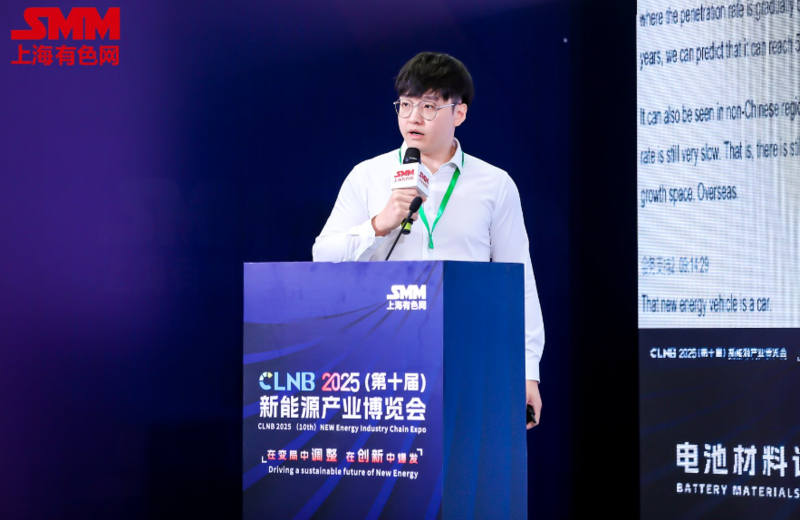
At the CLNB 2025 (10th) New Energy Industry Chain Expo - Battery Materials Forum hosted by SMM Information & Technology Co., Ltd., Chen Bolin, cathode material analyst of Shanghai Metals Market, shared insights on the topic "2025 China LFP Cathode Material Industry Trends and Supply-Demand Pattern Changes."
He stated that SMM expects LFP battery cell production to exceed 1,100 GWh in 2025, far surpassing ternary battery cell production. Globally, the market share of LFP battery cells reached 60% in 2024 and is expected to increase to around 63% in 2025. In the Chinese market, the market share of LFP battery cells was around 71% in 2024 and is projected to rise to approximately 74% in 2025.
Global Lithium Battery Demand Steadily Growing
Benefiting from the global implementation of the "dual carbon" policy, the NEV market, after a period of rapid growth, will continue to maintain stable growth, albeit at a slower pace compared to previous years. China will remain the dominant market player in the long term, with penetration rates gradually increasing.
SMM expects global NEV sales to reach around 21 million units in 2025, a 20% YoY increase from 2024, with NEV penetration expected to reach around 54%, and future penetration rates will continue to rise.
From 2025 to 2028, global NEV sales are expected to steadily increase, with a compound annual growth rate (CAGR) of around 11% from 2024 to 2028.
Overall, SMM anticipates that, driven by policy guidance, continuous investment from vehicle and battery manufacturers, industry chain collaboration, and increased market awareness, NEV sales will continue to grow steadily in the coming years, with China maintaining its dominant market position.
In 2024, overseas market demand remained sluggish, leading to a rapid decline in the global market share of ternary batteries, while the demand for LFP batteries increased year by year. It is expected that overseas demand for ternary batteries will slowly recover, while the market share of LFP batteries will continue to rise steadily.
According to SMM analysis, LFP has been steadily eroding the market share of ternary materials due to its high cost-effectiveness, safety, and rapid technological advancements. Against the backdrop of rising nickel and cobalt prices, LFP's market share has further increased. Overseas cathode manufacturers plan to enter the LFP field, and Chinese LFP companies are beginning to expand overseas projects. Overall, LFP will further solidify its market position and is expected to account for around 63% of the NEV market by 2028.
After rapid expansion, the overall growth rate of ESS market has stabilized, with China remaining the dominant market
In 2025, due to the cancellation of mandatory energy storage allocation in China and new tariffs in the US, global ESS demand is expected to be slightly revised downward.
SMM expects global ESS demand to reach around 350 GWh in 2025, a 12% YoY increase from 2024. From 2024 to 2028, global ESS demand is expected to grow at a CAGR of around 16%, reaching approximately 550 GWh by 2028.
In the long term, according to SMM analysis, global ESS demand will continue to grow steadily. China, North America, and Europe will play significant roles. Although the cancellation of mandatory energy storage allocation in China has impacted short-term demand, the long-term impact is limited. As the power market becomes more rational, companies will focus more on R&D and technological innovation, accelerating market consolidation.
It is worth noting that recent tariff hikes by the US on Chinese imports have led to a slight downward revision of annual ESS demand expectations from 2025 to 2028, with overall growth slowing down.
In 2025, global LFP battery cell market share is expected to exceed 60%, driven by technological breakthroughs and cost advantages, while China's LFP market share is expected to exceed 70%.
Globally, the market share of LFP battery cells reached 60% in 2024 and is expected to increase to around 63% in 2025.
In the Chinese market, the market share of LFP battery cells was around 71% in 2024 and is projected to rise to approximately 74% in 2025.
In terms of production, LFP battery cell production is expected to exceed 1,100 GWh in 2025, far surpassing ternary battery cell production.
LFP battery cell production is expected to increase by over 20% YoY in 2025.
From 2025 to 2028, China's total battery cell production is expected to grow at a CAGR of around 15%, reaching approximately 1,600 GWh by 2028.
Global LFP Material Supply
China's total LFP capacity is gradually increasing, with production expected to reach around 3 million mt in 2025. The overall industry operating rate remains around 50%, but the top-tier companies maintain operating rates above 70%, with CR5 concentration declining.
SMM predicts that China's total LFP capacity will gradually increase from 2025 to 2028, with production expected to reach around 3 million mt in 2025, and the overall industry operating rate remaining around 50%.
As more new material manufacturers enter the market, rapidly improving their R&D capabilities and securing market orders at low prices, the concentration of top players has declined.
In 2025, some companies will exit the market, but overall capacity will remain sufficient.
Overseas LFP material production began to ramp up in Q4 2024, with small shipments starting. As capacity continues to expand, production is expected to rise, reaching over 20,000 mt in 2025.
In overseas markets, according to SMM, LFP material production began to ramp up in Q4 2024, with small shipments starting. As capacity continues to expand, overseas LFP production is expected to rise, reaching over 20,000 mt in 2025 and around 78,000 mt by 2028.
2025 China LFP New Capacity Layout
According to SMM, in 2025, Jiangxi will add around 200,000 mt of capacity, Shandong will add around 100,000 mt, Hubei will add around 95,000 mt, and Sichuan and Hunan will add around 80,000 mt each.
Global Expansion of Chinese LFP Material Companies
Going global has become a new growth point. Several leading LFP companies are expanding overseas through their own technology and capabilities or by forming alliances with global companies, building cathode capacity overseas, investing in resource projects, improving their resource layout, and forming deeper ties with upstream and downstream partners, contributing to global new energy development.
SMM expects overseas LFP capacity to exceed 600,000 mt by 2028.
High-voltage fourth-generation LFP battery materials are expected to gradually increase in volume in Q1 2025, with shipments doubling compared to 2024, reaching around 15% of total shipments in 2025.
According to SMM, only 2 to 3 companies in the industry can currently mass-produce and ship fourth-generation high-voltage LFP battery materials. Most LFP material manufacturers are focusing on mastering fourth-generation technology and striving for mass production and shipment.
The growth rate of fourth-generation LFP material applications depends not only on material manufacturers' R&D but also on battery cell manufacturers' technological advancements. The progress of battery cell manufacturers' R&D capabilities is fundamental to the growth of fourth-generation material demand.
In 2024, the market was dominated by second-generation and second-generation half products, but by 2025, third-generation products will dominate, accounting for 64% of the market.
In the future, as fourth-generation capacity increases, fourth-generation products will transition from surplus to balance, and prices will gradually return to rational levels.
LFP Price Analysis
In 2024, LFP prices generally followed lithium carbonate price trends. As conventional LFP capacity gradually became surplus, processing fees for conventional products decreased despite rising raw material prices in 2024.
According to SMM analysis, lithium carbonate, as the main cost component of LFP, has a decisive impact on LFP price trends. Therefore, in 2024, LFP prices generally followed lithium carbonate price fluctuations.
LFP processing fees are adjusted quarterly and are significantly affected by iron phosphate prices. However, actual processing fees in long-term contracts are relatively low. With surplus conventional product capacity, battery cell manufacturers have more bargaining power through tenders.
Although iron phosphate prices slowly increased in 2024, processing fees for conventional products decreased. In early 2025, some suppliers of medium and high-compaction density LFP had slightly more bargaining power in processing fees. LFP prices in 2025 are still expected to be largely affected by lithium carbonate prices, but processing fees will be difficult to increase. Only by continuously breaking through high-compaction density technology can manufacturers gain more bargaining power with battery cell manufacturers.
LFP Technology Development Process - LMFP
LFMP has many advantages, and market expectations are high. Potential technical issues are still being addressed. Currently, mainstream products still need to be blended with NCM, but overall demand is weak, and industry concentration is extremely high.
Specifically, compared to LFP, LFMP has advantages in energy density, output power, low-temperature performance, and cost-effectiveness. Compared to ternary batteries, LFMP has better safety and thermal stability. However, it also has disadvantages, such as reduced structural stability (manganese dissolution), poor kinetic properties (C-rate and cycle performance), and high process requirements (low compaction density).
According to SMM, the top three companies in the LFMP industry account for 88% of the market, indicating extremely high concentration.
LinkedIn: https://www.linkedin.com/company/98924065/admin/dashboard/
Facebook: https://www.facebook.com/profile.php?id=61572704694550
![[SMM 뉴스] 브라질 규제 당국, '임박한 위험'으로 시그마 리튬 광산 일부 가동 중단 명령](https://imgqn.smm.cn/usercenter/zJWny20251217171726.jpg)
![[SMM 뉴스] 리튬 아르헨티나, 카우차리-올라로스 단계적 확장 계획 발표](https://imgqn.smm.cn/usercenter/Bwmed20251217171726.jpg)
![[SMM 뉴스] 파타고니아 리튬, 실론에서 72시간 양수 시험 완료](https://imgqn.smm.cn/usercenter/ajAmi20251217171726.jpg)