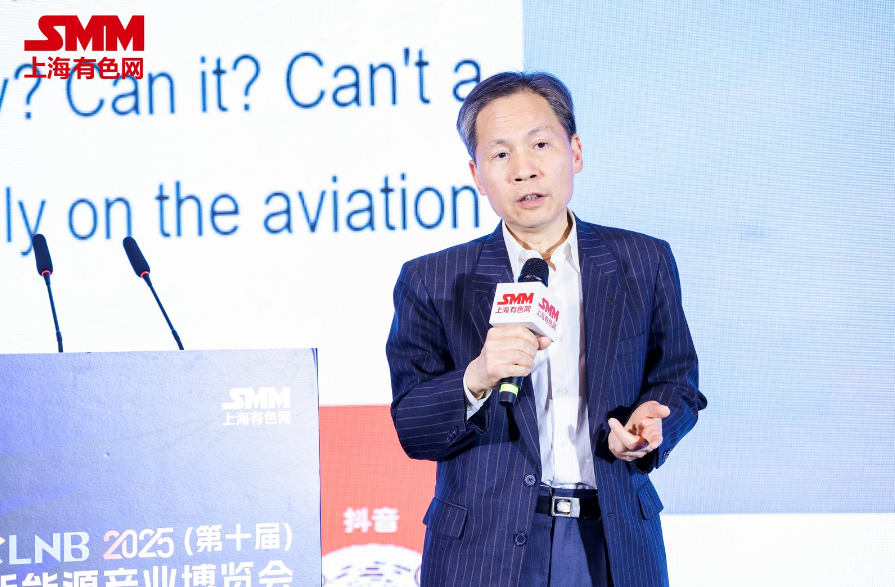
At the CLNB 2025 (10th) New Energy Industry Chain Expo - New Energy Industry Special Session hosted by SMM Information & Technology Co., Ltd. (SMM), Liang Yuancong, the rotating chairman of the Yangtze River Delta Automotive Technology Innovation Consortium, shared insights on the topic of "Cool Thinking in the Low-Altitude Economy Boom."
He emphasized the importance of correctly and professionally understanding the low-altitude economy, grasping its key elements of incubation, germination, and development, and driving efforts from multiple perspectives such as manufacturing, quality control, supply chain, standards, regulations, and industry platforms to ensure the sustainable, high-quality, scalable, and profitable development of the low-altitude economy.
Understanding the Low-Altitude Economy
The Origin of the Low-Altitude Economy Concept
From 2014 to 2020, visionaries in the aviation and aircraft fields proposed the development of low-altitude resources to serve economic growth.
In 2021, the concept of "low-altitude economy" was first included in national planning.
In 2023, the Central Economic Work Conference first mentioned the "low-altitude economy" and listed it as a strategic emerging industry.
In 2024, during the Two Sessions, the "low-altitude economy" was first included in the government work report.
In 2024, the "Decision of the Central Committee of the Communist Party of China on Further Comprehensively Deepening Reforms and Promoting Chinese-style Modernization" adopted at the Third Plenary Session of the 20th Central Committee explicitly mentioned "developing general aviation and the low-altitude economy."
Under a series of intensive policy boosts, the low-altitude economy has received unprecedented attention and ongoing discussion from the public.
Technical Definition
Low-Altitude Range:
Within the vertical height of 1,000 meters, extending up to no more than 3,000 meters as needed.
Operations and Carriers:
Primarily using civil manned and unmanned aircraft as carriers, driven by multi-scenario low-altitude flight activities such as passenger, cargo, and other operations.
Comprehensive Ecosystem:
Low-altitude infrastructure construction; R&D and manufacturing of low-altitude aircraft; low-altitude operation services; comprehensive support for low-altitude flights, etc.
The low-altitude economy is a promising strategic emerging industry and a typical representative of new quality productive forces.
Market Size of the "Low-Altitude Economy"
In 2024, the market size of China's low-altitude economy industry reached 670.25 billion yuan.
In 2025, the market size of China's low-altitude economy industry is expected to reach 859.17 billion yuan.
By 2035, the market size of China's low-altitude economy industry is projected to exceed 3.5 trillion yuan.
The scale of low-altitude aircraft manufacturing and low-altitude operation services accounts for nearly 55%.
Characteristics and Development Barriers of the Low-Altitude Economy
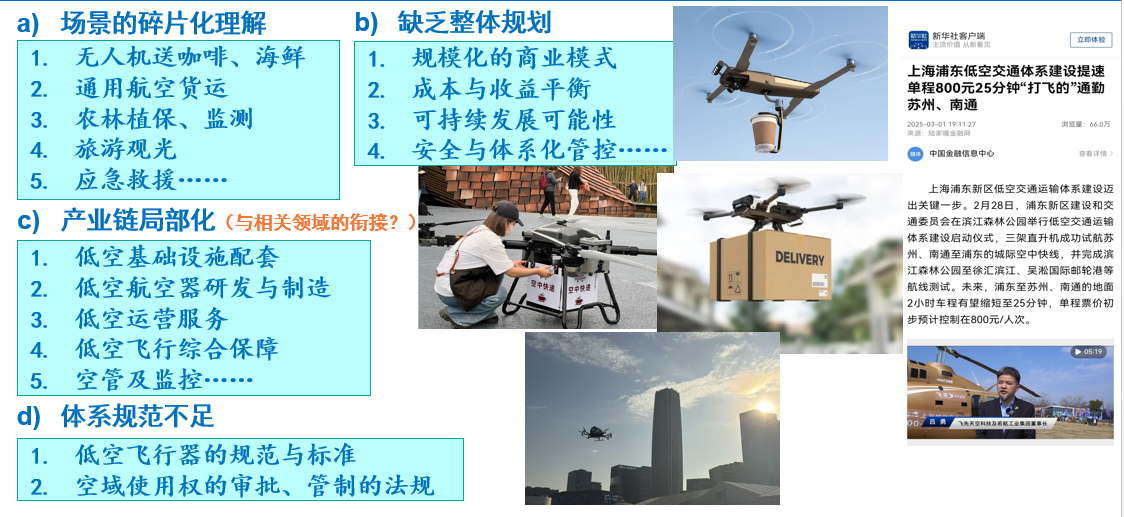
There are currently no ready-made business models or application scenarios to reference.
As a complex emerging industry, its path of incubation, germination, development, and maturity still needs to be explored in practice.
Key Elements for the Incubation and Development of the Low-Altitude Economy
Current Diverse Perceptions of the Low-Altitude Economy
1st Key Element of Incubation, Germination, and Development
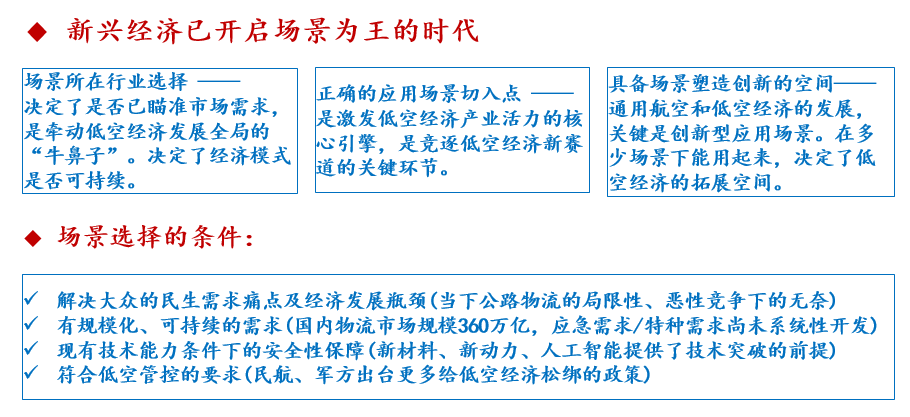
Scenarios are the main engine driving the development of the low-altitude economy. Without scenarios as a carrier, no matter how advanced the low-altitude aircraft or how intelligent the low-altitude networked infrastructure, there would be no stage for them to shine. Only on the broad stage built by scenarios can low-altitude manufacturing, low-altitude flights, low-altitude support, and comprehensive services be fully showcased. Low-altitude economic activities can directly solve real-world production and life problems, creating measurable economic and social value.
2nd Key Element of Incubation, Germination, and Development
Industry chain collaboration is crucial.
Related Upstream and Downstream Fields
Aircraft: Power systems, avionics systems, materials industry (airframe), energy (fuel, electricity), etc.
Infrastructure: Bases (control towers and approach systems), takeoff and landing sites, runways, signal systems.
Support systems: Air traffic control, central control systems, detection and regulation, communication, weather monitoring and forecasting, route information, etc.
Task-related software and hardware, including:
Cargo scenarios: Storage facilities (warehouses, sorting, loading and unloading, counterweights, tracking).
Passenger scenarios: Tourism or transportation service systems, life support systems, safety management, emergency rescue capabilities.
Agricultural and forestry protection, environmental monitoring: Remote control systems, dosing and spraying equipment, photography preparation, image recognition.
Emergency rescue: Medical emergency facilities, related medical equipment.
3rd Key Element of Incubation, Germination, and Development
Systematic Planning of Economic Models
Integrated Construction of Airspace Utilization Safety Systems
Integrated planning of airspace control systems—covering various low-altitude usage scenarios.
Building a unified information platform and opening it as a public product to various low-altitude operating economies.
Establishing standards and norms for operational systems.
Comprehensive implementation and enforcement of safety management systems.
Systematic Design of Economic Models for the Entire Industry Chain
Reasonably distributed takeoff and landing infrastructure.
Low-cost flight support systems.
Efficient and applicable task systems (software and hardware for cargo, passenger, agricultural and forestry monitoring, emergency rescue, etc.).
High-reliability aircraft with mass low-cost manufacturing capabilities.
4th Key Element of Incubation, Germination, and Development
Up-to-Date Policies, Regulations, and Standards
Airspace usage control regulations; route and airway application processes; airworthiness certification standards and related procedures for low-altitude aircraft; standards for aircraft parts access and system certification.
Achieving Scale, High Reliability, and Low Cost
Ecosystem Covered by the Industry Chain
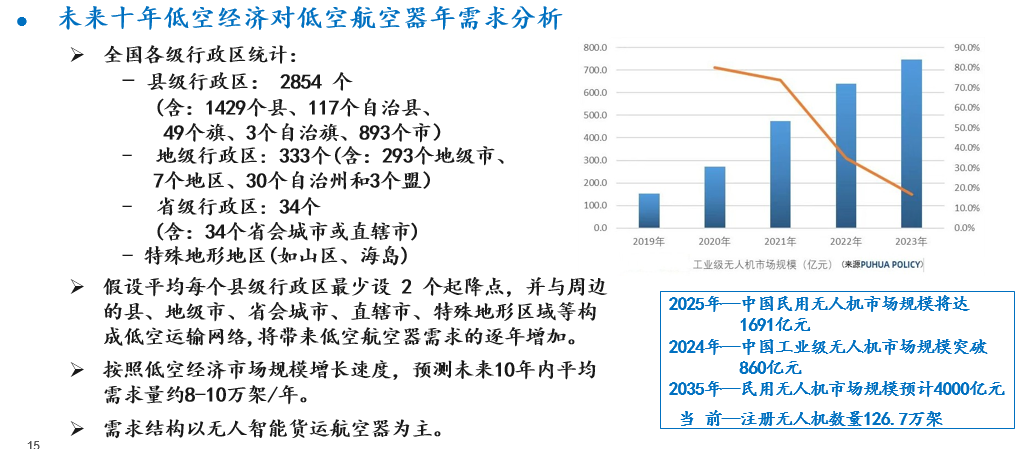
Market Demand: Unmanned Cargo Aircraft Will Continue to Increase
The development of county-level economic strategies will boost the demand for fast low-altitude cargo transportation, which will rise year by year.
Analysis of Annual Demand for Low-Altitude Aircraft in the Next Decade
Current Supply Side Status of Low-Altitude Passenger and Cargo Aircraft
• Small batch orders.
• High cost and expensive prices.
• Insufficient verification data on safety and reliability.
• Production method: Single-unit assembly production.
• Supply chain quality control: Incoming inspection.
Response Measures
1. Learn from Other Industries' Production Models to Organize Mass Production of High-Reliability, Low-Cost Manufacturing
Build efficient and standardized intelligent manufacturing systems; establish efficient and low-cost parts supporting systems.
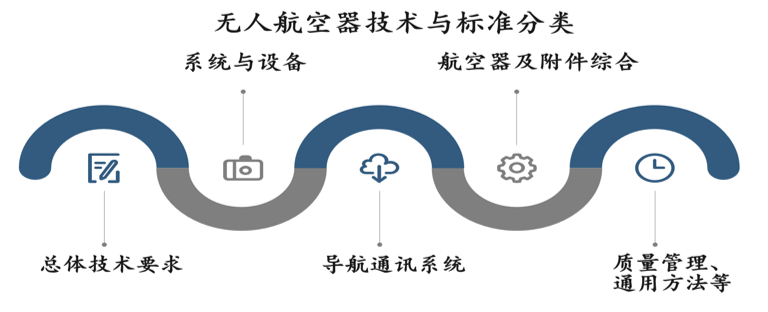
2. Support from Technical Standards
3. Construction of Legal, Regulatory, and Institutional Systems
1. Establish a drone airworthiness certification system. Form a drone airworthiness certification agency to develop "operation-centered" certification procedures and standards, supporting and encouraging related enterprises to engage in drone R&D and production.
2. Establish a drone information registration system. Set up a unified drone information management center; drone production, sales, ownership, and operation enterprises should register relevant airworthiness, rights, and radio frequency bands.
3. Establish a drone operation control system. Set up a drone operation control center, utilizing proprietary technologies (positioning, navigation, network) to achieve identification, tracking, monitoring, and management of drones.
4. Establish a business and operation licensing system for drone operation enterprises. Develop standards for business and operation licenses for drone enterprises, and conduct market access and operational capability assessments for drone operation enterprises, issuing business and operation licenses to qualified enterprises.
5. Establish a route and schedule management system for drone operation enterprises. Develop management measures for routes and schedules of drone enterprises, and conduct pre-approval or record management for regular or temporary routes and schedules applied by drone enterprises according to the measures, issuing business licenses.
6. Establish a drone accident investigation system. Develop drone accident investigation procedures, simplify accident investigation processes, and establish a self-inspection-based investigation system for enterprises.
7. Establish a drone operation insurance system. Set up drone operation insurance, providing insurance services for drone property, cargo loss, and third-party ground damage.
To promote the healthy development of the unmanned aviation industry, the Civil Aviation Administration, in accordance with the spirit of the "State Council's Several Opinions on Promoting the Development of the Civil Aviation Industry" and the "State Council General Office's Guiding Opinions on Promoting the Development of the General Aviation Industry," deepens the reform of "delegating power, improving regulation, and optimizing services," streamlines administrative licensing matters, improves the institutional mechanism for administrative management using internet, big data, artificial intelligence, and other technological means, explores the establishment of institutional mechanisms adapted to the R&D, production, operation, and regulation of unmanned aircraft, and revises them in a timely manner based on the operation of the system.
IV. Industry Platform Support
1. Support the establishment of a drone industry alliance at the Yangtze River Delta and national levels, and establish enterprise standards and quality management systems for upstream and downstream industries of drones.
2. Support the establishment of a national center for drone standard detection and inspection and corresponding sub-centers.
3. Support the release of industry standard specifications and guidelines for drones.
Summary
I. Correctly and professionally understand the low-altitude economy.
II. Grasp the key elements of its gestation, emergence, and development.
III. From multiple perspectives such as manufacturing, quality control, supply chain, standards, regulations, and industry platforms, ensure the sustainable, high-quality, large-scale, and profitable development of the low-altitude economy.
LinkedIn: https://www.linkedin.com/company/98924065/admin/dashboard/
Facebook: https://www.facebook.com/profile.php?id=61572704694550
X.: https://x.com/CLNB_official
![전고체 배터리 향후 10년 시리즈, 9부 중 4부: PV식 산업 전반의 과열 경쟁 바퀴에 짓눌릴 것인가? [SMM 분석]](https://imgqn.smm.cn/usercenter/lzgUR20251217171731.jpg)