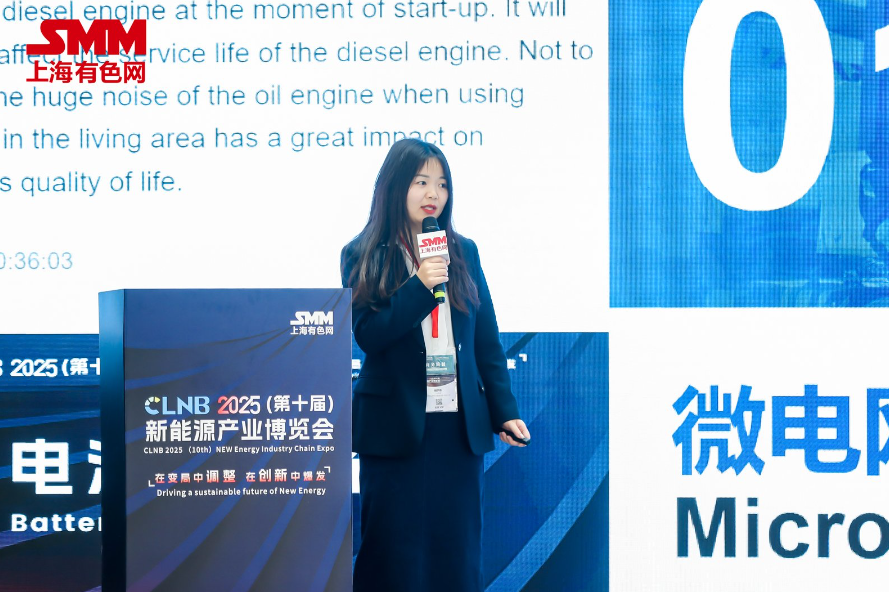
At the CLNB 2025 (10th) New Energy Industry Chain Expo - Battery Raw Materials Forum hosted by SMM Information & Technology Co., Ltd. (SMM), Mengdie Wei, Product Manager of Jiangsu Fanye Power Energy Equipment Co., Ltd., shared insights on the topic "Smart Microgrid - Empowering the New Era of Green Mines."
Overview of Microgrid Technology
In the current wave of global energy transition, power supply issues in remote areas and specific industries have always been significant bottlenecks hindering development. Taking the mining industry as an example, many mining areas are located in remote regions, far from the main power grid. Traditional diesel power generation is not only costly but also suffers from poor power supply stability, with voltage fluctuations severely affecting the normal operation of production equipment.
The emergence of microgrid technology has provided innovative solutions to this challenge, leading a profound transformation in the mining energy sector.
Definition and Composition of Microgrid
A microgrid is essentially a small-scale autonomous power system composed of distributed power sources, energy storage devices, energy conversion devices, loads, and monitoring and protection devices. It can operate independently or be connected to the external grid. In remote mining areas, a microgrid consisting of solar power, wind power, diesel generators, and ESS batteries can provide stable electricity to local residents and businesses.
Definition and Composition of Microgrid
Architectural Features
Microgrids are relatively small in scale, typically composed of distributed power sources (such as PV and wind power) ranging from kW to MW, small energy storage devices, and local loads.
The voltage level is mainly low or medium voltage, with a radial or simple ring network distribution structure, adapting to flexible deployment needs.
Mining Area Example
A typical configuration includes several wind turbines (kW level), PV arrays (tens of kW), and a limited-capacity battery pack.
Through simple distribution lines, stable power supply is achieved for mining users, addressing the pain point of insufficient grid coverage in remote areas.
Flexible Control: Operation and Management Strategies
In terms of operation control and management, microgrids balance local autonomy with grid coordination. In mining scenarios, the controller within the microgrid acts like a responsive commander, quickly responding to load changes and power source fluctuations, maintaining voltage and frequency stability, and ensuring internal power balance.
Dynamic Regulation: The controller rapidly responds to load and power source changes, maintaining voltage, frequency stability, and power balance;
Mode Switching: When connected to the grid, it exchanges power bidirectionally with the main grid, and in case of failure, it switches to island mode within seconds, ensuring power supply to critical loads;
Energy Optimization: Utilizing the peak-valley electricity price spread, selling electricity at night, purchasing electricity during the day, and using energy storage for peak shaving, enhancing economic efficiency and stability.
Creating Customized Microgrid Solutions
In customized services for mining scenarios, Fanye adopts a full-cycle model of "survey - design - delivery - operation and maintenance." In the early stages, the technical team conducts on-site surveys in mining areas based on local geographical environments and power loads, meticulously designing targeted solutions, such as optimizing the layout of solar panels to fully utilize local sunlight resources.
Post-Operation Maintenance
Remarkable Results from the Murehwa Project in Zimbabwe
Daily average power generation of 4,500 kWh, fully covering the 24-hour power demand of the mining area.
Fanye Power's PV ESS diesel containerized microgrid project has been successfully implemented in multiple mines in Zimbabwe, Africa. Taking the Murehwa project as an example, its daily average power generation of 4,500 kWh fully covers the 24-hour power demand of the mining area.
Fuel costs reduced by 62%, with seamless switching in 15ms
In terms of energy-saving benefits, compared to pure diesel power generation, fuel costs were reduced by 62%, with nighttime energy storage power supply accounting for up to 78%. In terms of intelligent switching, the diesel generator set can achieve seamless grid connection within 15ms, easily coping with extreme weather, overload, and other low-power scenarios. Moreover, the system outputs pure power with THD < 3%, providing reliable protection for the stable operation of precision equipment.
Follow us for more information
LinkedIn: https://www.linkedin.com/company/98924065/admin/dashboard/
Facebook: https://www.facebook.com/profile.php?id=61572704694550
![마그네슘 가격 3거래일 연속 상승! 원가 측면은 여전히 '뜨겁게 타오르는' 반면 수요 측면은 바통을 이어받기 어려워 [SMM 논평]](https://imgqn.smm.cn/usercenter/EutUV20251217171724.jpeg)