SMM March 11 News:
With favorable policy expectations, tight supply on the raw material side, and anticipated growth in end-use demand driven by the rapid development of robotics and the low-altitude economy, coupled with several metal plants operating at full capacity, the rare earth market in February experienced "simultaneous increases in volume and price." Specifically, Pr-Nd oxide rose by 6.99%, dysprosium oxide by 2.7%, and terbium oxide by 9.01% in February. The production of Pr-Nd oxide, Pr-Nd alloy, dysprosium oxide, and terbium oxide all increased MoM in February. Entering March, the rare earth market is currently fluctuating rangebound, with the tight supply on the raw material side yet to ease, combined with restocking expectations as magnet manufacturers' inventories hit bottom. Will this drive the rare earth market to continue strengthening?
Pr-Nd Oxide Up 6.99% in February, Dysprosium Oxide Up 2.7%, Terbium Oxide Up 9.01%
》Click to View SMM Rare Earth Spot Prices
》Subscribe to View SMM Historical Metal Spot Price Trends
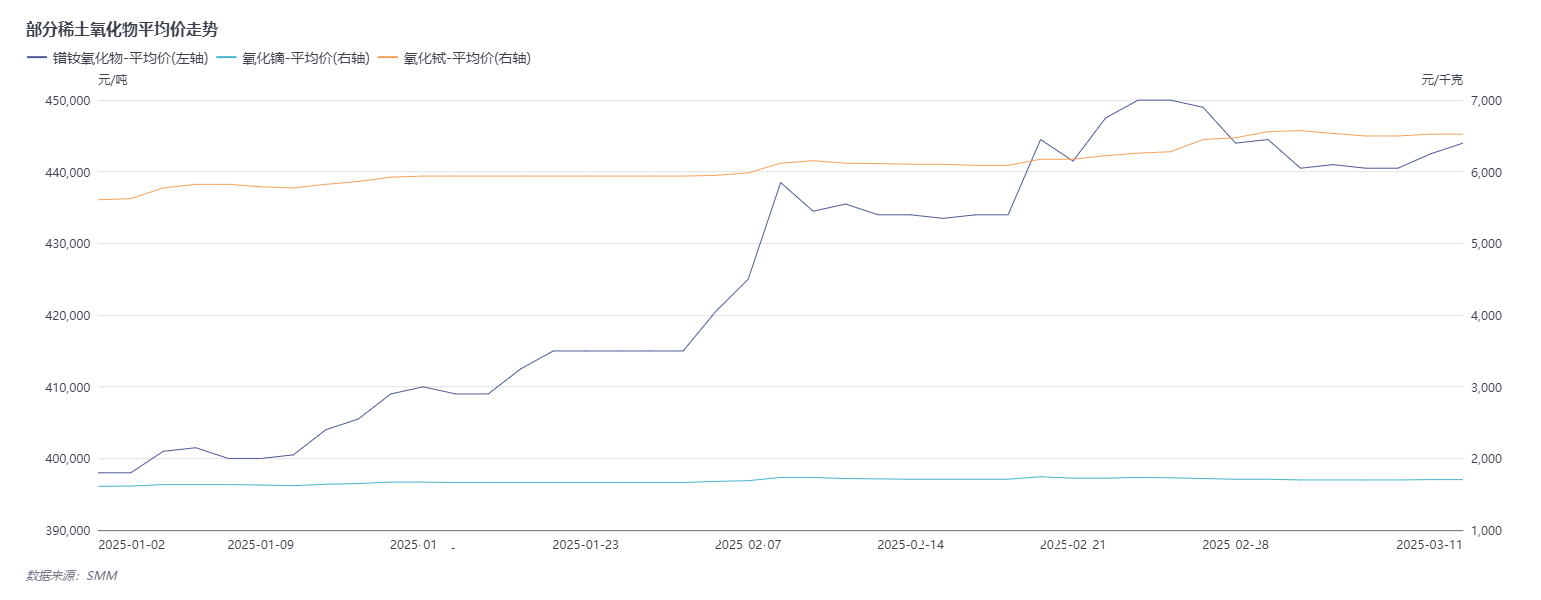
Light Rare Earth Prices: Taking the historical price trend of Pr-Nd oxide as an example, according to SMM quotes: the average price of Pr-Nd oxide was 415,000 yuan/mt on January 27 and 444,000 yuan/mt on February 28, reflecting an increase of 29,000 yuan/mt in February, with a monthly increase of 6.99%. Favorable policy expectations combined with major producers' tenders drove the average price of Pr-Nd oxide to exceed a one-year high of 450,000 yuan/mt on February 25. However, downstream "fear of high prices" sentiment was evident, with limited acceptance of high-priced supplies, causing the average price of Pr-Nd oxide to slightly decline from February 27. Entering March, light rare earth prices fluctuated rangebound. On March 11, the average price of Pr-Nd oxide was 444,000 yuan/mt, unchanged from February 28, while the average price of Pr-Nd alloy was 544,000 yuan/mt, slightly down from 546,500 yuan/mt on February 28.
Medium-Heavy Rare Earth Prices: Taking the price trend of dysprosium oxide as an example, according to SMM quotes: the average price of dysprosium oxide was 1,665 yuan/kg on January 27 and 1,710 yuan/kg on February 28, reflecting an increase of 45 yuan/kg in February, with a monthly increase of 2.7%. Entering March, dysprosium oxide prices remained stable with a weak trend, with an average price of 1,705 yuan/kg on March 11.
Taking the price trend of terbium oxide as an example, according to SMM quotes: the average price of terbium oxide was 5,940 yuan/kg on January 27 and 6,475 yuan/kg on February 28, reflecting an increase of 535 yuan/kg in February, with a monthly increase of 9.01%. Entering March, terbium oxide prices mostly rose, with the average price slightly increasing to 6,525 yuan/kg as of March 11.
Pr-Nd Oxide, Pr-Nd Alloy, Dysprosium Oxide, and Terbium Oxide Production Increased MoM in February
》Click to View SMM Metal Industry Chain Database
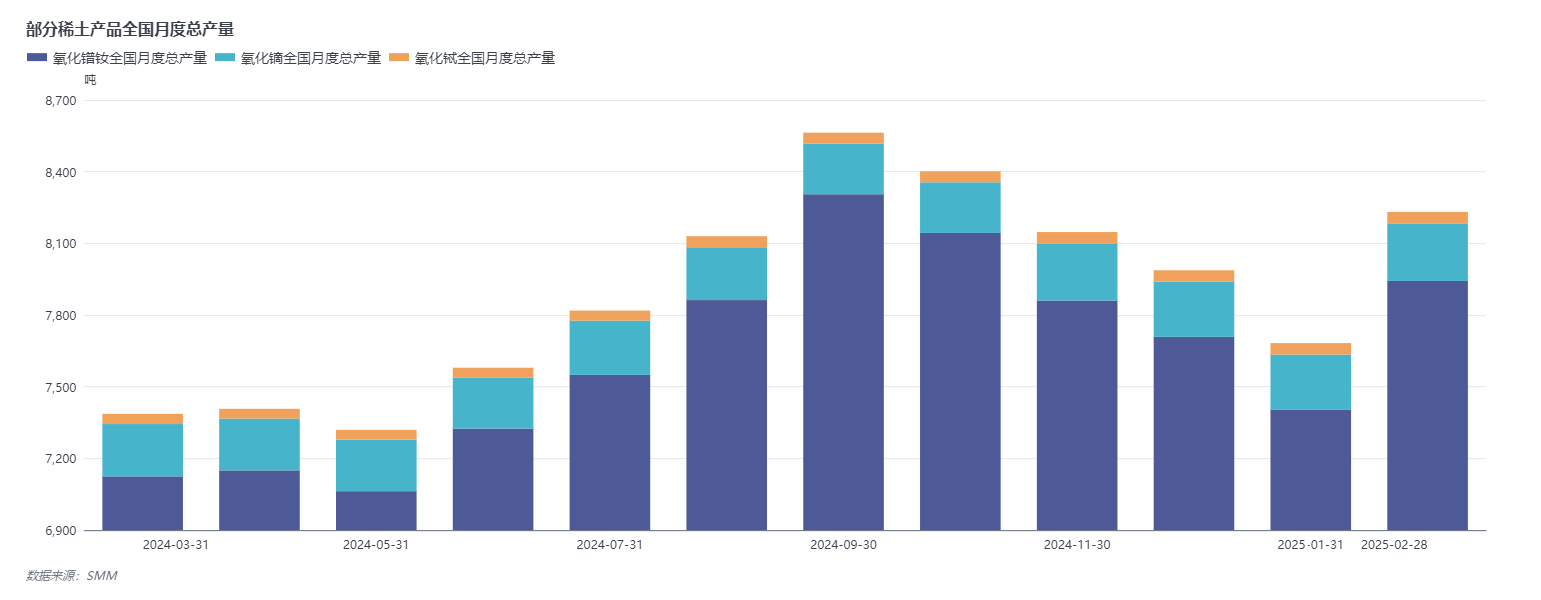
Light Rare Earth Production: In February, domestic production of Pr-Nd oxide and Pr-Nd alloy both achieved significant growth. The increase in Pr-Nd oxide production was mainly concentrated in Jiangxi, Sichuan, and Shandong, while the increase in Pr-Nd alloy production was notable in Jiangxi, Sichuan, Inner Mongolia, and Zhejiang.
According to SMM survey data, enterprises that had suspended operations in January due to maintenance gradually resumed production in February. Meanwhile, with the market holding an optimistic outlook for the future of Pr-Nd oxides, most separation plants operated at relatively high rates, driving Pr-Nd oxide production to increase by over 7% MoM.
In metal production, many metal enterprises planned capacity expansions this year. Against the backdrop of generally optimistic downstream demand, major metal enterprises operated at full capacity, resulting in Pr-Nd alloy production increasing by over 8% MoM in February.
Medium-Heavy Rare Earth Production: In February, the production of most medium-heavy rare earth oxides increased MoM compared to January, with the main increases coming from Jiangxi and Jiangsu.
According to SMM surveys, some separation enterprises had reduced or suspended production in January for various reasons, but after the Chinese New Year holiday in February, these enterprises fully resumed production, with operating rates also improving compared to January. These factors collectively drove a significant MoM increase in medium-heavy rare earth oxide production in February.
Market Outlook
From import data, rare earth imports declined in the first two months of 2025. According to customs data, rare earth imports reached 16,922.2 mt in January-February 2025, down 24.1% YoY from January-February 2024. In terms of supply: rare earth imports continued the downward trend from 2024, failing to alleviate the tight supply of raw materials. The first batch of rare earth mining quotas for 2025 has yet to be issued, and some market participants expect a slight increase in mining quotas, which could ease the tight supply caused by declining imported ores. SMM will continue to monitor the issuance of rare earth mining quotas. On the demand side: restocking and stockpiling demand are expected as downstream magnet manufacturers' inventories hit bottom, supporting rare earth prices. The approaching mass production of humanoid robots and the ongoing boom in the low-altitude economy have fueled expectations for increased demand for high-performance NdFeB permanent magnet materials, a core material for robot servo motors. Currently, suppliers are reluctant to sell at low prices, while downstream enterprises have limited acceptance of rare earth prices, which are at their highest levels in over a year. Without significant demand growth, rare earth prices may continue to fluctuate upward.
Voices from Various Sides
Liu Leiyun, Party Secretary and Chairman of China Rare Earth Group, stated in the article "Enhancing Technological Innovation to Promote China's Transition from a Major Rare Earth Country to a Rare Earth Powerhouse" published in "New-Type Industrialization" that innovation in systems and mechanisms is needed to vigorously develop new quality productive forces. Rare earths, with their wide applications and significant roles, require coordinated regional industry resources, optimized factor allocation, and the establishment of systems and mechanisms tailored to regional characteristics to develop new quality productive forces and promote high-quality development in China's manufacturing industry. Efforts should be made to explore various effective forms of technological investment, accelerate the establishment of a diversified and multi-channel technological innovation investment system led by the government, driven by the market, and centered on enterprises. Major platforms such as a national rare earth industry upgrade fund and a rare earth basic and applied research fund should be established to provide financial support for rare earth technological innovation. A sound incentive mechanism for the transformation of scientific and technological achievements should be established to encourage researchers to focus on the "Four Orientations," bridging the "last mile" of technological achievement transformation, enabling rare earth technology to empower various industries and reach households.
On March 6, Innost announced on its investor interaction platform that its products can be applied in humanoid robots' motors, reducers, and dexterous hands. Humanoid robots are expected to be a key growth driver for high-performance NdFeB magnet materials in the future. The company will continue to monitor technological development trends in this industry and actively seize market opportunities.
On March 4, Zhenghai Magnetic Material responded to investor inquiries on its interaction platform, stating that humanoid robots are expected to be a significant incremental market for high-performance NdFeB permanent magnet materials in the future. The company's products are highly compatible with core components such as hollow cup motors and frameless torque motors used in humanoid robots. The company has already engaged in joint R&D and small-scale sample supply with several downstream customers, with progress going smoothly. However, there is no substantial impact on the company's operating performance at present. The company will continue to closely monitor the development trends of the humanoid robot market, seize market opportunities, and meet downstream application demands.
CITIC Securities stated that humanoid robots are about to enter the mass production era. Benefiting from the rapid technological iteration of components, changes in related materials are expected to bring considerable demand elasticity. CITIC Securities recommends focusing on areas such as dexterous hand tendons, lightweight materials, rare earth permanent magnets, and cables. As manufacturers release new models, confirm technical solutions, and finalize mass production suppliers, the related sectors are expected to see continued market performance. Attention should be given to manufacturers that have already provided samples or entered the supply chain.
Guoyuan Securities pointed out: On the supply side, as a globally contested strategic mineral resource, China's rare earth reserves and production account for the largest share globally. In 2024, China's total control quotas for rare earth mining and smelting separation were 270,000 mt (+5.88%) and 254,000 mt (+4.16%), respectively. Compared to the over 20% growth rate in the past three years, the growth rate has significantly slowed. With the "Rare Earth Management Regulations" officially implemented on October 1, 2024, a new sustainable development pattern for the rare earth supply side is expected to deepen further. On the demand side, the application scope of rare earths in high-tech fields continues to expand. The demand growth in consumption areas such as NEVs, wind power, and industrial robots, combined with industry technological advancements and national policy support, will usher in a period of rapid growth opportunities for the rare earth industry.
For more information on rare earth fundamentals, policies, technologies, and end-use application changes, please participate in the 2025 SMM (2nd) Rare Earth Industry Forum~
![[SMM 희토류 조간 회의 요약] 프라세오디뮴-네오디뮴 산화물은 공급업체들이 가격을 고수하며 소폭 반등했고, 터븀 산화물은 계속 약세를 보였으며, 금속은 상승세를 따랐지만 거래는 여전히 제한적이었다.](https://imgqn.smm.cn/usercenter/THqPM20251217171743.jpeg)