The Rise and Fall of Jiangsu Delong: Reflections Behind the Bankruptcy of a Billion-Yuan Steel Giant Amid the Shutdown Turmoil of Its Indonesian Project
Recently, the Gunbuster Nickel Industry (GNI) project under the Indonesian industrial park of PT. Virtue Dragon has been delaying payments to local energy suppliers and is currently unable to procure nickel ore, leading to rumors of a shutdown. Although the Indonesian government urgently responded, stating that its "operations remain stable," this news has once again drawn international market attention to Jiangsu Delong Nickel Industry, a Chinese stainless steel giant. This company, once hailed as the "world's second-largest stainless steel supplier," had already collapsed into bankruptcy restructuring six months ago due to a debt crisis. The turbulence of the Indonesian project not only highlights the fragility of the global nickel industry chain but also brings the Delong bankruptcy case back into the public eye.
Founded in 2010, Jiangsu Delong specializes in the production and sales of nickel alloys. The company has established a fully integrated production chain encompassing ironmaking, steelmaking, rolling, solution acid pickling, and cold rolling. It is the world's second-largest stainless steel supplier after Tsingshan Group, ranking 47th on the 2023 list of China's Top 500 Private Enterprises.
Looking back at Delong's business expansion, it is evident that the company expanded too aggressively and too quickly. Around 2020, Delong simultaneously advanced multiple billion-yuan projects in Yancheng Xiangshui and Changzhou Liyang domestically, alleviating financial pressure through financing and build-transfer models (e.g., in cooperation with Fuhuang Steel Structure). Meanwhile, nickel prices in Indonesia plummeted by over 40% from 2021, and Delong's Indonesian project incurred losses exceeding 1 billion yuan in 2023, becoming the "last straw" that broke the camel's back.

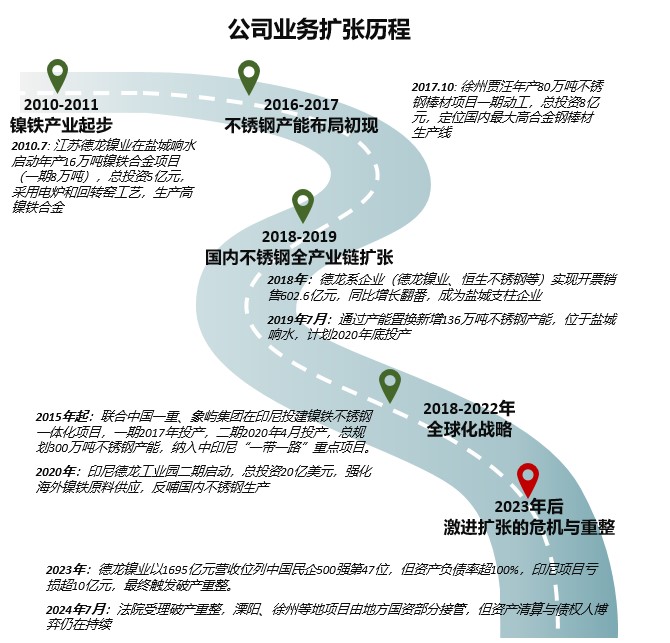
Image Source: SMM
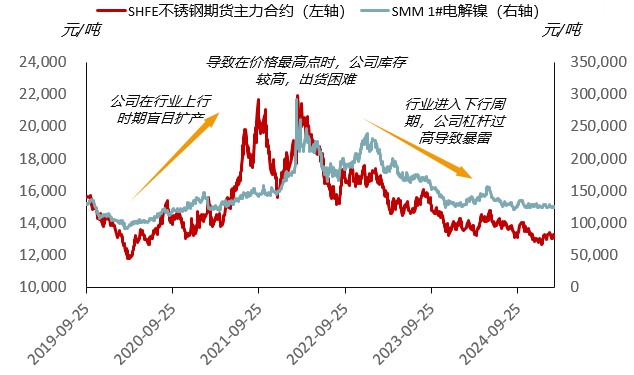
Reviewing the bankruptcy case, the primary reasons for the "steel giant's" bankruptcy were excessive investment combined with a market downturn and significant internal management issues, triggering a chain reaction. During the industry's upward cycle, the company pursued a "scale-first" model, aggressively expanding capacity. After project commissioning, the company accumulated a large inventory of spot nickel at high prices. The subsequent sharp decline in nickel prices made it difficult to sell high-priced finished products. Even though the company adopted a "bundled sales" model at the time, it could not reverse the losses.
Data Source: SMM
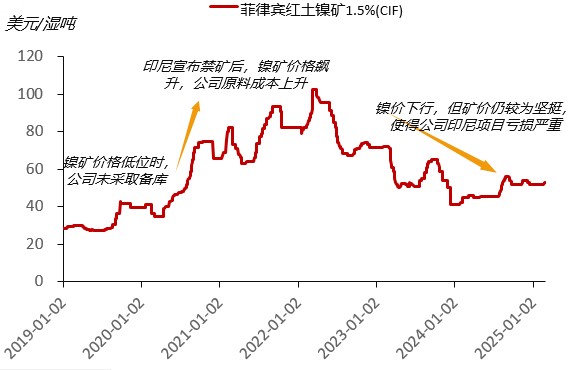
A similar strategic error occurred on the raw material procurement side. From 2019 to 2020, nickel ore prices were at a low point. However, Delong did not choose to stockpile large quantities of nickel ore but instead further expanded capacity, missing the best opportunity to procure low-cost raw materials. Subsequently, with the announcement of Indonesia's comprehensive ore export ban, nickel ore prices soared, further increasing the company's production costs. Coupled with the decline in stainless steel prices, the company's losses became severe.
Data Source: SMM
Amid the industry's downward cycle, the company's profitability was continuously dragged down by its poor decisions. After 2020, the Indonesian project became the company's primary revenue source. However, with the severe surplus of NPI, rising labor costs in Indonesia, and frequent labor disputes, the company's internal management deficiencies became increasingly apparent. The Indonesian project gradually entered a loss-making phase, further straining the company's cash flow.
Additionally, the company's financing channels were limited, and risks were highly concentrated. Overinvestment and reliance on high leverage led to funding needs far exceeding the company's profitability, causing liquidity to dry up. Ultimately, the company's Liyang project, with overdue construction payments exceeding 1 billion yuan, became the trigger for its financial collapse.
In July 2024, Jiangsu Delong filed for bankruptcy restructuring due to insolvency. Local governments and major state-owned enterprise partners stepped in to rescue the company. However, as of December 2024, Delong's 28 affiliated companies had declared debts totaling 71.763 billion yuan, while its reorganizable assets amounted to only 10.492 billion yuan, highlighting the severe imbalance between assets and liabilities, leaving all parties powerless to save the company. The "world's second-largest stainless steel supplier" thus fell. Currently, Delong's Indonesian assets have been taken over by its major state-owned enterprise partners. The third-phase Gunbuster project, which is now rumored to be "shut down," is still under further negotiation with Xiamen Xiangyu.
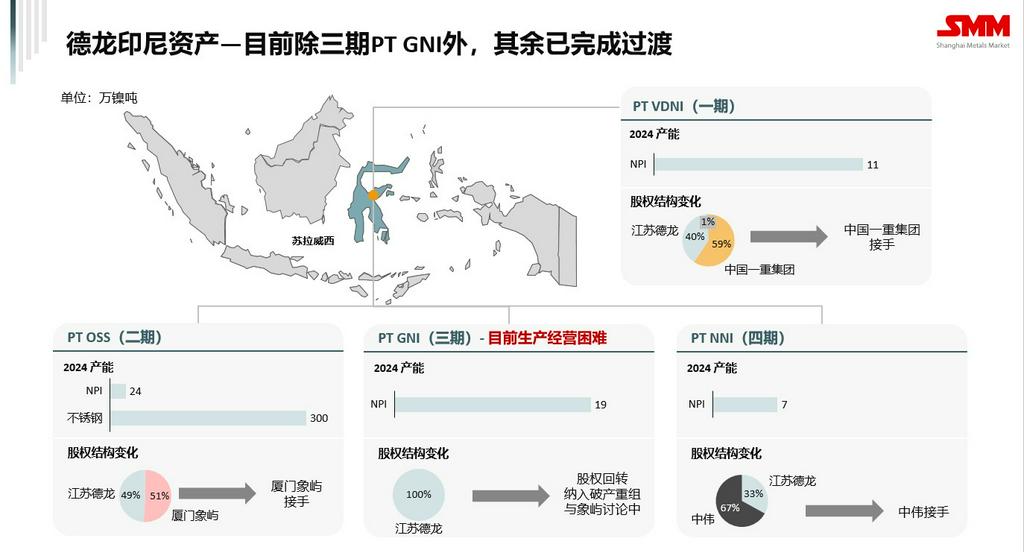
Data Source: SMM, Public Information Compilation
With China's rapid and sustained economic development, stainless steel capacity has expanded rapidly, making China the world's largest stainless steel producer, consumer, and investment market. However, on the demand side, traditional steel-consuming industries such as real estate and infrastructure have seen declining demand. Weak demand growth has led to a significant supply-demand imbalance. Against this backdrop, industry players have shifted their survival strategies from "bold advancement" to "steady progress" and from "scale is king" to "cash is king." The Delong casenot only reflects its internal management issues but also highlights the vulnerability of resource-intensive industries to cyclical fluctuations. Companies need to balance the economic benefits of expansion with the associated risks to avoid becoming "large but weak." While focusing on core businesses, they should also explore diversified paths to pursue high-quality development. Moreover, in an era of constantly changing international dynamics and volatile overseas policies,companies should develop market risk foresight, reasonably assess industry cycles, and plan expansion strategies accordingly. They should avoid overexpansion during industry downturns. Additionally, companies should reasonably control leverage ratios, optimize asset structures, and ensure that cash flow matches debt repayment capabilities.
Finally, during the industry's transitional period, the Delong bankruptcy case is merely a microcosm of the survival pressures faced by companies during a downward cycle. How to strategically plan investments during industry troughs and how to find market niches amid product surpluses have become core challenges for industry players. In this regard, the SMM analysis and consulting teams will continue to monitor industry hot topics and market dynamics, striving to provide professional consulting services to every industry player.
For more information and services on the nickel-chromium-manganese stainless steel industry, please contact:
Junyan Huo, Senior Consulting Project Manager huojunyan@smm.cn
Disheng Feng, Senior Nickel Research Manager fengdisheng@smm.cn
![[SMM 니켈 속보] 인도네시아 업데이트 — 2026년 10월 9일](https://imgqn.smm.cn/usercenter/KFwsY20251217171734.jpg)
![[NPI 데일리 리뷰] 중국 니켈선철 현물 거래 정체, 향후 추세에 대한 시장 전망 엇갈려](https://imgqn.smm.cn/usercenter/vcoVV20251217171732.jpeg)