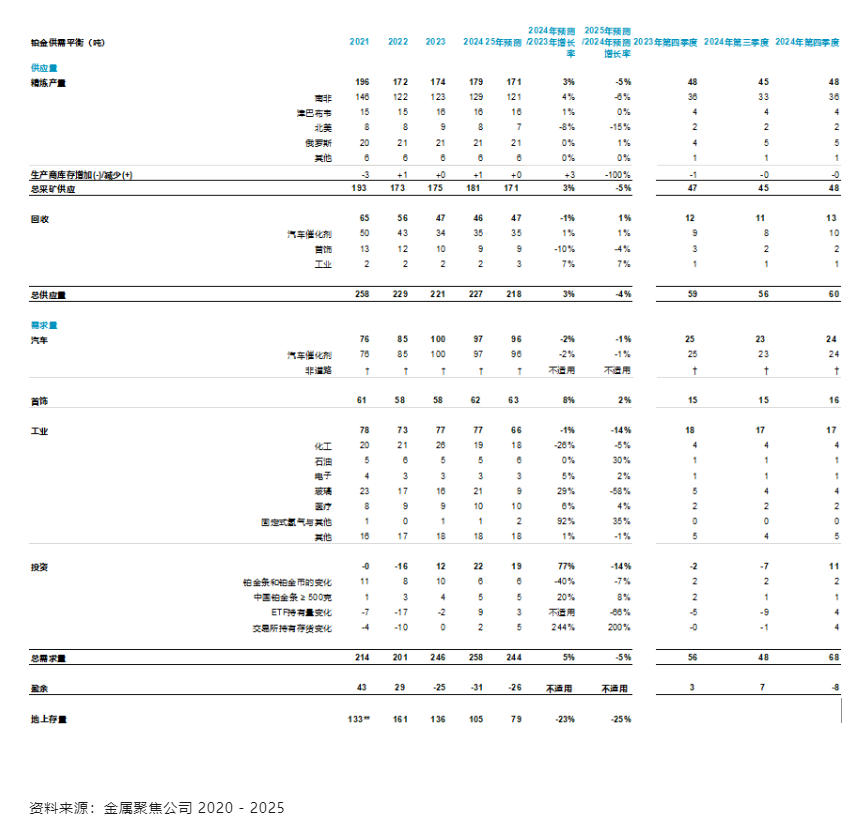
The World Platinum Investment Council (WPIC) released the "Platinum Quarterly" for Q4 2024 and the full year on March 5, and revised its forecast for 2025. A deficit is expected for the third consecutive year in 2025, with the shortfall deepening, currently projected at 26 mt. Demand in 2025 is expected to decrease by 5% to 244 mt, though it will remain well above the five-year average since 2020, while total supply is forecast to decline by 4% YoY to 218 mt.
In 2024, the platinum market experienced a significant deficit of 31 mt (46% higher than the previous forecast), with total demand exceeding 258 mt for the first time since 2019. Strong investment demand (driven by approximately 8 mt of ETF and exchange stock inflows in Q4) and growth in jewelry demand led to a 5% YoY increase in total platinum demand to 258 mt, while total supply reached 227 mt, up 3% YoY.
Mine supply in 2025 is forecast to shrink by 5%, while recycling supply is expected to decrease significantly.
In 2024, global mined platinum supply grew by 3% YoY to 179 mt, driven by higher-than-expected production in South Africa and Russia. In South Africa, production increased by 4% YoY to 129 mt due to reduced in-process inventory and less-than-expected production cuts caused by power rationing. In Russia, early completion of furnace maintenance stabilized production at 21 mt.
In 2025, refined platinum supply is forecast to decline by 5% YoY to 171 mt, due to palladium production cuts in North America and reduced platinum output in South Africa, along with significantly lowered expectations for in-process inventory releases. Meanwhile, downside risks to production remain, such as major restructuring driven by persistently low PGM basket prices.
Global recycling volume in 2024 continued to face unfavourable factors, declining by 1% to 46 mt, the lowest level since the "Platinum Quarterly" report began in 2013. These unfavourable factors are expected to persist in 2025. Recycling supply is forecast to increase slightly to 47 mt (+1%), reflecting continued constraints on the recycling of scrap automotive catalysts (despite an increase in global scrap vehicle numbers) and further declines in jewelry recycling. Notably, the forecast for 2025 recycling supply has been revised down by 9 mt since the last prediction, due to current expectations that market improvements will be difficult to achieve in the short term.
Overall, global platinum supply in 2024 reached 227 mt, up 3% YoY, but is expected to decline by 4% to 218 mt in 2025.
Above-ground platinum stocks fell by 23% in 2024 to 105 mt and are forecast to decline further by 25% in 2025 to 79 mt, sufficient to meet less than four months of demand.
Despite headwinds, automotive platinum demand remains at historically strong levels.
In 2024, total production of catalyst-equipped light vehicles (including ICE and hybrid vehicles) and heavy vehicles declined by 2% and 5%, respectively, leading to a 2% decrease in automotive platinum demand to 97 mt. In H2 2024, heavy vehicle production declined, reflecting reduced freight volumes and overcapacity in the trucking industry. This was further exacerbated by a decline in ICE light vehicle production in Europe. YoY growth in automotive platinum demand in other regions (including North America, Japan, and the rest of the world) failed to offset these reductions.
In 2025, despite some of these challenges persisting and a forecasted 22% YoY increase in pure EV production, automotive platinum demand is expected to remain well above the five-year average since 2020, decreasing by only 1% to 96 mt.
Jewelry demand is forecast to grow for the second consecutive year in 2025, exceeding 62 mt, a six-year high.
In 2024, global platinum jewelry demand grew by 8% YoY (+4 mt) to 62 mt, with all regions showing growth. India surged by 31% YoY, while Europe and North America reached record highs. In the latter, platinum jewelry gained market share over white gold. In China, platinum jewelry demand grew by 1% YoY, marking a slight recovery after years of decline since 2014.
In 2025, platinum jewelry demand is forecast to reach 63 mt (+2%), exceeding 62 mt for the first time since 2019, with China and India expected to grow by 5% and 7%, respectively, while Europe and North America are set to achieve new highs. The significant price spread between platinum and gold will continue to be a key driver of demand growth.
Industrial platinum demand is expected to decline as the cyclical capacity expansion in the glass industry slows.
In 2024, industrial demand reached 77 mt, down slightly by 1% YoY. Increases in the glass (up 29% to 21 mt), medical (up 6% to 10 mt), electronics (up 5% to 3 mt), and hydrogen (up 92% to 1 mt) sectors were unable to offset a 26% decline in chemical demand (down to 19 mt), as China's petrochemical industry concluded its strategic capacity expansion from 2019 to 2023.
In 2025, industrial demand is forecast to decrease by 14% to 66 mt, primarily due to the waning of the cyclical capacity expansion in the glass industry that drove demand last year. Chemical platinum demand is expected to decline by 5% to 18 mt, while demand in the petroleum (up 30% to 6 mt), electrical (up 2% to 3 mt), medical (up 4% to 10 mt), and hydrogen (up 35% to 2 mt) sectors is forecast to grow.
Investment demand grew by 77% in 2024 and is expected to remain elevated in 2025.
Investment demand in 2024 grew strongly, up 77% YoY to 22 mt. Significant inflows in Q4, driven by market volatility stemming from uncertainty over US tariffs, contributed to this growth. In Q4 2024, platinum ETF holdings increased by 4 mt to 103 mt, primarily driven by US fund inflows, while NYMEX and TOCOM exchange stocks surged by 4 mt, marking the highest inflows since Q3 2020. In 2024, platinum bar and coin demand was subdued globally except in China, where demand for platinum bars of 500 grams or more grew strongly to 5 mt (+20%).
In 2025, investment demand is forecast to remain high at 19 mt, despite a 14% YoY decline. ETF holdings and exchange stocks are expected to increase by 3 mt and 5 mt, respectively. While improvements in Europe and North America (markets returning to growth) and continued growth in all specifications of Chinese investment demand are anticipated, net sales of platinum bars and coins in Japan are expected to erode growth in other regions, leading to further weakness in bar and coin demand.
Trevor Raymond, CEO of the World Platinum Investment Council, commented:
“The consecutive annual deficits in platinum reached 31 mt in 2024, including some investment inflows related to recent tariff-induced disruptions, but primarily structural in nature. As the growth of pure EVs slows, automotive platinum demand remains stable, and the expectation that ICE vehicles will have a 'higher for longer' market share is gaining broader recognition. Mine supply continues to decline, and as the benefits of in-process inventory releases diminish further, the pace of supply reduction may accelerate. Meanwhile, the previously anticipated recovery in recycling did not materialize in 2024. Recycling levels are at a 10-year low, and growth in recycling volume in 2025 appears set to remain challenging.”
At the end of 2024, Costco, the world's third-largest retailer, began selling platinum bars and coins in North America, while China's sovereign precious metal coin supplier, China Gold Coin Group, expanded its offerings to include 1 kg platinum bars in addition to its Panda and Lunar platinum coin series. These developments boosted investment demand. Following the launch of these key products, our partners have seen increased interest and demand for various other platinum products. This impact is expected to persist into 2025, enhancing potential institutional investment demand as investors find it increasingly difficult to ignore a structurally deficit market that is not yet reflected in prices.
“Platinum jewelry demand will grow for the second consecutive year in 2025, with all regional markets expanding as rising gold prices benefit platinum jewelry. Record-high gold prices have placed excessive balance sheet pressure on the value of gold jewelry retail inventories, leading to some gold jewelry stock being converted to platinum. This not only significantly reduces funding costs but also enables jewelers to attract consumers by highlighting the price advantage of platinum over white gold.”


![[SMM 귀금속 속보]](https://imgqn.smm.cn/usercenter/obeMy20251217171735.jpg)