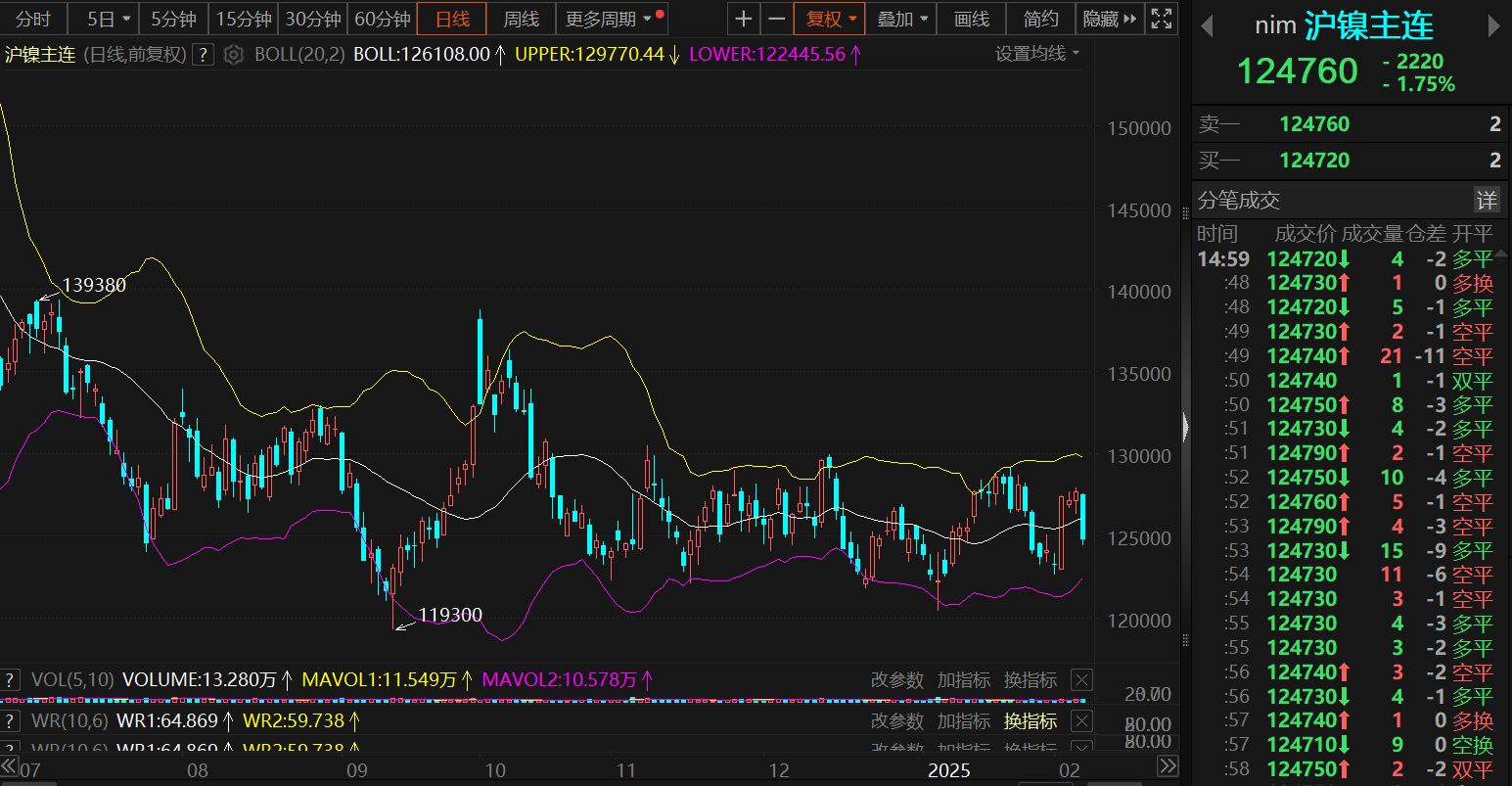
SMM, February 11: The seven-day Chinese New Year holiday has ended, and February has arrived. Looking back at January, nickel prices initially rose and then fell, driven by news from the mining side and the approach of the year-end Chinese New Year holiday. As of January 27, the most-traded SHFE nickel contract closed at 124,150 yuan/mt, down 0.34% on a monthly basis.
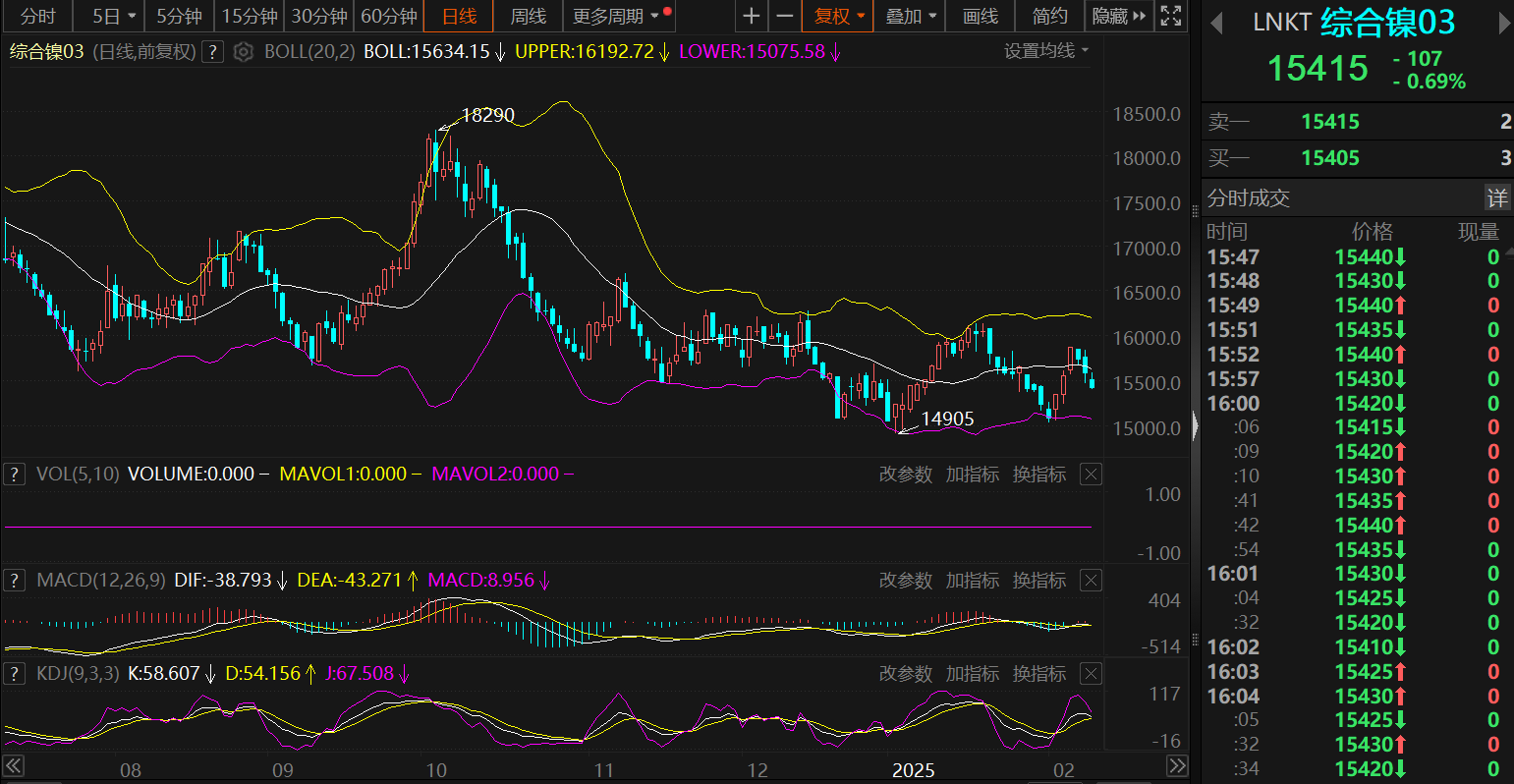
For LME nickel, January prices also showed an inverted "V" pattern, closing at $15,223/mt on January 31, with a monthly decline of 0.69%.
Spot Market:
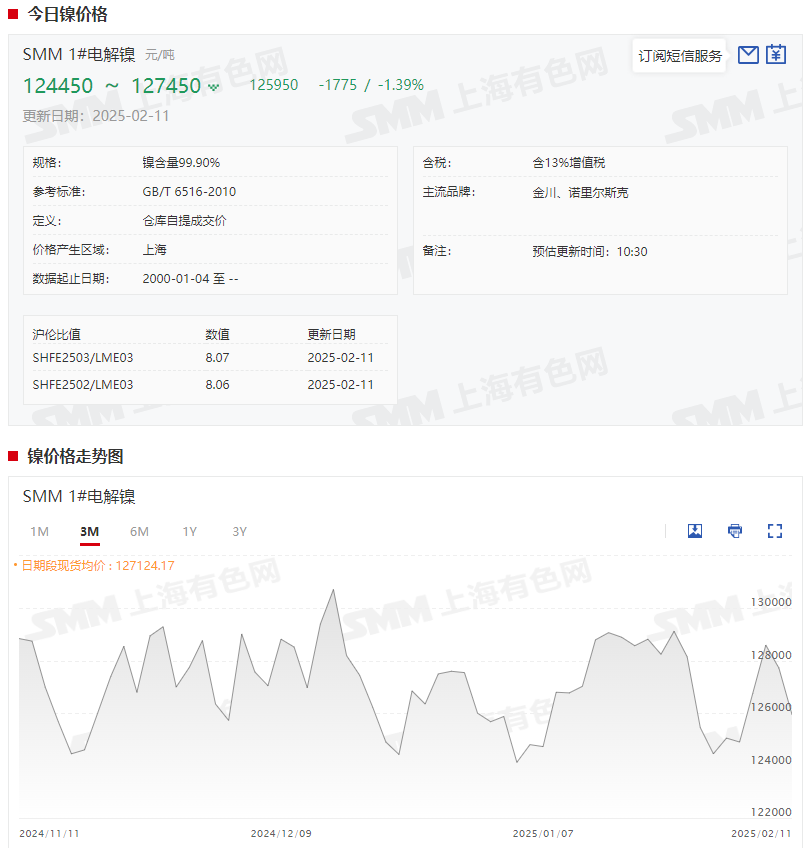
In the spot market, according to SMM spot quotes, the SMM 1# refined nickel spot price also showed an initial rise followed by a decline, peaking at 129,125 yuan/mt on January 21, the highest since December 16, 2024. As of January 27, the average spot price of SMM 1# refined nickel was 125,050 yuan/mt, down 625 yuan/mt or 0.5% from 125,675 yuan/mt on December 31, 2024.
》Click to view SMM metal spot quotes
Fundamentals
Supply Side:
According to an SMM survey, China's refined nickel production in January 2025 decreased by 4.9% MoM but increased by 18.7% YoY. The industry's operating rate was 69%, lower than the previous month, mainly due to the Chinese New Year holiday, during which some companies suspended operations, reducing the operating rate. On the demand side, influenced by year-end market sentiment in January, downstream stocking led to mediocre overall transactions. Demand for refined nickel in batteries, electroplating, and stainless steel did not show significant improvement, and the supply surplus of refined nickel remained unchanged.
Cost Side:
At the beginning of January, market expectations of Indonesia reducing nickel ore export quotas significantly supported refined nickel costs, driving SHFE nickel prices higher. However, with the latest APNI announcement that the approved 2025 nickel ore mining work plan and budget (RKAB) totals 298.49 million mt, nickel ore supply is expected to remain loose, weakening cost support and putting pressure on nickel prices.
Inventory:
According to SMM data, in January, SMM refined nickel social inventory showed an inventory buildup. As of January 24, SMM refined nickel social inventory totaled 41,273 mt, up 104 mt or 0.25% from 41,169 mt on December 27, 2024.
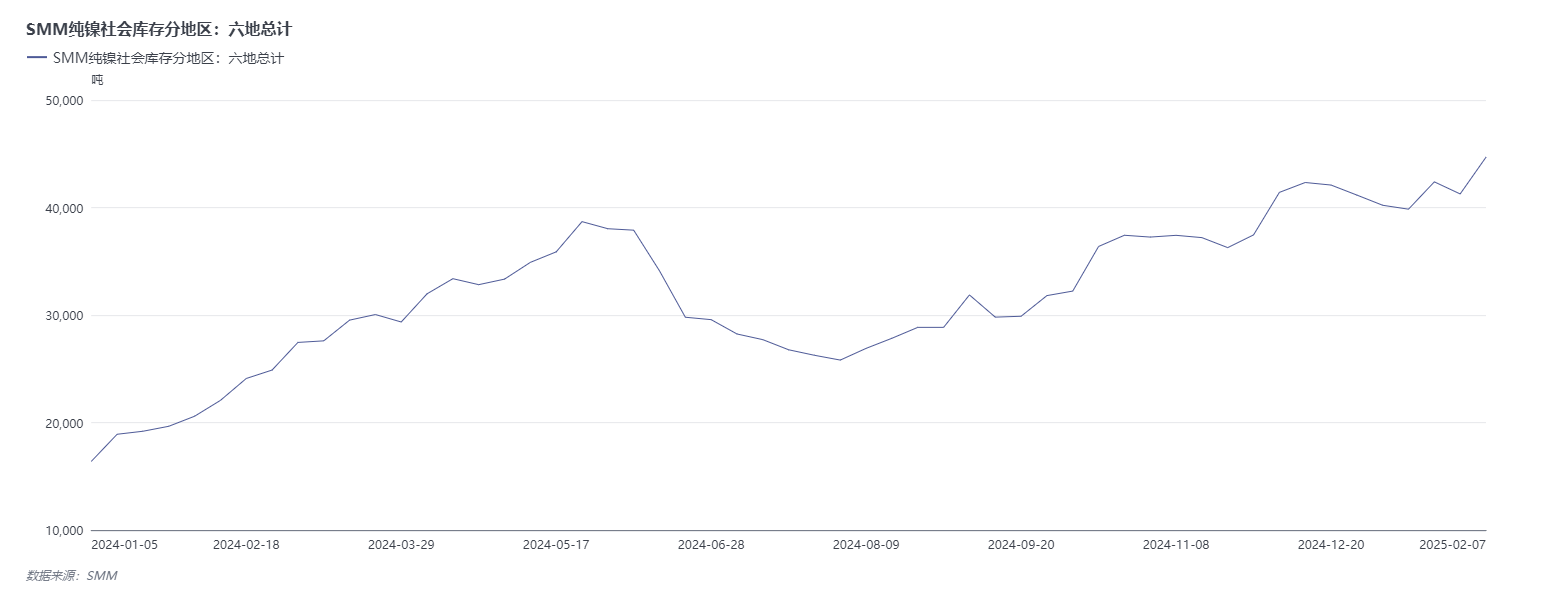
》Click to view the SMM database
Although refined nickel production in January decreased compared to December 2024, downstream transactions remained sluggish due to year-end market sentiment and downstream stocking. Demand for refined nickel in batteries, electroplating, and stainless steel did not show fundamental improvement. As a result, refined nickel social inventory saw a slight buildup in January.
Downstream Consumption:
In the stainless steel market, a major downstream consumption sector for nickel, SMM surveys showed that China's total stainless steel production in January decreased by approximately 9.32% MoM but increased by about 3.87% YoY. Specifically, 200-series stainless steel production fell by about 12.38% MoM, 300-series by 9.33%, and 400-series by 4.06%. The off-season deepened in January, especially with the approach of the Chinese New Year, leading to a decline in downstream operating rates and stainless steel mill orders.
In the new energy sector, SMM reported that ternary cathode precursor production in January was approximately 67,000 mt, down 13% MoM and 12% YoY. The decline was mainly due to the Chinese New Year break and losses, prompting precursor manufacturers to suspend production for maintenance or reduce production, leading to lower output.
Overall, nickel prices fluctuated in January. Early in the month, market expectations of Indonesia reducing nickel ore export quotas significantly supported refined nickel costs, driving the most-traded SHFE nickel contract higher. However, in mid-January, factors such as production halts and reduced demand during the Chinese New Year holiday, as well as macroeconomic uncertainties like US dollar index strength and tariff policies under the Trump administration, led to weaker nickel prices.
SMM Outlook
Although nickel prices fell sharply at the end of January, after the Chinese New Year holiday in February, multiple factors such as cost support, expected demand recovery, and tight supply drove SHFE nickel prices to a strong start. On February 6, SHFE nickel surged by 3.39% in a single day. The main driver of this increase was cost support. According to an SMM survey, as the world's largest nickel ore supplier, Indonesia's uncertain nickel ore quota policy has raised widespread market concerns. Although Indonesia's 2025 nickel ore quota approval is relatively high, the Philippines' attempt to emulate Indonesia's policy has strengthened miners' sentiment to stand firm on quotes, further pushing up nickel ore prices. Additionally, Indonesian nickel ore premiums have risen to $17-18/mt, with some high-priced transactions reaching $20/mt, directly increasing refined nickel production costs.
Looking ahead to February's overall nickel price trend, after the Chinese New Year holiday, the downstream consumer market remains in a traditional off-season. Although stainless steel mill maintenance will gradually end, capacity recovery and demand growth will take time. Therefore, February's overall consumption is expected to remain mediocre. From an inventory perspective, SMM expects refined nickel inventory to continue a slight buildup in February. The nickel market's supply surplus is expected to persist, and nickel prices may face downward pressure. Key factors to watch include Indonesia's nickel ore policy developments and the recovery of actual demand in the stainless steel and new energy sectors.
For more insights, stay tuned for SMM's mid-month publication of the China Nickel-Chromium-Stainless Steel Industry Chain Monthly Report!
Institutional Comments
Chaos Ternary Futures stated that last week, nickel prices surged due to news of the Philippines planning to ban nickel ore exports. However, the ban is unlikely to be implemented in the short term, and in the context of a global refined nickel supply surplus, the Philippines faces significant challenges in attracting companies to invest locally. After speculative sentiment subsided, the market returned to fundamental logic, and nickel prices largely gave up earlier gains. Looking ahead, in the medium and long term, the global nickel industry chain's supply surplus is expected to persist, with excess capacity awaiting clearance. If Indonesia does not reduce nickel ore supply, the loose supply-demand balance will remain. Under the pressure of slower overseas interest rate cuts and tariffs, nickel prices are expected to fluctuate downward. Future focus should be on Indonesia's industrial policies, the clearance of excess capacity, and macroeconomic trends.
Southwest Futures noted that Indonesia's new RKAB approvals, combined with ramp-ups of new production lines, have eased raw material tightness. However, Indonesia's discussion of reducing production quotas from 200 million to 150 million mt, with the new target being only 55% of 2024's level, indicates tighter control over mining resources. Meanwhile, the Philippines is in its rainy season, leading to seasonal increases in ore prices. Cost support remains, nickel pig iron profits have recently narrowed, and transactions are sluggish. The refined nickel spot market has improved, with slight demand recovery. The stainless steel futures and spot markets have strengthened, boosting downstream purchasing enthusiasm and accelerating inventory destocking. In February, while new energy consumption remains relatively strong, the market share of ternary batteries has declined this year, limiting the growth in nickel demand. Nickel sulphate demand remains sluggish, and the supply surplus persists. In the short term, prices are expected to follow macro sentiment, while long-term structural opportunities can be monitored.
Zhongcai Futures stated that on the macro side, the US PMI was in expansion territory in January, and the US's 10% tariff on Chinese goods triggered market panic. The US Fed kept interest rates unchanged in January, with a significant probability of a rate cut in June. On the fundamentals side, pre-Chinese New Year RKAB quota reductions supported nickel prices, but implementation remains to be seen. The Philippines' rainy season continues to impact exports, while post-holiday stainless steel production is expected to remain high. Recently, nickel prices have been driven by macroeconomic logic and are expected to remain weak.
Minmetals Futures stated that with cost-side disruptions fading, future attention should focus on demand-side performance. Without significant improvement, nickel prices are expected to continue fluctuating.
![[SMM 스테인리스 플래시] EU 용해·주조 규정, 스테인리스 공급망 추적성 재편 예고](https://imgqn.smm.cn/usercenter/PuSOO20251217171732.jpeg)