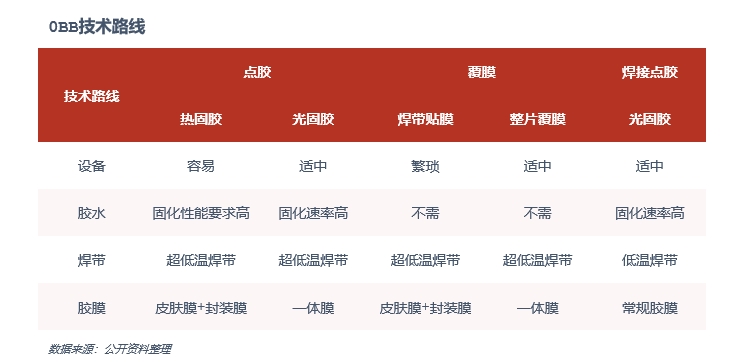
Currently, the welding method is the mainstream process for SMBB, and in 0BB, the welding and dispensing process has a higher similarity to the mainstream SMBB process, allowing for upgrades and modifications of existing equipment with higher acceptance. Regarding new capacity, the film-coating process has a lower entry barrier, and Chint New Energy has already achieved mass production and product delivery using the film-coating process.
Welding and dispensing. This method involves welding the welding strip onto the solar cell and fixing it with glue or tape to prevent displacement. Its advantages include no need for special film encapsulation, strong bonding strength, excellent hot spot resistance, reworkability, and the ability to upgrade on existing equipment. However, it also has disadvantages, such as high requirements for the welding system, the need for high precision in dispensing, and slower speed.
Dispensing technology. First, an adhesive (such as UV glue or hot melt adhesive) is applied to the solar cell, then the welding strip is adhered to the solar cell and alloyed through lamination. This method eliminates traditional welding steps. Advantages: 1) Simplified process suitable for existing screen printing technology; 2) Expanded process window for series interconnection; 3) Simple equipment that can be easily upgraded on SMBB systems. Disadvantages: 1) Requires the use of additional protective film; 2) Cell abnormalities can only be detected after lamination. Some companies have optimized the process by designing hollows on the protective film to reduce interference between the adhesive and the welding strip while enhancing the bonding strength between the adhesive and the solar cell, thereby reducing risks in reliability testing.
Film-coating process. This method involves directly laminating the film, solar cell, and welding strip in one step to create a solar cell string. The specific process includes: solar cell loading and transmission (including the production and transmission of adhesive film and welding strip) → precise positioning of adhesive film, welding strip, and solar cell → solar cell film-coating → PL detection → transmission to the layout machine. This method eliminates the need to pre-combine the welding strip and adhesive film. Advantages: 1) High adhesion between the welding strip and the solar cell, reducing the risk of gridline detachment; 2) Simplified process without dispensing and welding steps; 3) No need for flux, reducing maintenance difficulty. Disadvantages: 1) Requires additional skin film or integrated film; 2) EL detection abnormalities can only be identified after lamination; 3) Higher application risks in the current market. Specialized rework equipment is required.
![[SMM PV 플래시] Energiequelle, 프랑스 법인 및 500MW 재생에너지 포트폴리오를 H2air에 매각](https://imgqn.smm.cn/usercenter/wBAsG20251217171742.jpg)
![[SMM PV 플래시] Play, 폴란드에서 Qair와 15년 풍력·태양광 PPA 체결](https://imgqn.smm.cn/usercenter/JNxfy20251217171742.jpg)
![[SMM PV 플래시] Greenvolt, 폴란드 600MW/2.4GWh BESS 건설 착수](https://imgqn.smm.cn/usercenter/zMauQ20251217171742.jpg)