In 2024, the surplus in capacity continued to intensify, with polysilicon prices repeatedly breaking through the bottom line and module prices entering a cut-throat competition phase, raising concerns about low prices and low quality. Under "extreme competition," some enterprises faced bankruptcy.
On the positive side, PV technology in this year ended the "size" debate, with companies refocusing on PV efficiency and continuously launching new technologies and products.
Encouragingly, despite numerous challenges, the PV industry delivered impressive results. In the first eleven months, new PV installations exceeded 206 GW, setting a new historical record.
As winter fades, spring is anticipated. 2025 marks the final year of the "14th Five-Year Plan." What new changes will the market witness? This trend outlook aims to provide some initial insights!
I. Imminent Consolidation, Intensified Industry Reshuffling
The exit of PV enterprises in 2024 was just the prelude; industry reshuffling will continue in 2025. After cross-industry players exit first, second- and third-tier enterprises among the industry's "natives" will face greater competitive pressure, leading to fiercer battles.
On one hand, the homogenization of PV products remains unresolved. As companies shift from capacity competition to product competition, those lacking technological and cost advantages will face greater survival pressure.
On the other hand, the entire industry was almost in a loss-making state in 2024, with second- and third-tier enterprises suffering more severe losses. During the financing winter, few enterprises succeeded in raising funds through listing. Some resorted to selling PV assets to recover funds, but this approach appears to be a "temporary fix" rather than a long-term solution. Factors such as the lack of brand premium, poor overseas sales channels, and resistance to "low-price bidding" have made survival difficult for second- and third-tier enterprises.
The wave of mergers and acquisitions has already begun. In 2025, more acquisition cases will emerge, extending beyond the battery and module segments.
II. PV Prices Expected to Recover, But Challenges Persist
According to the China Photovoltaic Industry Association, in 2024, prices across the PV industry chain saw significant declines: polysilicon prices dropped by over 35%, wafer prices by over 45%, and solar cell and module prices by over 25%.
On the positive side, with the consensus on "anti-competition" and industry self-discipline among PV enterprises, leading companies in the industry chain took the lead in production cuts, helping to correct capacity, improve the supply-demand pattern, and accelerate price recovery.
At the end of 2024, Tongwei and Daqo Energy announced phased maintenance work on some polysilicon production lines, implementing orderly production cuts. GCL Technology also announced production cuts and maintenance during the same period. The production cuts and controls by these three polysilicon giants not only help reduce operational losses but also positively impact downstream sectors.
However, it is worth noting that the industry is still in an expansion trend, with projects continuing to come online from the end of 2024 to the present. Amid back-and-forth negotiations between upstream and downstream, it will still be challenging for PV prices to return to rational levels in the short term in 2025.
III. Efficiency as King, Complex Enterprise Alliances Under Technological Integration
Efficiency improvement remains the driving force behind the continuous reduction in PV's levelized cost of electricity. In 2025, solar cell and module enterprises will continue to compete in the "efficiency" main track.
From the market share of the "n-type" technology route, TOPCon accounted for approximately 70% of the market share in 2024. According to InfoLink Consulting's forecast, TOPCon's market share will increase to 80% by 2025.
As for the BC and HJT routes, central state-owned enterprises began to include BC and HJT in their centralised procurement sections in 2024, and their share is expected to increase in 2025.
In the efficiency race, technological integration is a key path to achieving solar cell efficiency improvements from 26%+ to 28%. In 2025, more TOPCon+BC TBC products and HJT+BC HBC products will emerge. With technological integration, enterprise alliances will also shift. The currently distinct TOPCon and BC camps will become more blurred, with TOPCon enterprises transitioning to BC or BC enterprises adopting TBC technology becoming more common.
IV. Growth of Distributed PV Slows Down
In the first three quarters of 2024, China's new distributed PV installations reached 85.22 million kW, surpassing centralized installations. Cumulative distributed PV installations reached 340 million kW, nearing half of the total PV installations. In 2025, under the influence of various uncertainties, the growth rate of distributed PV in China may slow down.
On one hand, provinces such as Hebei, Shandong, and Hunan have successively introduced policies for distributed PV to participate in market-based transactions. Changes in electricity prices and volumes have made power station yields more uncertain, requiring a reassessment of the investment boundaries for distributed PV projects.
On the other hand, the "Draft for Comments on the Management Measures for Distributed PV Power Generation Development and Construction" issued by the National Energy Administration in October 2024 introduced policy changes such as the cancellation of full-grid connection for industrial and commercial projects and self-use requirements for projects above 6 MW. These changes have brought uncertainties to distributed PV. Some developers have temporarily halted industrial and commercial project development, awaiting clearer policies.
Household PV also faces challenges. In the first three quarters of 2024, new household PV installations reached 22.8 GW, a YoY decline of 31%. During this year, central state-owned enterprises like SPIC temporarily halted household PV project development and sold household assets, while major holders like Yuexiu also sold household assets. Issues such as the bottom-line support for household power stations and the suspension or delay of household and distributed PV project filings in many regions due to limited consumption have also impacted the development progress of household PV.
V. Land Remains a Major Obstacle
Land remains one of the major obstacles for PV development enterprises.
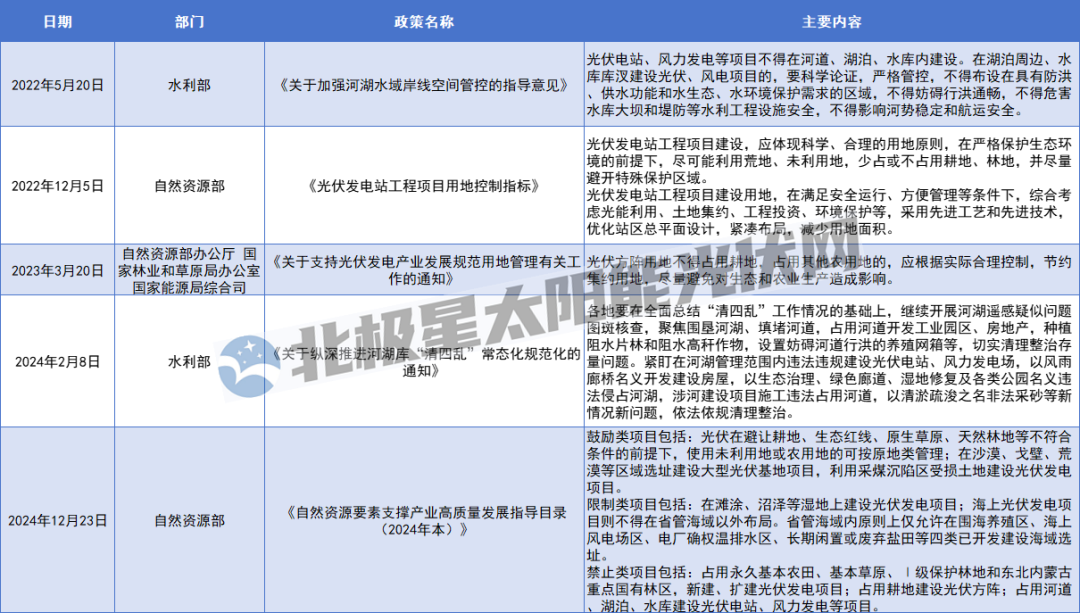
In 2024, numerous PV projects were penalized for illegal occupation of forest and grasslands, with some cases referred to public security authorities for investigation. Additionally, after reviewing the compliance of PV project land use, some regions have canceled certain PV project quotas.
In 2025, policies on PV land use will remain strict and show a tightening trend. As a result, the site selection risks for hybrid PV projects persist, and the gradual reduction in the scale of usable PV land will further drive up land costs.
A summary of national-level PV land use policies in recent years:
VI. Investment Focus Shifts from PV to Wind Power
In the article "170 GW Wind and Solar Indicators Analysis: Is PV Losing Its Appeal?" Polaris summarized the 2024 wind and solar indicator allocation. According to the latest data, wind power indicators in provinces such as Hebei, Guizhou, Guangxi, Hubei, Shanxi, Hunan, Gansu, and the Xinjiang Production and Construction Corps' 13th Division New Star City exceeded those for PV.
Beyond indicators, the introduction of time-of-use electricity prices in various regions has turned PV output peaks at midday into off-peak electricity, directly impacting PV electricity prices. Additionally, the increased participation of PV in electricity market transactions has led to more projects failing to meet internal rate of return standards.
Combined with factors such as land and power rationing, investors are increasingly turning to wind power. From the current PV indicator allocation, PV giant SPIC's PV indicators are already lower than those of Huadian and Huaneng.
VII. Offshore PV Holds Great Potential but Faces Challenges
Under the constraints of land resources, seeking additional space for PV growth has become a priority, with offshore PV being a key direction.
In 2024, various regions successively announced offshore PV development plans. For instance, the Shanghai Municipal Development and Reform Commission released the "2024 Offshore PV Project Competitive Allocation Plan," with a total application scale limit of 3.5 million kW. The Jiangsu Provincial Development and Reform Commission issued the "Jiangsu Offshore PV Development and Construction Implementation Plan (2025–2030)," proposing the construction of 60 offshore PV project sites with a scale of 27.25 GW. According to the plan, more offshore PV projects will achieve grid connection in 2025 and beyond.
Additionally, national-level policies on offshore PV system design standards and marine PV regulations have been introduced to promote the standardized development of offshore PV.
However, it is important to note that while offshore PV holds great potential, challenges remain. The reliability of PV modules, inverters, and mounting systems needs improvement, and difficulties in offshore PV project construction and operation and maintenance require joint efforts to overcome.
VIII. Rise of Grid-Forming ESS
With the accelerated progress of the "dual carbon" goals, the scale of new energy grid connections has been increasing annually, posing "dual high" challenges (i.e., high proportions of renewable energy and power electronic equipment) to the power system. To further ensure grid stability, grid-forming ESS has emerged.
In July 2024, the National Development and Reform Commission, the National Energy Administration, and the National Data Administration jointly issued the "Action Plan for Accelerating the Construction of a New-Type Power System (2024–2027)," which explicitly proposed promoting the application of grid-forming technology. This technology is designed to meet the operational needs of high-proportion renewable energy power systems, enabling active support for grid voltage, frequency, and phase angle stability to ensure stable power system operation. Additionally, regions such as Tibet, Xinjiang, Liaoning, Fujian, Shaanxi, and Inner Mongolia have successively introduced policies supporting grid-forming ESS.
Driven by market demand and policy guidance, grid-forming ESS technology saw development opportunities in 2024. Leading enterprises such as Huawei and Sungrow launched grid-forming ESS solutions, achieving active and safe grid formation and significantly enhancing the grid's capacity to accommodate new energy.
In 2025, with China's wind and PV new installations expected to reach approximately 200 million kW, the "dual high" challenges will intensify further. The power system will face increasingly prominent issues such as randomness, high volatility, intermittency, and weak support. Against this backdrop, grid-forming ESS is set to rise strongly.
IX. Frequent Cross-Border Mergers and Acquisitions
Industry reshuffling in the PV sector is not limited to the Chinese market. In 2024, overseas markets also saw enterprises struggling. According to Polaris, since 2024, leading PV enterprises in countries such as the US, India, Germany, and Australia have successively announced layoffs, with some exiting the PV business entirely.
Against this backdrop, international PV acquisition cases are expected to become more frequent. Acquiring overseas PV enterprises not only helps expand overseas markets but also mitigates trade risks. In fact, cross-border PV acquisition cases are not uncommon. For example, TCL Zhonghuan acquired Maxeon, and TrinaSolar acquired Nclave.
On December 31, 2024, Haitian Holdings announced its plan to acquire Heraeus's PV silver paste division, a long-established German PV paste enterprise, through a newly established wholly-owned subsidiary by paying in cash. Haitian Holdings stated that this acquisition would help the company identify new growth points.
In 2025, under the influence of international trade barriers and policies supporting local manufacturing, more cross-border acquisition cases are likely to emerge.
X. Emerging Overseas Markets Gain More Attention
From global sales to global manufacturing, Chinese PV enterprises are expanding their overseas capacity layouts in multiple directions. In 2025, emerging overseas markets will become a battleground for Chinese PV enterprises.
According to the China Photovoltaic Industry Association, from January to October 2024, Europe remained the largest export market for PV modules, but its market share declined significantly. Meanwhile, South Asia, Latin America, and the Middle East held substantial shares. Another notable trend is the diversification of module export markets, with "other" markets outside the top ten accounting for over one-third of the share, indicating the emergence of numerous new markets.
According to TrendForce's forecast, Southeast Asia, Latin America, and the Middle East are expected to perform well in 2025, providing new directions for PV enterprises going global.
On the other hand, trade barriers and supply chain issues are more pronounced in major markets such as the US and Europe. For instance, the US Department of Commerce recently issued a preliminary anti-dumping (AD) ruling on crystalline silicon PV products exported from Cambodia, Malaysia, Thailand, and Vietnam, significantly impacting the PV industry's layout for the US market. Additionally, starting in 2025, the US will impose a 50% tariff on Chinese polysilicon and wafers, further increasing export pressure on PV enterprises.
Amid these barriers, PV enterprises are no longer focusing solely on traditional markets. A multi-faceted layout and comprehensive expansion are the best strategies for enterprises to "go global."
![[SMM PV 플래시] 호주 옥상 태양광, 2021년 이후 최강의 상반기 기록](https://imgqn.smm.cn/usercenter/TtmPF20251217171741.jpg)
![[SMM PV 플래시] Doral Renewables, 매머드 솔라 영농형 태양광 프로젝트 상업 운전 돌입](https://imgqn.smm.cn/usercenter/ZbnfH20251217171741.jpg)
![[SMM PV 플래시] 라이선 에너지, 공항 및 주거용 안티글레어 HJT 모듈 출시](https://imgqn.smm.cn/usercenter/HdPjk20251217171741.jpg)