SMM, January 2: On December 31, 2024, LONGi Green Energy released an investor activity report. When asked about the "recent divergence in PV module bid prices and the outlook for module prices," LONGi Green Energy stated that the supply-demand imbalance in the PV industry still requires time to resolve. Currently, even if module prices recover to 0.7 yuan/W, modules remain in a loss-making state. With the release of a new wave of global PV demand and the improvement in the relationship between actual industry output and demand, industry chain costs may rise. In this context, irrationally low module prices will further expand losses, hindering the sustainable and healthy development of the industry. Driven by policy guidance and industry self-discipline, module prices are expected to gradually stabilize in 2025.
It is worth noting that since 2023, persistently low module prices have sparked heated discussions in the market. At the end of 2023, debates continued over news of module bid prices falling below 1 yuan/W. Entering 2024, module prices continued to decline. As of December 31, 2024, the quoted prices for single/double-sided PERC 182mm modules in centralized projects ranged from 0.63 to 0.67 yuan/W, with an average price of 0.66 yuan/W. For single/double-sided PERC 210mm modules, the quoted prices ranged from 0.64 to 0.69 yuan/W, with an average price of 0.67 yuan/W. N-type 182mm modules were quoted at 0.64 to 0.69 yuan/W, with an average price of 0.67 yuan/W, while N-type 210mm modules were quoted at 0.65 to 0.7 yuan/W, with an average price of 0.68 yuan/W.
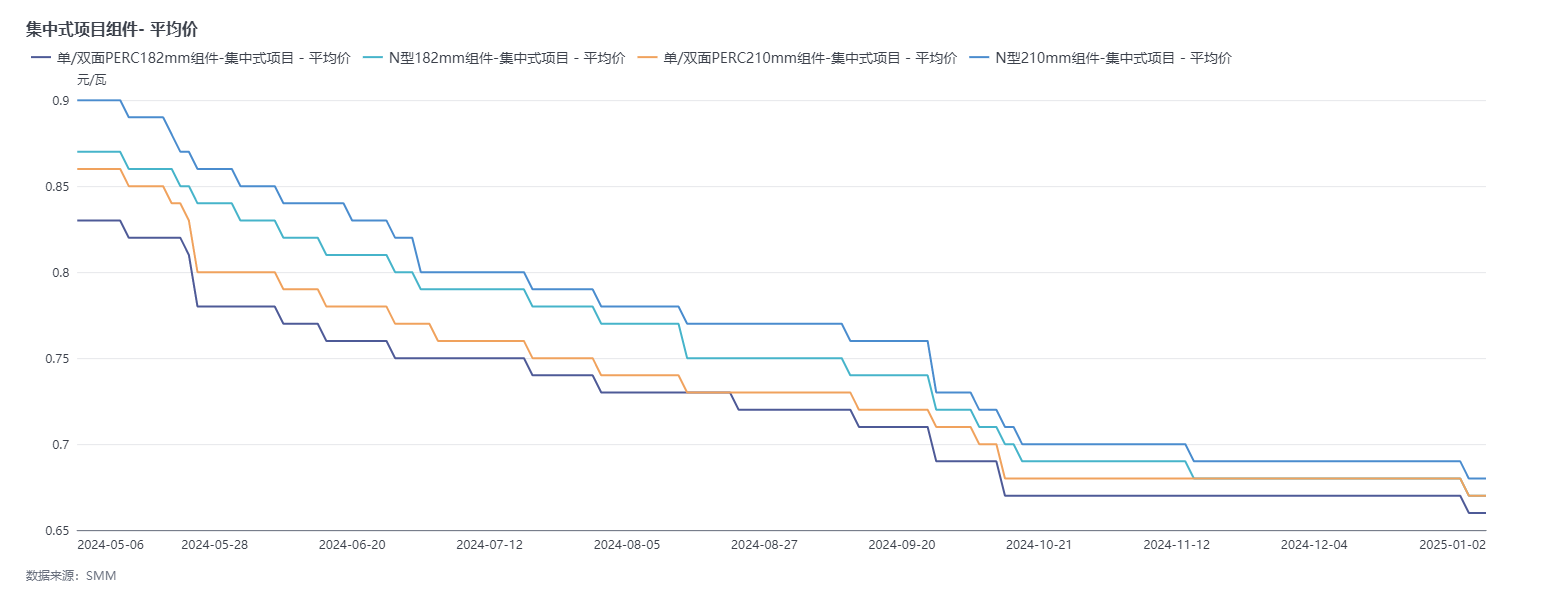
》Click to view the SMM database
It should be noted that in September 2024, the lowest bid price for the second batch of PV module centralized procurement by China Huadian Corporation reached as low as 0.6221 yuan/W, setting a new industry low. This figure was even below the 0.690 yuan/W benchmark set by the China Photovoltaic Industry Association in October. On October 18, 2024, the continuous decline in PV module winning bid prices caught the attention of the China Photovoltaic Industry Association, which stated that bid prices below cost had become a major challenge for the PV manufacturing industry. According to the association's calculations, at that time, the VAT-inclusive production cost (excluding transportation and miscellaneous fees) of integrated N-type M10 bifacial PV modules, excluding depreciation and VAT for polysilicon, silicon wafers, and solar cells, was 0.68 yuan/W. On November 20, the association published another article stating that the current VAT-inclusive cost (including minimum necessary expenses) of modules, excluding depreciation and VAT for polysilicon, silicon wafers, and solar cells, was 0.690 yuan/W. The association emphasized that the above cost estimates did not include depreciation, were lower than the actual production cost, and were even lower than the full cost, including the three expenses (selling expenses, administrative expenses, and financial expenses). These figures represent the minimum cost for top-performing companies in the industry while ensuring product quality.
Despite the existence of this "cost line," the market still sees cases of ultra-low prices being used to capture market share. In December 2024, the 600 MW PV module procurement project by Guodian Power Xinjiang Bayingolin Mongolian Autonomous Prefecture Power Generation Company set a maximum bid price of 0.6313 yuan/W, significantly lower than the 0.69 yuan/W "bottom line" disclosed by the association in November. According to the final winning bid result, the bid prices of the two winning companies were 0.6245 yuan/W and 0.629 yuan/W, the lowest and second-lowest among the 16 bidding companies for the project. This situation sparked strong dissatisfaction from the China Photovoltaic Industry Association, which repeatedly sought explanations but ultimately received no response.
Undoubtedly, in the current context of severe cut-throat competition in the PV industry, "anti-cut-throat competition" and enabling healthy development for industry players have become a consensus among most top-tier enterprises. This can be observed from current policies and the actions of the association and leading enterprises in the industry.
Returning to the current module market, according to the SMM survey, market prices are relatively stagnant, and the trading volume of discounted modules is gradually decreasing. With the off-season in Q1 2025 approaching, companies are producing based on sales and focusing on selling inventory. Most companies have scheduled holidays of 10-15 days or more. SMM expects module operating rates to continue to decline, with production schedules expected to fall below 40 GW. Regarding inventory, although days of inventories remain at a medium level, year-end demand for picking up goods has improved turnover, significantly alleviating year-end inventory pressure compared to earlier periods.
With the recovery of upstream raw material and auxiliary material prices, considering the reduced inventory pressure and cost support in Q1, SMM expects module prices to stabilize temporarily or even rebound.
In addition to module-related issues, LONGi Green Energy was also asked whether domestic PV demand in 2025 would be affected by the current absorption pressure in certain regions. LONGi Green Energy responded that, according to statistics from the National Energy Administration, from January to November 2024, China's new PV installations reached 206.3 GW, nearly matching the total for 2023. Given the high base, subsequent domestic PV demand will enter a stable development phase under the influence of absorption pressure. Meanwhile, policies continue to support the vigorous development of new energy in desert, barren, and Gobi areas, as well as in the construction sector, which is expected to create new demand opportunities. From a neutral perspective, domestic new PV installations in 2025 are not expected to experience significant volatility compared to this year.
As for the European PV market demand in 2025, LONGi Green Energy stated that the latest report from SolarPower Europe estimates that in 2024, new PV installations in the 27 EU countries will reach approximately 65.5 GW, up 4% YoY, marking a significant slowdown compared to recent years. The main reasons include reduced urgency for PV power in the end-use market following the end of the European energy crisis, coupled with a weakening European economy and insufficient flexibility in power grid systems, which collectively limit the growth of European PV demand. Considering that resolving power grid absorption bottlenecks will take time, European new PV installations in 2025 are expected to remain relatively stable YoY.
Additionally, when discussing overseas capacity expansion, LONGi Green Energy stated that when choosing to expand overseas, companies must consider various factors, including local policies and legal environments, geographical location, economic conditions, and market size. They must also fully assess potential opportunities and risks from a medium and long-term perspective. Therefore, the company is currently adopting a cautious approach to overseas capacity expansion.
![[SMM PV 플래시]](https://imgqn.smm.cn/usercenter/xAoMy20251217171743.jpg)
![[SMM PV 뉴스] 화넝 산시 선무 100MW 태양광 프로젝트 전용량 계통 연계 달성](https://imgqn.smm.cn/usercenter/HKFoG20251217171742.jpg)
![[SMM PV 뉴스] 극한의 '열' 시험을 견뎌내다: APsystems APstorage 261L, UL 9540A 시험 성공적으로 통과!](https://imgqn.smm.cn/usercenter/oytJq20251217171740.jpg)