This article is published in the LONGi Photovoltaic Review August Issue
Author: Mao Tingting, Senior Photovoltaic Analyst at SMM
Date: August 2024
The continuous cost reduction and efficiency improvement in the photovoltaic industry have driven the rapid development of the photovoltaic market. The economic viability of photovoltaic power generation has become prominent, and its share in the power supply structure has also been steadily increasing. From 2023 to 2024, thanks to ongoing technological breakthroughs, process innovations, and the application of new materials throughout the photovoltaic industry chain, the photoelectric conversion efficiency of solar cells increased from 23.2% to over 26%, and the mainstream power range of modules increased from 540-600W to 580-710W, achieving a market transition from P-type to N-type.
However, due to the rapid expansion of capacity, the imbalance between supply and demand in the industry chain has become prominent, leading to fierce price competition and losses within the industry chain. The extreme cost reduction has eliminated the premium for high-efficiency products. Nonetheless, from a medium and long-term perspective, products with higher power generation gains and greater potential for technological improvement will be the first to reap market benefits during the next wave of market demand explosion.
1. Enhancing power generation throughout the entire life cycle is the core driver of product development.
For PV module products, the core performance indicators of power generation throughout the life cycle are photoelectric conversion efficiency and degradation. Factors such as the effective light-receiving area, low-light performance, temperature coefficient, and anti-microcrack performance of PV modules, project sites' light conditions and irradiation uniformity, and the impact of encapsulation materials on solar cell performance all significantly affect the power generation of PV module.
The theoretical conversion efficiency limit of crystalline silicon cells is 29.4%. For different cell technologies, the theoretical efficiency limits vary: TOPCon and HJT cells have a theoretical limit efficiency of 28.5%, and back contact (BC) cells have a theoretical limit efficiency of 29.1%. The theoretical limit efficiency can be improved with technological innovation and the introduction of new materials, but the improvement space is limited. Leading domestic photovoltaic companies have invested substantial R&D funds in the technological development of modules. The laboratory efficiency of solar cells is approaching the theoretical limit, and the mass production efficiency level is also rapidly improving. Currently, the mass production efficiency of top domestic TOPCon cells is around 25.5%, HJT cells around 25.8%, and BC cells around 26.5%. From the perspective of theoretical limit efficiency and the best efficiency achieved in mass production, BC cells have a more obvious advantage.
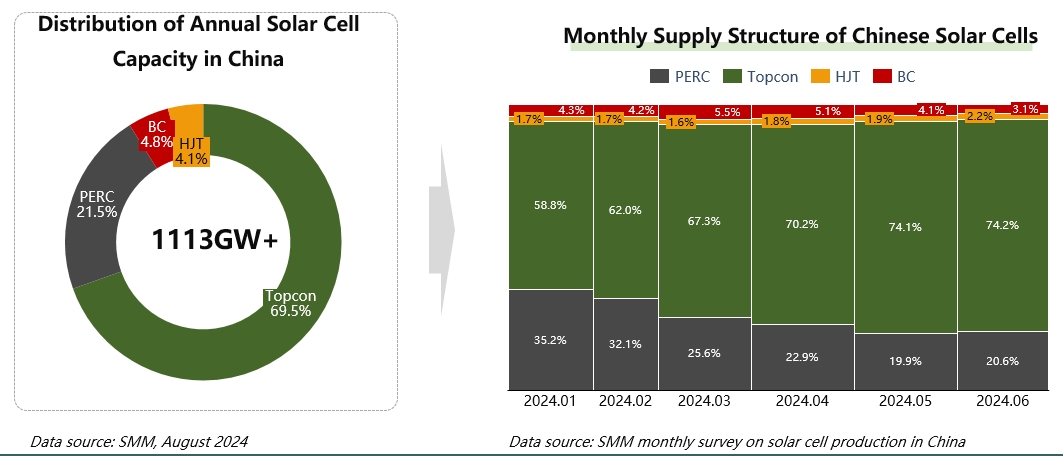
Products with higher power generation will inevitably become the market mainstream. Currently, there is still debate about the mainstream technology route for the next three to five years, mainly because the industrialisation time of high-efficiency products like TOPCon, HJT, and BC modules is relatively short, and there is limited empirical project data available for tracking. It is difficult to compare the power generation throughout the entire life cycle. However, the market demand for high-efficiency module products continues to grow, with domestic and international end-users actively trying new technologies. TOPCon products have quickly replaced PERC, occupying more than 70% of the market share. HJT and BC technologies are relatively more challenging, and their industrialisation speed is slower. However, the number of HJT and BC projects and installed capacity are gradually increasing in 2024 both domestically and internationally. Notably, BC modules have garnered widespread market attention in 2024, emerging in both distributed and centralized projects. They have become a key R&D direction for photovoltaic companies. The industrialisation process may accelerate in the future.
Current Status of Solar Cell Supply in China in 2024
II. Current Structure of the Solar Cell Market
The market iteration speed of solar cells transitioning from P-type to N-type has significantly exceeded market expectations. According to an SMM survey, in 2022, the market shares of monocrystal PERC, TOPCon, HJT, and BC cells in China were 91.11%, 6.29%, 0.6%, and 0.2%, respectively, with a small amount of polysilicon cells still in the market. By 2023, polysilicon cells had almost exited the market, and the market shares of monocrystal PERC, TOPCon, HJT, and BC cells were 73%, 23.6%, 1.8%, and 0.9%, respectively. In H1 2024, TOPCon cells surpassed PERC cells to become the market mainstream, with its market share exceeding 75%, PERC's market share dropping to 20%, and the combined market share of HJT and BC cells rising to 5%.
2023 was a period of rapid growth in demand for N-type cells and also a period of intensified contradictions. From the perspective of photovoltaic end-users, the proportion of N-type module procurement by state-owned enterprises and central enterprises increased from less than 10% at the beginning of 2023 to over 67% by the end of the year. The exports of N-type modules also gradually increased, with the monthly proportion of N-type cells in China rising from 10% at the beginning of the year to 48.68% in December. Throughout 2023, a large number of new cell makers entered the market, and existing cell manufacturers significantly expanded their capacity to maintain market share. TOPCon cell capacity surged from 65GW at the beginning of the year to over 490GW by the end of the year, with the total solar cell capacity reaching 961.31GW by the end of 2023. The imbalance between supply and demand for cells was significant, with the domestic solar cell operating rate dropping from over 90% at the end of Q1 2023 to around 77% by the end of the year. The total demand for solar cells in China in 2023 was approximately 530-540GW (including exports), with the demand for TOPCon cells being less than 150GW. As the competition among TOPCon cell manufacturers was fierce, the product premium quickly disappeared, and the market for TOPCon cells at the same price as PERC cells arrived.
In 2024, a price war swept through the entire photovoltaic industry chain, and the premium for high-efficiency TOPCon cells disappeared. The completion rate of planned capacity projects for 2024-2025 was only 40%. According to an SMM survey, as of August 2024, TOPCon cell capacity had reached over 770GW, accounting for nearly 70% of China's total solar cell capacity, with demand rising from around 60% at the beginning of the year to about 90% in August. However, the growth rate of demand did not match that of supply, and the average operating rate of solar cells in 2024 fell below 60%. Most new makers' TOPCon cell production lines operated at less than 20% capacity. Due to the current market cell prices being lower than costs and insufficient market demand, companies faced losses upon production, with some manufacturers having suspended production for several months and continuously delaying resumption. The originally planned new TOPCon cell capacity was about 1,500GW, but as of August 2024, the actual new capacity realized was less than 650GW, with over 140GW of PERC cell production lines having been or about to be converted to TOPCon cell. Due to the supply-demand imbalance of Topcon solar cells and the loss of premiums, the expansion wave of Topcon cells in H2 2024 has temporarily come to an end.
III. After TOPCon solar cells, BC cells become the focus of the next round of technological iteration
To guide the orderly expansion of photovoltaic enterprises, accelerate industry transformation, upgrading and structure adjustments, and promote high-quality development of the photovoltaic industry, the Electronic Information Department of the Ministry of Industry and Information Technology publicly solicited opinions on the "Regulations and Announcement Management Measures for the Photovoltaic Manufacturing Industry (Exposure Draft)" in July 2024. The industry regulations are formulated based on principles of optimizing layout, adjusting structure, controlling total volume, encouraging innovation, and supporting applications. They aim to guide photovoltaic enterprises to reduce projects that merely expand capacity, strengthen technological innovation, improve product quality, and reduce production costs.
The exposure draft of the Regulations and Announcement Management Measures for the Photovoltaic Manufacturing Industry (2024 edition) mentions the following core points related to the quality and process technology of module products:
(1) Enterprises are required to spend no less than 3% of their total sales and no less than 10 million yuan annually on R&D and process improvements;
(2) Existing module manufacturers are required to ensure that the average photoelectric conversion efficiency of P-type monocrystalline silicon cells and N-type monocrystalline silicon cells (bifacial cells calculated by front-side efficiency) is no less than 23.2% and 25%, respectively. The average photoelectric conversion efficiency of P-type monocrystalline silicon modules and N-type monocrystalline silicon modules (bifacial modules calculated by front-side efficiency) should be no less than 21.2% and 22.3%, respectively;
(3) New and expanded enterprises and projects are required to ensure that the average photoelectric conversion efficiency of P-type monocrystalline silicon cells and N-type monocrystalline silicon cells (bifacial cells calculated by front-side efficiency) is no less than 23.7% and 26%, respectively. The average photoelectric conversion efficiency of P-type monocrystalline silicon modules and N-type monocrystalline silicon modules (bifacial modules calculated by front-side efficiency) should be no less than 21.8% and 23.1%, respectively;
(4) The performance requirements for module products produced by enterprises are as follows: the degradation rate of P-type crystalline silicon modules should not exceed 2% in the first year, 0.55% annually thereafter, and 15% within 25 years. The degradation rate of N-type crystalline silicon modules should not exceed 1% in the first year, 0.4% annually thereafter, and 11% within 25 years.
The regulations set requirements for the future photoelectric conversion efficiency of modules. According to an SMM survey, the current average efficiency levels of most modules meet the efficiency and degradation rate requirements mentioned in the regulations. However, some new TOPCon module enterprises face certain technical challenges in improving efficiency, resulting in lower-than-expected improvements. The current mainstream mass production efficiency range for TOPCon cells is 24.7%-25.4%. Leading domestic cell enterprises can mass-produce ultra-high-efficiency cells (over 26%), but the proportion of output at this efficiency level is relatively low. In the future, enterprises with N-type cell photoelectric conversion efficiency below 25% and N-type module efficiency below 22.3% may be quickly eliminated from the market. The requirement for new and expanded enterprises and projects to achieve an N-type photoelectric conversion efficiency of 26% undoubtedly sets a high threshold for new entrants.
As the mass production efficiency of TOPCon cells gradually approaches theoretical levels, the difficulty for further efficiency improvements is becoming larger and the space more limited. To enhance competitiveness and maintain market share and position, major solar cell enterprises are turning to TBC technology. From the perspective of conversion efficiency, BC module products are more than 0.5% higher than TOPCon modules. According to SMM, leading module enterprises have technical reserves for BC cells, and more manufacturers will set up mass production lines for BC cells in the future.
It is well known that the process technology of BC cells is highly challenging, requiring strong R&D capabilities and significant financial investment, as well as long-term technical accumulation and process exploration. Currently, only two leading enterprises, Longi and Aiko, have mass-produced BC cells, with a combined capacity of over 50 GW. According to SMM, some enterprises will add BC cell mass production lines in H2 2024. For other enterprises still in the R&D and pilot stages, it may take 2-3 years to reach the mature mass production stage, depending on their technical capabilities. It is expected that TOPCon cells will remain the largest cell type in the next three years. However, as market demand for higher conversion efficiency cells increases, more enterprises will invest in BC cell capacity. The capacity of BC cells is expected to reach 100 GW in 2025, with growth mainly from Longi and Aiko. The mass production progress of other leading enterprises may accelerate in 2026, with BC cell capacity potentially reaching over 160 GW and possibly exceeding 200 GW in 2027.
Summary
The iterative path of solar cell technology and the optimization direction of its supporting supply chain drive the development of the entire industry chain, which has always been a key focus of the market. High-quality development of the industry requires continuous technological innovation and product iteration. In the next two to three years, the growth in solar cell capacity will come from cells with higher conversion efficiency, with BC cells having significant potential.
![[SMM PV 플래시] Energiequelle, 프랑스 법인 및 500MW 재생에너지 포트폴리오를 H2air에 매각](https://imgqn.smm.cn/usercenter/wBAsG20251217171742.jpg)
![[SMM PV 플래시] Play, 폴란드에서 Qair와 15년 풍력·태양광 PPA 체결](https://imgqn.smm.cn/usercenter/JNxfy20251217171742.jpg)
![[SMM PV 플래시] Greenvolt, 폴란드 600MW/2.4GWh BESS 건설 착수](https://imgqn.smm.cn/usercenter/zMauQ20251217171742.jpg)